
 E-Paper



5 private labs get govt approval to conduct genome sequencing
Experts have suggested private labs can be roped into the genome surveillance process, which will help in improving epidemiological vigil.


The government has approved five private laboratories to carry out whole genome sequencing of Sars-CoV-2 samples, the process that identifies the variant, people aware of the matter said.
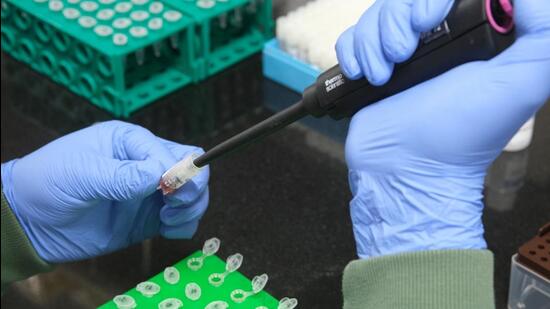
Three of the laboratories are in Bengaluru and the remaining in Delhi and Ahmedabad each, according to details accessed by HT, which show that these labs will now be part of the Indian Sars-CoV-2 Genomics Consortium (Insacog).
“…the competent authority of the department of biotechnology has approved the inclusion of the following private genome sequencing laboratories in the Indian Sars-CoV-2 Genomics Consortium..,” said an office order issued on Tuesday by the department of biotechnology, which is part of the Union science ministry.
The Bengaluru-based labs are Strand Life Sciences, Genotypic Technologies Pvt Ltd, and Eurofins Genomics India; the one from Delhi CARINGdx, and the one from Ahmedabad is Neuberg Supratech Reference Labs Pvt Ltd.
“The work has not started yet as we have just been intimated by the government about our lab having been included for genome sequencing. The next step is going to be to have a dialogue with the authorities concerned on how to go about the process as there are certain conditions that the labs are meant to follow,” said Dr Harsh Mahajan, founder of CARINGdx, which is part of Mahajan Imaging.
As per the initial information available, samples will be provided by the government.
Experts have suggested private labs can be roped into the genome surveillance process, which will help in improving epidemiological vigil.
“Involvement of private sector was considered as one of the options for some time for the purpose of genome sequencing as there are some laboratories in the private sector that are adequately equipped to do so. However, there are certain conditions that have been underlined for the labs that they need to fulfil mandatorily as part of the approval. SOPs have been shared with the labs concerned,” said a senior central government official aware of the matter, asking not to be named.
Insacog has 10 central laboratories and about 30 regional ones to carry out whole genome sequencing, a process that is more complicated than simply detecting the virus. There are close to 300 sentinel sites in the country from where positive samples are picked up and sent for routine sampling.
“…Based on interest expressed by some of the private sector laboratories, a discussion meeting was organised with secretary DBT as the chair… In this meeting, based on the proven expertise and experience of the private sector laboratories, it was thought prudent to involve private sector laboratories for genome sequencing of Covid-19 virus and it was decided to have a standard operating procedure for involvement of private sector laboratories…,” read the minutes of the meeting.
As part of the conditions, the private labs will have to meet the sequencing costs with no charges levied from patients. Labs will also have to clearly declare their source of funding for such testing. The samples will be routed and reported via Insacog, and the labs concerned will have to strictly adhere to government of India guidelines on data protection and safety.
Insacog, established for genomic surveillance in the country, was setup in Jan 2021 with initial participation of 10 national research laboratories belonging to the department of biotechnology, Indian council of medical research, council of scientific and industrial research, and Union ministry of health and family welfare.
More labs will be approved gradually in future based on assessment results of their sequencing capacities and infrastructure.
“This is the first batch of approvals; more labs could be approved depending on whether they meet the criteria for approval or not,” said the official cited above.
Experts said it is important to increase genomic sequencing capacity for a better understanding of disease transmission.
“Whole genome sequencing is crucial in getting key information on the way disease is spreading, what kind of variants are in circulation, and to determine whether we are dealing with a variant of concern or not, which eventually helps in managing the outbreak,” said Dr Giridhara Babu, head, epidemiology, Indian Institute of Public Health.


