
 E-Paper



50% general quota should be based only on merit: SC on 10% EWS quota
Attorney General KK Venugopal, who concluded his submissions for the Centre, stated that the general category should welcome this reservation as it seeks to uplift persons among them who are poor


New Delhi: The Supreme Court on Wednesday told the Centre that the law introducing 10% quota for the poor among forward classes should not eat into the 50% seats for the general category as this class, which is out of the reservation ambit, is to be filled purely on basis of merit.
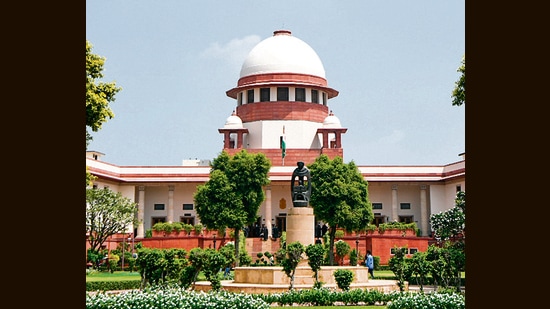
Confronting the Centre on the validity of the 103rd Constitution (Amendment) Act that introduced 10% quota for economically weaker section (EWS) among the unreserved population in jobs and admissions, a five-judge Constitution bench led by Chief Justice of India (CJI) Uday Umesh Lalit said, “As a result of this amendment, the total seats under general category will reduce from 50% to 40%. This eats into the general category.”
Attorney General KK Venugopal, who concluded his submissions for the Centre, stated that the general category should welcome this reservation as it seeks to uplift persons among them who are poor . He argued that EWS reservation is for people other than those belonging to the Scheduled Caste (SC), Scheduled Tribe (ST) and other backward classes (OBC) communities, and therefore does not add to the 50% reservation cap prescribed by the 1992 decision of the top court in Indira Sawhney case.
But the bench asked AG to examine it from the angle of damage caused to the open “merit” category. For this category, which includes the unreserved class of citizens and the creamy layer among OBCs who failed to qualify under the 27% OBC quota, merit-based selection shrinks from 50% to 40%.
“If you (Centre) say you have a special reservation for a certain class which needs protection, you must confine yourself to that,” said the bench, also comprising justices Dinesh Maheshwari, S Ravindra Bhat, Bela M Trivedi and JB Pardiwala. In case of EWS, the Constitution bench remarked, “there is no identification based on caste or class. We will not permit you (reservation) from that arena (50% reserved category) to this arena (50% general category). This is reserved to those who have no reservation….Notionally, 50% general quota should be purely based on merit.”
Venugopal argued that if the court accepted that reservation based on economic criteria is permissible, then it should not embark upon questioning the wisdom of Parliament in passing this law. “EWS quota must be seen as a measure of a progressive state thinking about citizens who are struggling to afford one square meal a day. Since securing dignity is a constitutional mandate, this quota promotes and fulfils this ideal so that no individual goes hungry and dignity for those living in slums, who are jobless and suffering,” the AG submitted.
He shared data from the Sinho Committee report and a Niti Aayog report on the poor under the general category and the reserved category to show that EWS quota will benefit over 58 million below poverty line persons in the unreserved categories. The court, however, pointed out that as per the Niti Aayog’s Multi Dimensional Poverty Index, the below poverty line (BPL) mapping among general category stood lowest at 18.2%, while the poor among SC and OBC stood at over 38% and 33% respectively.
“This is not a large category of EWS for which you must have affirmative action. It is a miniscule of the total BPL population,” the bench remarked. AG Venugopal said that including the poor among SCs, STs, OBCs will defeat the purpose of this reservation because either 10% each will have to be carved out for the poor among SCs, STs and OBCs, making it 30%; or the 10% will have to be broken down into 2.5% each for SCs, STs, OBCs and EWS. Moreover, he added that the purpose of EWS reservation is to reduce the percentage of quota with the passage of time.
Solicitor general Tushar Mehta also opened his submissions and said that since the EWS quota was made possible through a Constitutional Amendment, any challenge to it should meet a very high threshold. He argued that even if total reservation breaches the 50% cap, it will not violate basic structure of Constitution since the 50% rule is a flexible limit that can be exceeded, and hence a breach does not amount to violating basic structure.
Posting the matter for hearing on Thursday, the court asked the Centre to provide statistics of how EWS quota has been rolled out in states since its inception in January 2019. It said, “We would like statistics from some of the states on who are the beneficiaries and how this quota has worked out.”
Though the court has entertained petitions challenging the EWS quota, no stay has been granted on its operation in admissions and jobs across the country. The petitions challenging the 10% quota argue that reservation cannot be based on economic criteria, EWS as a class is not identifiable and hence this is an arbitrary action, and that the addition of 10% quota makes reservation excessive as it breaches the 50% limit set by the Supreme Court in 1992.


