
 E-Paper



69 aspirational districts see dip in branches of Public Sector Banks
The Aspirational Districts Programme (ADP), launched by Prime Minister Narendra Modi on January 5, 2018, aims at rapid transformation of 112 districts that have emerged as pockets of under-development.


The number of functioning branches of public sector banks (PSBs) in 112 so-called aspirational districts that lagged behind their peers on several developmental parameters including financial inclusion have shrunk by 120 to 7,875 on June 30 from 7,995 in December 31, 2017, according to Reserve Bank of India (RBI) data.
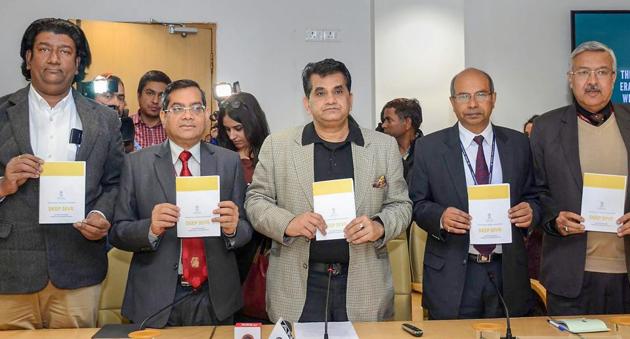
The Aspirational Districts Programme (ADP), launched by Prime Minister Narendra Modi on January 5, 2018, aims at rapid transformation of 112 districts that have emerged as pockets of under-development.
According to data compiled by RBI, 69 of 112 aspirational districts saw a decline in the number of public sector bank branches in the 18-month period, while 19 saw a rise. The numbers remained unchanged in 24 districts. The reasons for the decline aren’t clear. The data is only for the aspirational districts, so it isn’t known whether the number of PSB branches in other districts declined in the same period.
Financial sector experts said while bank branches are still relevant for development of aspirational districts, the decline in numbers of their branches, which is not very alarming, could have been due to mergers of public sector banks and rationalisation of bank branches to remain cost efficient.
Speaking at the Hindustan Times Leadership Summit on December 6, PM Modi said that the 112 districts were being developed as aspirational ones, with a focus on all aspects of development and governance. The government is undertaking real-time monitoring on various parameters he said at the summit adding that better future of these districts would ensure better future for the country.
A NITI Aayog ranking of the aspirational districts about six months after the launch of the programme found Khandwa (Madhya Pradesh), Kupwara and Baramula (Jammu & Kashmir), Bijapur (Chhattisgarh) and Khunti (Jharkhand) to be the least improved districts on the parameters of financial inclusion. According to RBI data, Khandwa had 71 branches of PSBs in December 2017 that came down to 70 in June 2019. Khunti also saw a decline to 35 from 36 in the same period. The number of branches, however, increased from seven to eight in Kupwara and 10 to 18 in Bijapur. There has been no change in the number of branches in Baramula (16).
Email queries sent to the finance ministry, the department of financial services, RBI, NITI Aayog and the PMO did not elicit any response.
The second ranking released by NITI Aayog in December last year found Dantewada (Chhattisgarh), Kondagaon (Chhattisgarh), Namsai (Arunachal Pradesh), Asifabad (Telangana), Chandel (Manipur) as the least improved districts on the parameters of financial inclusion. According to RBI’s data, number of bank branches in most of these districts either increased or remained constant between December 2017 and June 2019.
Number of branches increased significantly in the Naxal affected area of Dantewada from 19 to 23 between December 2017 and June 2019. Asifabad saw an increase from 14 to 16. The numbers remain constant in Namsai (five) and Chandel (three), but it decreased from 19 to 18 in Kondagaon.
According to two government officials who spoke on condition of anonymity, the government has created a dashboard for monitoring real-time progress of the districts.
Vijay Kumar Gupta, former Central Council Member of the Institute of Chartered Accountants of India (ICAI) said, “It is possible that public sector bank branches may have declined marginally because of bank mergers. However, banks are an important factor in financial inclusion, especially in backward regions and under-developed areas, because they still lack banking and other digital infrastructure supports.”
Sandeep Ghosh, Partner & Leader, Financial Services Advisory, EY India said, “I don’t believe that there has been any material reduction or that this reduction has any direct bearing on the financial inclusion programmes. Besides commercial banks, payment banks, Small Finance Banks (SFBs), and other digital payment platforms are helping in financial inclusion. I don’t think financial inclusion is affected by closure of few hundred branches by scheduled commercial banks. They often close bank branches for commercial reasons. Bank mergers could have played a role in rationalisation of overlapping branches in the same location.”


