E-Paper



8 cheetahs set free in Kunoas PM hails boost to wildlife
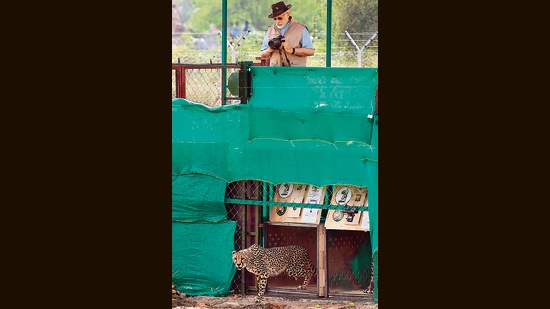
From a 10-foot-high tower, PM Modi, who turned 72 on Saturday, accompanied by Madhya Pradesh chief minister Shivraj Singh Chouhan, released the cheetahs into a special enclosure by turning a wheel to open the cages in which cheetahs were kept


Sheopur
Seven decades after their population went extinct in the country, eight cheetahs arrived in India on Saturday when a much-watched intercontinental relocation culminated with Prime Minister Narendra Modi letting the first of the felines into the Kuno National Park.
From a 10-foot-high tower, PM Modi, who turned 72 on Saturday, accompanied by Madhya Pradesh chief minister Shivraj Singh Chouhan, released the cheetahs into a special enclosure by turning a wheel to open the cages in which cheetahs were kept.
“When the cheetah will run again… grasslands will be restored, biodiversity will increase and ecotourism will get a boost,” said Modi, who stayed back at the dais with a camera, capturing the moments as the first three cheetahs gingerly made their way out.
The eight cats, five female and three male, will spend a month in quarantine at the enclosure before they are shifted to a 6-square-km enclosed patch of land within the national park where they will stay for up to four months before being released in the wild.
In his speech after releasing the cheetahs, Prime Minister Modi cautioned that they need time to get used to their new surroundings before people can see them in the wild.
“Today, these cheetahs have come as guests, and are unaware of this area. For these cheetahs to be able to make Kuno National Park their home, we have to give them a few months’ time,” the PM said, adding that all effort should be made for success of the experiment.
The cats first landed in Gwalior, where Union civil aviation minister Jyotiraditya Scindia welcomed their arrival before veterinarians checked their health. They were then boarded onto two Indian Air Force (IAF) helicopters.
Travelling over 8,000km from Namibia, the big cats — the fastest land animal on the planet — represent a key milestone for a decades-long effort to restore a species that was declared extinct in 1952 due to poaching and shrinking of grasslands.
“Decades ago, the age-old link of biodiversity that was broken and became extinct, today we have a chance to restore it. Today, the cheetah has returned to the soil of India,” he said.
“The cheetahs were provided water and buffalo meat, which was certified and tested by veterinary doctors. For the next one month, they will be provided meat by the experts,” said SP Yadav, secretary, National Tiger Conservation Authority (NTCA).
The enclosure will be covered with green screens and sheds so that sightings do not take place and the cheetahs can adapt effectively, he added.
The cheetah was completely wiped out from India due to excessive hunting and shrinking grasslands, its natural habitat. The last cheetah was killed in Koria district of Chhattisgarh in 1947 and it was declared extinct in 1952. Efforts to bring the animal — the smallest of the big cats and the fastest land mammal — have been decades in the making, beginning with Indira Gandhi in the 1970s but always running into international diplomatic or legal hurdles, until now.
Several wildlife experts and environmentalists have criticised the Cheetah translocation project but Cheetah Conservation Fund (CCF), which is coordinating the project, said establishing a self-sufficient population of Cheetahs in India is a very long process that may take years and a lot of dedication.
“It is a very difficult process and we have to be realistic about it. As far as Kuno is concerned, I don’t see any problems in them adapting to this region. It is very similar to Namibia or any other habitat,” explained Eli Walker, conservation biologist with CCF who has been working on the project and helped prepare the enclosures in Kuno.
Modi said that even though cheetahs had become extinct from India in 1952, no meaningful effort was made to rehabilitate them for the past seven decades.
Modi made a special mention of Namibia and its government whose cooperation, he said, helped bring the cheetahs to Indian soil after decades.
“I am sure, these cheetahs will not only make us aware of our responsibilities towards nature but will also make us aware of our human values and traditions,” said the Prime Minister.
The PM said a detailed Cheetah Action Plan was prepared while Indian scientists conducted extensive research, working closely with South African and Namibian experts. The Prime Minister added that scientific studies were conducted across the country to locate the most suitable area for cheetahs, following which Kuno National Park was chosen. “Today, our hard work is in front of us as a result”, he added.
The Prime Minister’s political remarks on the occasion drew a retort from Congress leaders.
Former environment minister Jairam Ramesh said the event was “theatre” to take attention away from the Congress’s Bharat Jodo Yatra.
Ramesh also posted photos of his visit to Cape Town in 2010 to attempt a cheetah translocation project that was stayed by the Supreme Court after concerns from environmentalists. The stay was lifted in 2020.
With inputs from Jayashree Nandi