E-Paper



87 hrs, 56 mins later, India and Pakistan halt hostilities; doubts remain
India, Pakistan announce a halt in hostilities but hours later, explosions and drone sightings sow doubts over Islamabad’s commitment

 Prefer HTon Google


India and Pakistan agreed on Saturday to stop all military actions against each other, bringing to an end four days of fierce fighting across the western border, although by late evening, there were enough violations by Pakistan to evoke a strong statement from India.

The four-day scrap represented the worst face-off between the two nuclear-armed neighbours in decades and stoked fears of a full-blown war.
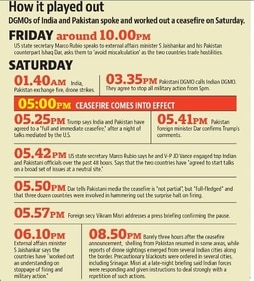
Foreign secretary Vikram Misri announced the ceasefire around 6pm, minutes after US President Donald Trump made the surprise declaration on social media. But he returned at a hurriedly called and brief press briefing at 11pm to confirm that Pakistan repeatedly violated the ceasefire in the evening and that the armed forces had given an adequate and appropriate response. There were unconfirmed reports of drone sightings in several border provinces, including Punjab, Gujarat, Rajasthan, and the Union Territory of Jammu & Kashmir.
However, the intensity of attacks was lower than that seen in previous rounds, and India, according to people familiar with the matter, did not retaliate by targeting specific targets in Pakistan.
The violations marred the announcement of the ceasefire, which Trump and US officials attributed to intense mediation by their country, although Indian officials said it was worked out directly by the two countries.
“The Director General of Military Operations of Pakistan called the Director General of Military Operations of India at 1535 hours Indian Standard Time earlier today. It was agreed between them that both sides would stop all firing and military action on land and in the air and sea with effect from 1700 hours IST today,” Misri said earlier in the day.
“Instructions have been given on both sides to give effect to the understanding. The Director Generals of Military Operations will talk again on the 12th of May at 1200 hours,” he added, without giving details.
The surprise announcement capped four days of escalating hostilities that began at 1.04am on Wednesday when India hit nine terror targets inside Pakistan and Pakistan-Occupied Kashmir as part of Operation Sindoor, as retaliation for the April 22 Pahalgam attack that killed 26 people.
“India and Pakistan have today worked out an understanding on the stoppage of firing and military action. India has consistently maintained a firm and uncompromising stance against terrorism in all its forms and manifestations. It will continue to do so,” external affairs minister S Jaishankar posted on X.
The day was packed with dramatic twists and ferocious fighting that saw India’s forces strike eight military sites in Pakistan with air-launched precision weapons in response to attacks on Indian military infrastructure and civilian areas by combat jets, drones and missiles. Trump made the surprise announcement around 530pm but reports of ceasefire violations started pouring in around 8pm.
Trump and US secretary of state Marco Rubio suggested that Washington DC mediated between the two neighbours and that talks were imminent at a neutral venue, but Indian officials clarified that no dialogue was forthcoming and all steps undertaken after the Pahalgam terror attack – including the suspension of the Indus Waters Treaty, closure of the only land border post at Attari, the whittling down of diplomatic presence and the expulsion of Pakistani nationals – will hold.
Misri’s announcement was preceded by social media posts by Trump and Pakistan’s deputy prime minister Ishaq Dar that spoke of a ceasefire. Trump said India and Pakistan agreed to a “full and immediate ceasefire” after a “long night of talks mediated by the United States”. He added, “Congratulations to both Countries on using Common Sense and Great Intelligence.”
Dar said the two sides had agreed to a “ceasefire with immediate effect”, and that Pakistan has strived for peace and security in the region without compromising on its sovereignty and territorial integrity.
Rubio, who spoke earlier in the day with Pakistan Army chief Gen Asim Munir, said that him and US vice president JD Vance engaged with senior Indian and Pakistani officials, including Prime Ministers Narendra Modi and Shehbaz Sharif, external affairs minister S Jaishankar, and National Security Advisers Ajit Doval and Asim Malik, to broker a “ceasefire”. Rubio also contended that India and Pakistan would “start talks on a broad set of issues at a neutral site”.
But New Delhi played down the US’s role. People familiar with the matter, who spoke on condition of anonymity, said the two sides reached an understanding to stop military actions bilaterally, after the Pakistani side initiated a call for discussions on the matter. There were no preconditions attached to the understanding, which was also not linked to other issues between India and Pakistan, the people said.
The people also set aside the US secretary of state’s contention that India and Pakistan will hold talks on a range of issues at a neutral venue, saying no agreement had been reached on such an issue.
“There are absolutely no conditions attached to this understanding and our resolve to counter terrorism directed against India remains firm and unchanged,” one person said. The people said India will not deviate from its long-standing position of engaging with Pakistan on all issues only bilaterally.
A second person said Operation Sindoor demonstrated that the dynamics of India’s response to cross-border terrorism had changed. “We have shown that we are capable of striking terrorist infrastructure and military installations deep within Pakistan, and that there will be a high cost for cross-border terrorism,” he said.
The punitive measures put in place against Pakistan by India a day after the Pahalgam terror attack, including the suspension of the Indus Waters Treaty, closure of the only land border crossing at Attari and downgrading of diplomatic ties, will remain in place and won’t be affected by Saturday’s understanding, the people said.
Commodore Raghu R Nair of the Indian Navy, while briefing the media alongside Col Sofiya Qureshi of the army and Wing Commander Vyomika Singh of the air force, said all three services were instructed to adhere to the understanding. India’s responses since the Pahalgam terror attack were “measured and very responsible”, he said.
“Let me reiterate that whilst we will be adhering to the understanding that has been reached today...we remain fully prepared and ever vigilant and committed to defending the sovereignty and integrity of the motherland. Every misadventure by Pakistan has been met with strength and every future escalation will invite a decisive response,” he said.
Qureshi and Singh said Pakistan suffered “very heavy and unsustainable losses” after its unprovoked attack on Indian installations. There was extensive damage to crucial Pakistani air bases such as Skardu in PoK, Sargodha, Jacobabad and Bholari, and the loss of air defence weapon systems and radars made the defence of Pakistani airspace untenable, they said.
Across the Line of Control, there was “extensive and precise damage” to military infrastructure, command and control centres and logistic installations, leading to a “breakdown of its defensive and offensive capability”, they added.
Qureshi and Singh told another briefing on Saturday morning that the Indian Air Force struck eight military sites in Pakistan, including radar units and ammunition dumps, with air-launched precision weapons, in response to Pakistan’s attacks on India’s military infrastructure and civilian areas using combat jets, unmanned combat aerial vehicles (UCAVs) and missiles.
In a swift and calibrated response, the IAF struck military targets in Rafiqui, Murid, Chaklala, Rahim Yar Khan, Sukkur, Chunian, Pasrur and Sialkot, the officials said. Pakistani forces targeted a raft of air bases in Punjab with missiles after 1.40 am, and medicare centres and schools at three air bases in Jammu and Kashmir were hit too.
The night-long developments marked the fiercest clashes between the two sides since India launched Operation Sindoor in the early hours of May 7.
Misri, who too addressed the earlier briefing, said India’s military strikes on Saturday were a response to the escalatory and provocative actions of Pakistan, which is engaged in a “wanton campaign” of targeting civilians in Jammu and Kashmir and Punjab.
Misri debunked Pakistan’s claims about destroying or damaging military installations, critical infrastructure, and power and cyber systems in counter strikes and said India has “defended and reacted in a responsible and measured fashion to these provocations and these escalations”.