E-Paper



A 1988 jet crash, 133 deaths and an unending struggle
The Indian Airlines Boeing 737 Flight IC-113 that was carrying the Patel family among 129 passengers crashed on its final approach to Ahmedabad

 Prefer HTon Google


On October 19, 1988, Pankesh Patel and his family were eagerly waiting to receive his younger brother Rakesh and his wife Bhavna, a US citizen. The couple had gone to Mumbai to attend the famous garba festivities at Mithibai College.
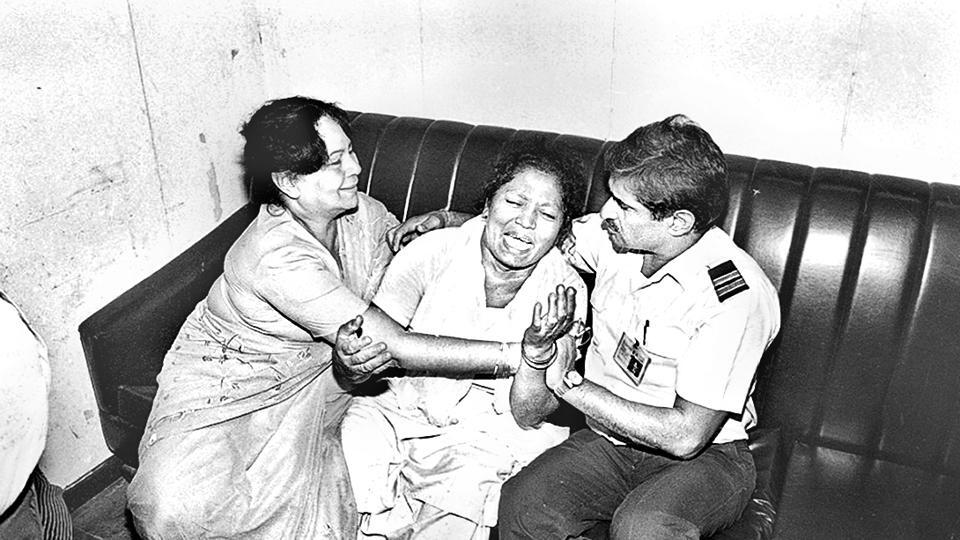
“After the wedding, they were coming home for the first time. The college was famous for garba competition and my brother and bhabhi were skilled at garba, hoping to win a prize,” said Patel, now a retired bank employee.
That was not to be.
The Indian Airlines Boeing 737 Flight IC-113 that was carrying the Patel family among 129 passengers crashed on its final approach to Ahmedabad at approximately 6.53am on October 19, 1988.
The aircraft carried 129 passengers, including five children, and six crew members when it took off from Mumbai at 6.05am. After reporting overhead in Ahmedabad at 6.47am, the aircraft crashed near Chiloda-Kotarpur, about 2,540 metres short of Runway No 23. It hit trees and an electric wire during the landing approach, killing 133 of the 135 people on board.
Patel rushed to the post-mortem room at Ahmedabad Civil Hospital in Asarwa that morning. “Bodies were lying all around, many burnt beyond recognition. I recognised my brother from his wedding ring and my sister-in-law from her mangalsutra. The world came crashing down on us,” he said.
A string of errors
A government-appointed Court of Inquiry, constituted under Rule 75 of the Aircraft Rules, 1937, and chaired by former Supreme Court judge, justice AK Mathur, submitted its report on October 10, 1989.
The inquiry found that the aircraft was travelling at 158 knots instead of the stipulated 128 knots and descended below the minimum descent altitude without establishing visual contact with the runway or approach lights. The pilots failed to follow the prescribed missed approach procedure and continued landing despite visibility conditions lower than the prescribed minimum.
The Airports Authority of India (AAI), which managed the airport, failed to communicate deteriorating visibility conditions to the pilots, as visibility had reduced to 700 metres. The Ahmedabad airport lacked a functioning Instrument Landing System at the time, and its approach lights were inoperative. Inadequate firefighting services exacerbated the tragedy, as 6,000 litres of fuel ignited after impact.
According to the Justice Mathur Commission report, the pilot’s errors in judgement amid poor visibility caused the accident. The report suggested the pilots violated the prescribed minimum descend altitude and did not follow the standard call-out procedure while descending to the Ahmedabad airport.
Then civil aviation and tourism minister Shivraj Patil, visited the crash site the same day and ordered a full investigation under the 1937 Aircraft Rules and announced a ₹2 lakh compensation to the next of kin of each deceased passenger. A parliamentary consultative committee discussed the crash with members criticising Indian Airlines and the civil aviation ministry. Lok Sabha member P Kolandaivelu demanded that Patil resign.
The crash also prompted a flurry of significant safety improvements. Ahmedabad’s Sardar Vallabhbhai Patel International Airport installed an Instrument Landing System (ILS) by 1992, upgraded its approach and runway lighting and enhanced its firefighting capabilities by 1995.
The 1937 Aircraft Rules were amended in 1991 to mandate real-time Runway Visual Range (RVR) reporting by the Air Traffic Control during low visibility conditions and stricter pilot training for low visibility landings. The Directorate General of Civil Aviation (DGCA) introduced guidelines in 1990, requiring airports to maintain enhanced fire and rescue services proportional to aircraft fuel loads.
The struggle begins
Initially, Indian Airlines – which was the government’s national domestic carrier at the time – offered families ₹2 lakh. “In those times, they used to write the compensation amount on the back of plane tickets, which said ₹2 lakh for Indian passengers and ₹5.5 lakh for international passengers,” said Patel.
Jatinder Kumar Sethi, deputy advocate general, who appeared on behalf of Indian Airlines, told the Supreme Court during July 24 hearing that no evidence was led either before the Ahmedabad city civil court or the Gujarat high court with regard to the recklessness on the part of the pilots. Sethi also submitted that there was no finding in the inquiry report that the accident was caused by recklessness, adding that the report did not find an error in judgment on part of the pilots. He questioned the admissibility and the evidentiary value of the report.
The Carriage by Air Act, 1972, incorporating the Warsaw Convention (1929) and Hague Protocol (1955), governed the crash. It capped liability at ₹2 lakh for domestic passengers and ₹5.5 lakh for international passengers.
Rule 25 of the Act stated: “The limits of liability specified in Rule 22 shall not apply if it is proved that the damage resulted from an act or omission of the carrier, his servants or agents, done with intent to cause damage or recklessly and with knowledge that damage would probably result; provided that, in the case of such act or omission of a servant or agent, it is also proved that he was acting within the scope of his employment.”
The Act was amended in 2009 to align with the Montreal Convention (1999), raising liability to around ₹1 crore in 2009 for international flights and up to ₹20 lakh for domestic flights without proving fault. As of 2025, the amended Act sets international liability at around ₹1.4 crore and domestic at ₹20 lakh, with higher amounts possible for negligence.
All passengers on board were “considered domestic” because the aircraft was flying within the country and not connecting to an international flight.
Patel said he immediately began reaching out to other victims’ families, urging them not to accept the compensation amount, as he thought it was inadequate. “The ₹2 lakh offer was inadequate for the loss of my brother and his wife.” He attended several prayer meetings of the deceased and reached out to their families.
“Many of them turned me down, saying I was talking about compensation when their family members had died. I told them that I was one of them too, but this was a fight we couldn’t avoid. If we didn’t stand up for ourselves then, we would regret it later,” Patel said.
Ushaben Patel, in her petition to the Supreme Court, said: “The ₹2 lakh offer couldn’t replace my husband’s role as our family’s provider”. Vidyagauri Jani told the trial court that “The ₹2 lakh offer did not account for my husband Ramshankar’s earning capacity, which supported our sons’ future”.
Patel and 59 others formed the Accident Claim Victims Association in 1989, registering it as a non-trading consultancy. Key figures included Ritaben Shah, the association’s president, and Ushaben Patel. The association coordinated litigation efforts with support from Consumer Education and Research Centre (CERC), a Gujarat-based consumer rights NGO.
In 1990, at least 34 families representing dependents of deceased passengers and crew filed civil suits in Ahmedabad’s city civil court, seeking higher compensation.
Survivor Ashok Agarwal filed a separate claim for his injuries, bringing the total to 35 claimants, according to court records. Among the claimants were Ushaben Patel and her two sons, pursuing claims for her husband Sharadchandra Patel’s death, and Vidyagauri Jani, widow of Ramshankar Jani, along with her sons Shishir and Niranjan, who filed through their power-of-attorney holder, Himanshu Jani.
Ushaben Patel argued that her husband’s death was due to the airline’s recklessness. “I demand compensation reflecting his earning capacity”. They sued Indian Airlines and AAI for composite negligence.
From courtroom...
The city civil court delivered its judgment in 2003, holding Indian Airlines and AAI jointly liable. The court attributed fault in the ratio of 70% to Indian Airlines and 30% to AAI, awarding ₹6 crore to the 34 merged suits with 6% annual interest from 1990.
The court said, “The pilots’ recklessness in descending without runway visibility, despite knowing the visibility was below the prescribed minimum and failing to follow the missed approach procedure, constitutes wilful misconduct under Rule 25 of the Carriage by Air Act, 1972... AAI’s failure to provide real-time RVR updates and maintain operational approach lights contributed to the accident,” the order said.
Ushaben Patel’s family received ₹14.7 lakh and Agarwal ₹61 lakh. The ₹6 crore was not uniform and varied by dependency and injury. Ushaben’s award reflected her husband’s high earning capacity for three dependents. Agarwal’s higher award accounted for lifelong disability and medical costs.
Indian Airlines appealed, arguing its liability was limited to ₹2 lakh per passenger under the Carriage by Air Act, 1972, unless claimants proved recklessness. AAI challenged the finding of negligence and its share of liability.
The claimants filed cross-appeals seeking higher interest rates, citing international standards under the Warsaw and Montreal Conventions.
On October 14, 2009, a division bench of the Gujarat high court comprising justices Mohit Shah and Harsha Devani largely upheld the civil court’s ruling, maintaining the ₹6 crore award but making significant adjustments.
The court increased the interest to 9% per annum, adjusted liability to 90% for Indian Airlines and 10% for AAI, and reduced certain compensation components, such as pain and suffering, to ₹50,000.
Agarwal’s compensation was reduced to ₹45.30 lakh with 9% interest on ₹35.30 lakh and 7.5% on ₹10 lakh. The court ordered payment by December 31, 2009, and required defendants to cover litigation costs.
The claimants argued the award underestimated dependency losses. Indian Airlines claimed no recklessness, capping liability at ₹2 lakh and AAI disputed its 30% liability, arguing pilots’ actions were primary.
“The pilots’ reckless conduct in continuing the descent without runway visibility…warrants 90% liability on Indian Airlines, while AAI’s negligence in failing to provide real-time Runway Visual Range (RVR) updates justifies 10% liability,” the high court order said.
...to courtroom
Both sides approached the Supreme Court in 2010. The families, represented by Ushaben Patel and her sons, argued that the HC underestimated the deceased’s prospective income, failed to account for statutory bonuses, and awarded inadequate litigation costs despite 21 years of legal battles across three forums.
“We seek much higher compensation adhering to international rules,” said Patel. He said while many families of the plane crash victims accepted the compensation amount, the association members have not.
Ritaben Shah’s chartered accountant husband, 56-year-old Shirish Shah, was returning from work in Mumbai when he died in the crash. Ritaben said the number of members in the association has dwindled from 60 to 27.
Shirish Shah’s sons Ashish Shah and Nirmay Shah have accepted their share of the high court’s ₹6 crore compensation award but not without protest. This means that the amount is held in a fixed deposit from which they can only draw interest, and they reserve the right to pursue higher compensation in the court.
“Our father was the sole breadwinner, yet the compensation was the same for someone with a B Com degree and a qualified professional like him,” Ashish said.
“Many could not pursue due to geographical restrictions and we couldn’t keep track of everyone. At least 27 of us are still fighting. Now everything is in the Supreme Court,” said Ritaben, president of the association.
On July 24, a bench of Justices Sudhanshu Dhulia and Aravind Kumar took up the case of Air India Ltd vs. Airports Authority of India & Ors., involving multiple appeals from the 2009 Gujarat high court ruling. The proceedings showed Indian Airlines filed 40 civil appeals challenging the HC judgment. AAI also challenged the judgment through 32 petitions.
The airline’s counsel argued that no evidence was presented before either the city civil court or HC on pilot recklessness, and alleged that the Court of Inquiry report found no error of judgment by the pilots. The counsel also questioned the admissibility and evidentiary value of the Court of Inquiry report, arguing that it found no negligence on the part of Indian Airlines. They noted that while the trial court held liability in a 70:30 ratio between the airline and airport authority, the HC had modified this to 90:10.
“The airline was directed to deposit the compensation in court which has been withdrawn by the claimants,” the counsel for Indian Airlines submitted before the court, adding that 12 counter claims have been filed by some of the claimants in the Supreme Court for enhancement of compensation.
Senior counsel Samir Parikh, appearing for the families, argued that both the trial court and HC had concurrently held that Indian Airlines and AAI were negligent and reckless. He emphasised that the recklessness of the pilots was considered in detail, with findings that they acted recklessly with knowledge that damage would probably result, thereby removing the liability limits and allowing for enhanced compensation.
The court has adjourned the case to August 21.
By the time the case comes up again, nearly four decades would have passed since the crash – the fifth deadliest air accident in India. Indian Airlines has ceased to exist, and even its successor Air India is a private company now.
The Ahmedabad airport modernised with a new terminal in 2010 and radar upgrades, and privatisation in 2020, when AAI leased it to Adani Enterprises for 50 years. Indian Airlines merged with Air India in 2007 and was privatised in 2022 under Tata Group. DGCA introduced crew resource management training in 2005 and stricter safety audits.
“It’s been nearly four decades and we still haven’t received the compensation we deserve,” said Ashish Shah.