
 E-Paper



A lifetime of nation building
The legacy of Sukumar Sen, the architect of the modern Indian election, goes far beyond party symbols, indelible ink, and ballot boxes.


The year is 1919. The embers of the first World War are still smouldering. The massacre at Jallianwala Bagh is reverberating across the Indian subcontinent, coalescing the fledgling independence movement into a potent force. A new form of passive resistance, called Satyagraha, against a draconian new British law is taking root, championed by a rising political leader called MK Gandhi.
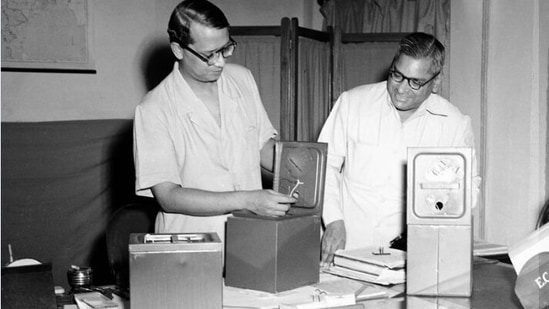
In September, a 21-year-old Bengali named Sukumar Sen sets sail for London for higher studies. He hopes to secure a degree in mathematics from the University of London. The young man, the third of seven brothers and two sisters, is the son of civil servant Akshay Kumar Sen and has just secured the first position in mathematics from Presidency College in Calcutta.
On the weeks-long voyage, as Sen would tell his family later, he meets another short, Bengali man and is dazzled with his knowledge. A proud man, he attempts to best the other man in knowledge of history, philosophy, science, mathematics and literature, but finds himself humbled. “He told the family years later that the other man was none other than Subhas Chandra Bose,” recalled Sen’s grandson Debdatta Sen.
As the architect of India’s first and second general election, Sen is one of modern India’s tallest figures, yet curiously little is known of him. His innovations -- using symbols for political parties instead of names, indelible ink, and meticulous planning of the polling schedule -- and his determination -- insisting on registering the full names of women voters, even if at the cost of 2.8 million incomplete names being struck off the rolls in 1951-- are well documented.
But he didn’t leave behind papers of any major significance, and an understanding of his legacy is still nascent. Using Bengali newspaper records, speeches and documents provided by his family, written tributes by people who worked with him and conversations with surviving family members, HT attempts to piece together the life of India’s first chief election commissioner, the man who made it all possible.
“He was a pillar of his family and the country. But I think he worked so much, he never got the chance to write it down,” said Sudipta Sen, Sen’s grandson and professor of history at the University of California, Davis.
Early career
Born in present-day Bangladesh’s Sonarang village on January 2, 1898 to Akshay and Sushama Sen, Sen would go on to earn a gold medal in mathematics and become one of the youngest Indians to join the British-era Indian Civil Service in 1921 -- a decision that was forced, at least partly, by his father’s untimely death. During his time in London, he also taught Bengali part-time to students at the School of Oriental and African Studies, said Sudipta Sen.
“He wanted to become a lawyer but sacrificed his first love to provide for his family. He had no choice but to opt for ICS because it gave stability,” said Sen’s grandson and Supreme Court advocate Sanjiv Sen.
As an ICS officer, he held positions as a district and sessions judge in various parts of Bengal for almost two decades. During this time, he took care to not toe the establishment’s line. In 1930, for instance, when he was the district judge of Medinipur, his verdict freeing several freedom fighters annoyed the British, who promptly transferred him to Noakhali, roughly 500km away. “My father was not a favourite of the British,” his daughter Jayanti Sen told Navin Chawla for his 2019 book Every Vote Counts.
His first big assignment came at the moment of India’s independence -- at a time when, riven by the horrors of Partition and overwhelmed by the bursts of refugees streaming into West Bengal, the state government was scrambling to restore law and order. Bengal’s first chief minister Prafulla Chandra Ghosh, handpicked Sen to be the state’s first chief secretary.
He held the position for roughly three years, quickly gaining the trust and favour of Bidhan Chandra Ray, who succeeded Ghosh in 1948. During this time, Bengali papers note that Sen worked on issues of rehabilitation, law and order, and daily administration but also kept an eye out for refugees struggling to make ends meet.
“A few months after independence, I met Sukumar babu to tell him about the heart-rending conditions of poor refugees who had been terrorised out of their homes, and were sleeping at Sealdah station. He listened to us patiently and took us to meet the CM. I was assured that the mild-mannered man had thought deeply about refugees,” wrote Congress leader and refugee activist Surendranath Chakrabarti in a Bengali publication.
Sudipta Sen recalled that Sen cultivated an image of an evenhanded, level-headed and gritty administrator, who stood firm on issues of law and order. “He handled a very tricky time with violent agitations erupting all over. He was apolitical, but had to take tough decisions on public safety that may not have been always popular,” said Sudipta Sen.
In the spring of 1950, Bidhan Roy recommended Sen to Jawaharlal Nehru to head the country’s young election commission for the first general election. On March 21, 1950, he took charge of what was going to be a career-defining role.
Project of democracy
Sen had abiding faith in the project of democracy, especially universal adult franchise, and viewed it as the natural extension of the republican forms of sovereign government in ancient India, and the autonomous (and in his view democratic) units of self-sufficient Indian villages.
“In the context of history, the establishment by the Constitution of the democratic and parliamentary forms of government in the country on the basis of adult franchise was like the rejoining of a historic thread that had been snapped by alien rule,” he wrote in his official report on the 1951-52 election. Of course, this view was at odds with that of the Constitution’s architect, BR Ambedkar, who famously described villages as dens of ignorance and narrow-mindedness.
One of his first decisions was to push back the election and declare that it couldn’t be held in 1950. In his report, he wrote that the electoral law was yet to be passed, scheduled castes and tribes were yet to be officially specified by the president, electoral rolls were incomplete, and carving of constituencies hadn’t begun.
The late passage of the electoral law -- the Representation of the People Act only cleared Parliament in July 1951 --- and the slow updation of rolls meant that elections were finally pushed from spring to autumn of 1951.
Poll challenges
From his report, it is clear that Sen faced three major challenges before the polls.
One was delimitation, or the process of creating poll constituencies. The Constitution mandated that the Lower House shall not have more than 500 members and no more than one member shall be elected for 500,000 people. But the population figures had been skewed because the last census was in 1941, and because of large-scale displacement during Partition. Sen mandated estimates of a state’s population as on March 1, 1950 be made by taking an average of the 1941 figure and the mathematical projection done on the basis of the last five decennial censuses. Double-member constituencies were created for reserving one seat for SCs or STs, but the voting and counting in these seats were cumbersome and complex.
Second was the preparation, updation and publication of electoral rolls -- a process that had begun, albeit slowly, in November 1947. For the first time, elections were being held on joint electorates so critical decisions were made to drop the religion and caste column from the rolls -- to some opposition, especially from Madras which published its rolls with these details intact, only to revise them later. People displaced by Partition were also included after a declaration by them. Supplementary rolls were published for registering voters who turned 21 between January 1, 1949 and March 1, 1950, and the last rolls were published on November 15, 1951. Sen noted that the quality of these rolls were not always satisfactory and blamed ignorance, lack of adequate organisation by political parties and inexperience of government machinery. Serious problems were faced in Delhi, Punjab, and Bengal on account of displaced people. Roughly 2.8 million women voters were struck off -- from Bihar, UP, MP, Rajasthan and Vindhya Pradesh -- for not disclosing their proper names. In all, 173.2 million were registered.
Third was the putting together of the electoral machinery. Sen devised symbols to get around the problem of illiteracy -- India’s literacy rate then was around 18% -- but steel ballot boxes, ballot papers, seals, pens, counting centres and polling stations had to be set up and personnel had to be trained in the tens of thousands. Sen leaned on state governments and the industry to fill in, designed himself the scheme of a polling booth, and brought forward the elections in the hill constituencies of Himachal Pradesh to avoid snow and landslides. Still, the remote areas of Lahaul and Spiti remained out of bounds and could only vote in 1957.
After the successful completion of the first general election, Sen went Sudan as the head of the international election commission in 1953 to hold polls in the African nation. “His knowledge of registering and working with tribespeople and poor populations in India helped him,” said Sudipta Sen. “Sometimes, he would be gifted cows as a mark of honour. He wouldn’t know what to do with them, but couldn’t refuse as it would be a sign of disrespect.” The country named a road after Sen in its capital Khartoum.
He was awarded the Padma Bhushan in 1954. He retired from the election commission on December 19, 1958 at an age earlier than what election commissioners in India do today. He spent the next few years relatively quietly, but then threw himself into a project that turned out to be as challenging, if not more, than the general election.
Later years
After his retirement, Sen spent a couple of years in Calcutta, attending to the house he was building for his family on Ballygunge Circular Road. “Every night he would call a stenographer and dictate passages well into the night. There was an air of mystery as to what grandpa was doing,” said Debdatta Sen.
Sen, it later turned out, was drafting the bills that would establish three new universities in Burdwan, Kalyani and North Bengal. He was also appointed the first vice-chancellor of Burdwan University, from where he received a posthumous D Litt degree . He was working in a special capacity in the state education department.
During this period, Sen spent time with his family and children. “We remember a man who never raised his voice, and yet everyone revered him. And he had a fantastic sense of humour,” said Sanjiv Sen. Debdatta recalled that Sen also became interested in music and was particularly proficient on the piano.
His wife, Gouri, was involved in social work and the women’s movement, especially dowry prohibition, and later helped set up Suruchi, the first proper Bengali cuisine restaurant. His youngest brother, Ashoke Sen, had been elected to Parliament and appointed the Union law minister. Another brother, Ameya Kumar Sen, was a famed physician.
In September 1960, Sen took on a mammoth project: heading the government’s ambitious, if controversial, project to rehabilitate and resettle partition-displaced people in the Dandakaranya region of present-day Odisha and Chhattisgarh. Historians and journalists later pointed out how the project was ill conceived and led to resentment among local populations as well as hardships for the refugees.
As head of the Dandakaranya Development Authority, he travelled frequently, going into villages to oversee projects that included settling villages, felling trees, building check dams and roads, and laying railway tracks.
He also oversaw one of India’s largest anti-malaria programmes in the area -- covering 200,000 people over 3,500 square miles -- that sharply cut infection rates in the area.
“He would often tell us that I have got enough honours and posts. But now, if I can do something for these people, then I want nothing more,” wrote Binay Sengupta, a zonal officer, in a Bengali publication.
But Sen’s health was already failing and officers noted that he stopped travelling into the villages after a while. During this time, he grew more philosophical, penning some short monographs. In one, an appeal to the displaced people being resettled in Dandakaranya, he listed the ways agriculture could be started on the barren land and government guidelines for getting subsidies. “We have to prove that the displaced Bengali from East Bengal are patriotic, believe in hard work and cooperation, and dream of building a new India,” he wrote in the 1961 document.
In another, titled What Life has Taught Me, Sen talks about the key to contentment, the importance of resisting evil and the value of frankness in human relationships. “A rational adjustment of ambition and contentment is, to my experience, the key to human happiness,” he wrote.
Sen passed away soon after, at 3pm on May 13, 1963.
 ABOUT THE AUTHORDhrubo Jyoti
Dhrubo works as an edit resource and writes at the intersection of caste, gender, sexuality and politics. Formerly trained in Physics, abandoned a study of the stars for the glitter of journalism. Fish out of digital water.Read More


