
 E-Paper



A quest for closure, 30 years after Mumbai was torn apart
It’s August in Mumbai

 Prefer HTon Google


It’s August in Mumbai. The small scraggly patch of earth outside the modest Malad home, overrun by clucking chickens, smells of rain. Moosa Qureshi, 73, walks out of his front door, and goes up a flight of stairs to a makeshift room. Dressed in a blue-and-white striped shirt and trousers, beard neatly trimmed, he is tall, but his shoulders are drooping with age. It’s not difficult to imagine Qureshi as a strapping, well-built man in his forties, walking the streets of the violence-torn city, looking for justice in the smoking embers of its darkest hour.
Qureshi stomps back down the stairs, three folders clutched in his hands. He lays them down and a table, and from within emerge hundreds of documents. List upon list of handwritten names, letters to the police, educational qualifications, marriage certificates; anything that could inform an application of death. Papers that are fading memories of tragedy.
1992 was a fraught time. On December 6, the Babri Masjid was torn down in Ayodhya, and its repercussions were felt across India. India’s financial capital, home to the glitz and glamour of Bollywood but a metropolis with a thriving underworld, was no exception. For two months, between December 1992 and January 1993, Bombay burned. There was wave after wave of frenzied communal riots. The official death toll was 900, and 168 people went missing.
In July 1993, as a city crawled back to normalcy and attempted to repair the wounds, the state government announced financial assistance of ₹2 lakh to those affected by the riots. Qureshi, then a social worker, searched the wrecked city for families too scared to report missing relatives, chased down leads that led to locked homes, and helped others scour hospitals and mortuaries for the bodies of those they had loved and lost.
But the fear was too deep, information was difficult to gather; the paperwork too haphazard in a city that was still seething within. After 10 years, Qureshi stopped looking. “I did my best, but in many cases, the addresses were so vague, I had to give up,” he said.
Thirty years later, in October 2023 a representative of the Maharashtra government knocked on the Nashik door of Shamsundar Maralkar, a retired Indian Air Force officer who had quit the force and joined the Maharashtra police, but disappeared on January 28, 1993. It wasn’t to ask his whereabouts — the men and women who knocked, and the family inside, knew he was dead. It was part of a Supreme Court-mandated exercise, over three decades after Qureshi had tried and failed, to track down, identify, and compensate families of those who went missing when Mumbai burned.
Supreme Court order
In the years after the riots, the Maharashtra government disbursed compensation based on two government resolutions. The first was the one issued on July 8, 1993. The second, passed on July 22, 1998, granted ₹2 lakh compensation to legal heirs of those missing in the riots. Under the law, a person is presumed dead if they are missing for seven years. Though only five-and-a-half years had passed, the extraordinary number of people who vanished forced the government to make an exception.
By 2001, government records showed that the families of all of the dead had been compensated, and of those missing, 60 families had been disbursed a total of ₹1.19 crore in compensation. One hundred and eight families, believed to have fled the city, were yet to be traced.
A writ petition was filed in the Supreme Court in 2001 seeking the implementation of the recommendations of the Justice BN Srikrishna Commission, which investigated the riots between 1993 and 1998. Twenty-one years later, in November 2022, a bench of justices Sanjay Kishan Kaul, Abhay S Oka and Vikram Nath took a stern view of the fact that even until 2010 the government was yet to finish granting compensation to eligible families.
The top court directed that a three-member committee, headed by the member secretary of the Maharashtra State Legal Services Authority (MSLSA), a representative from the collector’s office, and an assistant commissioner of police, oversee and complete the exercise in 10 months. That deadline ended on September 4 this year.
It further asked the committee to identify all cases in which compensation was delayed. Those families, the apex court said, would receive interest at the rate of 9% per annum beginning six months from the passing of the two government resolutions dated 1993 and 1998.
The government spent the first seven months of the year nominating a resident deputy collector and an assistant commissioner of police to the committee, and then naming replacements when they retired shortly after. By July, panel finally comprised MSLSA member secretary Dinesh P Surana, resident deputy collector (Mumbai Suburban) Satish Bagal, and ACP (Pydhonie division) Jyotsna Rasam.
The challenge was not just to identify cases of delays and calculate the quantum of compensation they were eligible for, but also to look afresh at cases where the government had rejected claims. The heirs of 108 people, missing and presumed dead, needed to be found. The top court’s order was unambiguous — this time, every last person had to be traced and compensated.
Start of another hunt
In the last week of July, with the September deadline looming, the collector’s office and the police, having traced every available scrap of paper still surviving from 1992, dumped a bunch of incomplete records on Surana’s table.
The lists were a complete mess. “They were not organised according to who had and hadn’t received compensation. Many names were duplicated. Some names and addresses were incomplete,” the MSLSA official said, asking not to be named.
To begin with, Surana asked both authorities to submit separate lists of the dead and the missing. That exercise brought the recorded number of the dead down to 879 persons from the figure of 900 provided to the Supreme Court in a sworn affidavit. “This was a serious oversight. At that point, we asked the authorities to ensure that they do not cut the figure down any further,” added the official.
Between August and October, MSLSA digitised and organised the records it had the best it could. The Supreme Court had suggested that the committee enlist para legal volunteers (PLVs) to trace these families, and 2,680 empanelled as such across Maharashtra’s 36 districts. The committee submitted a preliminary report to the Supreme Court by September 4, and was granted an extension.
Now, more than a year later, work has been slow, painstaking, and frustrating. “The quality of data entry is poor. Addresses are incomplete so contacting families to verify financial records is not easy,” the official said.
The job was even harder 30 years ago.
In 1993, before he hit the streets in search of victim families, Moosa Qureshi found an ally in Satish Tripathi, then the principal secretary of the state’s relief and rehabilitation department, tasked with verifying and granting compensation claims. Qureshi was introduced to senior inspectors of all the police stations in the city, under orders to cooperate with him.
But there was no digitisation, no technological help. Locating one family meant visiting three or four addresses. Most families had been driven out of their homes, and often, had fled to their native villages if they were from out of state. In countless cases, the chawl or building at the end of an exhausting search had been demolished by the time he visited.
Filing compensation claims meant that the police had to satisfactorily conclude that an individual had disappeared during rioting; their next of kin needed to obtain heirship certificates.
In a terrified city, Qureshi’s detective work was fraught with danger. Peace had been restored, but it was tenuous — a stranger in their midst asking questions was unwelcome. On one occasion, he was accosted by a group of Shiv Sena workers while inquiring about a Hindu family. His identity was a red flag. “They threatened me and only allowed me to go after convincing them that I was assisting families irrespective of religion,” he said.
In September 2023, the PLVs took over. Here too, vague addresses such as “Gilbert Hill Zopadpatti” confounded them. Their work has been slow and painstaking; only two families have been traced. But there is a crucial difference. Under the protection of the Supreme Court, the PLVs can call upon the cooperation of every arm of government. And MSLSA has been able to rope in counterparts.
In October, there was a case that showed success was not impossible. The only clue was a name and a district — Gita Sarkar, Murshidabad.
Four teams of PLVs fanned across the West Bengal district, perusing records of the police, eight municipalities, thousands of gram panchayats and block development offices, every electoral roll from 1992 onwards and the 2011 census. Together, they met over 650,000 people in 5,274 villages, before finally, they found three heirs in Jalalpur village. “We are now assisting the family file their compensation claim,” the official said.
Memory and forgetting
Sudden loss is a hard to process, and families deal with it differently.
So, when the PLV’s knocked on the Maralkar family’s door in Nashik in October, they did not receive an enthusiastic welcome. It brought back memories that the family had long tried to forget, and a promise of closure they no longer wanted.
Amit, the family’s younger son was a Class 9 student when he last saw his father on January 28, 1993. A retired Indian Air Force officer, sub inspector Shamsundar Maralkar was then posted at Agripada police station in central Mumbai. “He was a jolly good Airman,” he said.
That morning, Maralkar borrowed a friend’s motorcycle to visit his family, 215km away in Nashik, for a few precious hours. It was his older son Anant’s birthday the next day. On his father’s request, the principal allowed Amit to leave school early and after a few joyous hours at home, Maralkar dropped Amit at his tuition class and rode back towards Mumbai.
They had no landline, and the next day the family waited for Maralkar to call at their neighbour’s home. He always called on a birthday, but Mumbai was on fire. Two days later, his wife phoned the police station. The family then rushed to Mumbai for what would be a fruitless search. “He may have been abducted, killed, lost his senses. Maybe he moved abroad. He may still be around somewhere. We are still waiting,” Amit said.
When the team of PLVs arrived, the family said they were not keen on compensation. “My parents ensured my brother and I got a good education. All we would have appreciated is if someone from the government had called all these years, to ask his whereabouts,” Amit said.
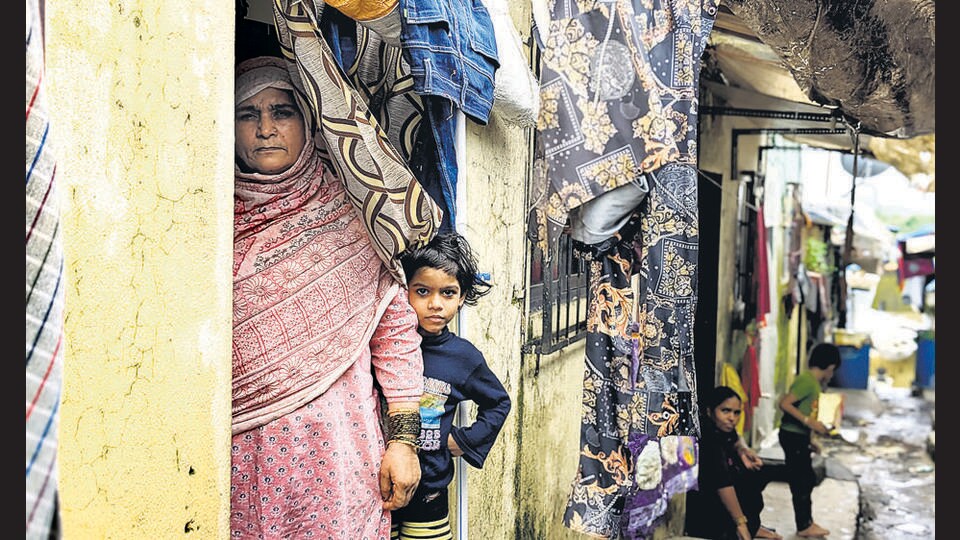
But 125km away, in a matchbox two-room home on a hillock in Titwala, Ashiyabanu Pathan has renewed hope, for maybe the government will at last acknowledge that her husband was a casualty in the riots. On January 11, 1993, garage mechanic Ilyas Pathan had decided that his young family was safer living with relatives in Mumbai than the cosmopolitan chawl in Thane where he had grown up. “He came home tired from work. He told me to pack our bags and that we would leave in the morning,” recalled Ashiyabanu, who was 22 then.
After dinner, he stepped out for paan. There was violence everywhere, it was dangerous, she pleaded with him. “He said that the shop was so close by that there was nothing to fear,” she said. He did not return.
She did not sleep that night, but with four children under the age of seven, she could not step out to look for him. At dawn, a neighbour told her she had seen some men lead Ilyas away to a hill. On that hill the next morning, she found his bloodstained lungi, and a few metres away, draped on the branches of a tree, her husband’s body.
With Qureshi’s help, the unlettered Ashiyabanu filed a claim for compensation. There was an FIR, but the government rejected her claim, ruling that Ilyas’s murder was unrelated to the riots. There was no further recourse.
In the months that followed, she went back to her village where she worked on her parents’ farm. There was no money, and there was only basic education for her children. She remarried, and her husband moved to Kurla to work in a footwear manufacturing unit. They now live at the end of a muddy alley where the rent is ₹2,500. One of her sons is a vegetable seller, the other a daily wage labourer. Her daughters do not work.
“If I had received the compensation in time, their lives would have been different,” she said. “Maybe now, the government will reconsider my claim. Maybe now I will get some justice.”


