E-Paper



Affordability key driver of food insecurity in India
How does India fare in terms of food safety for its people?

 Prefer HTon Google


Even though India did not experience a post-pandemic spike in food prices compared to the rest of the world, affordability of a healthy diet remains the key challenge in ensuring food security, according to the UN’s Food and Agricultural Organisation (FAO) report on “The State of Food Security and Nutrition” released last week. To be sure, India is not the only place of concern vis-à-vis food security, as the report paints a bleak view of access to quality food worldwide: global hunger remains far above pre-pandemic levels, with between 690 and 783 million people estimated to have faced hunger in 2022. Even those who may be able to eat are not alright, almost 2.5 billion people had no access to nutritious, safe, and sufficient food, the document adds.
The report was prepared by UN’s FAO, the International Fund for Agricultural Development (IFAD), the United Nations Children’s Fund (Unicef), the World Food Programme (WFP), and the World Health Organization (WHO). Here are five charts summarising key takeaways for India.
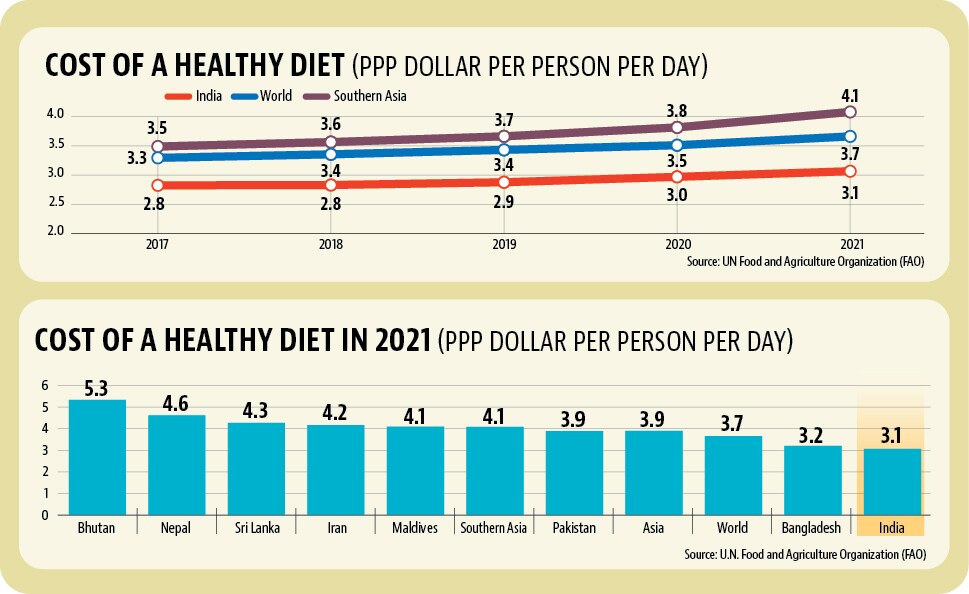
 Cost of a healthy diet has increased less in India than it has worldwideData on diet costs are available from 2017 through 2021. In 2017, costs in local currency units were calculated using price data from the World Bank’s International Comparison Programme (ICP). To compare the cost across countries, these figures are then converted into international dollars using purchasing power parity conversion factors from the World Development Indicators database. The Healthy Diet Basket (HDB) standard provides the average food group amounts recommended across several categories, which are to meet a dietary energy intake of 2330 kcals. Food group amounts found from the HDB are then compared with several global guidelines to capture commonalities, allowing statisticians to determine what qualifies as a healthy diet and make global comparatives. Since ICP data is not available every year, the 2017 healthy diet cost data is inflated using FAO’s national food consumer price indices to then obtain estimates for years 2018–2021. The cost of a healthy diet has risen over the last five years in India, South Asia, and the world overall. However, it has increased less in India than it has in South Asia or the globe. India’s advantage in terms of being a low food inflation region also holds within South Asia, as the cost of a healthy diet in India is significantly lower than its peers within the “Southern Asia” category for which data on diet costs are available (Afghanistan is not included here).
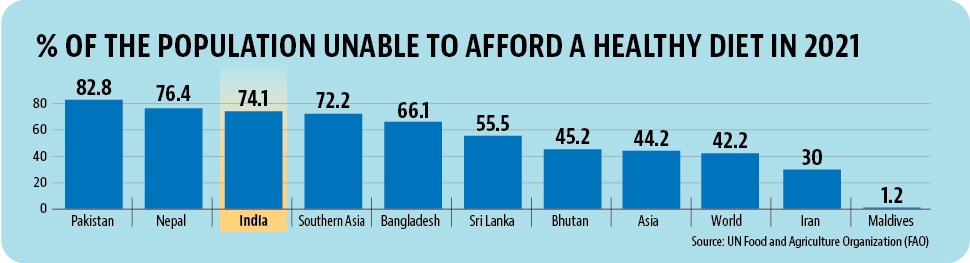
- Low food prices do not mean a balanced diet in India is affordable for mostThough the diet itself might be less expensive, almost three-quarters of India’s population could not afford a healthy diet in 2021 – more than the portion of people in South Asia overall and more than 30 percentage points greater than the same portion worldwide. Among South Asian countries (again excluding Afghanistan), FAO estimates posit that India has the third-greatest share of people who cannot afford healthy meals, following only Pakistan and Nepal. This highlights the crucial reality that costs alone do not translate to relative accessibility: People in India are overwhelmingly unable to afford quality food. In hindsight, the government providing additional free food grains to more than 800 million people after the pandemic was a policy recognition of this grim reality.
- Undernourishment in India is risingWhat is more alarming is the fact that the new UN report also shows the prevalence of undernourishment within India is on the rise – and well above the global prevalence. A global decline in undernourishment from the early 2000s till 2016 did help improve the situation in India, but in the seven years since, undernourishment has risen more dramatically in Southern Asia generally than in the world overall. This indicator, the prevalence of undernourishment along three-year averages, expresses the probability that a randomly selected individual from the population consumes an amount of calories insufficient to cover their energy requirement for an active and healthy life. According to FAO, it is computed by comparing a probability distribution of daily dietary energy consumption with a threshold level called the minimum dietary energy requirement. In India specifically, the average number of undernourished Indians – this is calculated by applying the estimated prevalence of undernourishment to total population – over the past three years (2018-2022) is the fourth highest this century. From 2020 to 2022, an estimated average of 233.9 million people per year did not receive quality food. This rise in number of poorly nourished people comes after more than 15 years of a decline. While the Covid-19 pandemic is often blamed for sharp declines in nutrition affordability, FAO data show that the rise in prevalence of poor nutrition precedes the pandemic. NOTE: The report’s “Southern Asia” category includes Afghanistan, Bangladesh, Bhutan, India, Iran, the Maldives, Nepal, Pakistan and Sri Lanka. Individual figures for Bhutan, the Maldives and Afghanistan are not reflected in every chart as such numbers are not available for all indicators of interest.