
 E-Paper



After furore, govt releases data on selection of R-Day tableaux
This year, the government has selected 22 tableaux -- 15 states, 1 union territory, and six government departments -- from a total of 56 applications (32 from states and UTs, 24, departments).


As Kerala became the latest state to complain that its tableau for the Republic Day Parade was rejected (for the second straight year) for political reasons, the government put out data on the number of proposals for tableaux received, and the number accepted.
This year, the government has selected 22 tableaux -- 15 states, 1 union territory, and six government departments -- from a total of 56 applications (32 from states and UTs, 24, departments).
Typically the government selects around 22 or 23 tableaux. The selection is made by a panel set up by the ministry of defence, which is in charge of the parade.
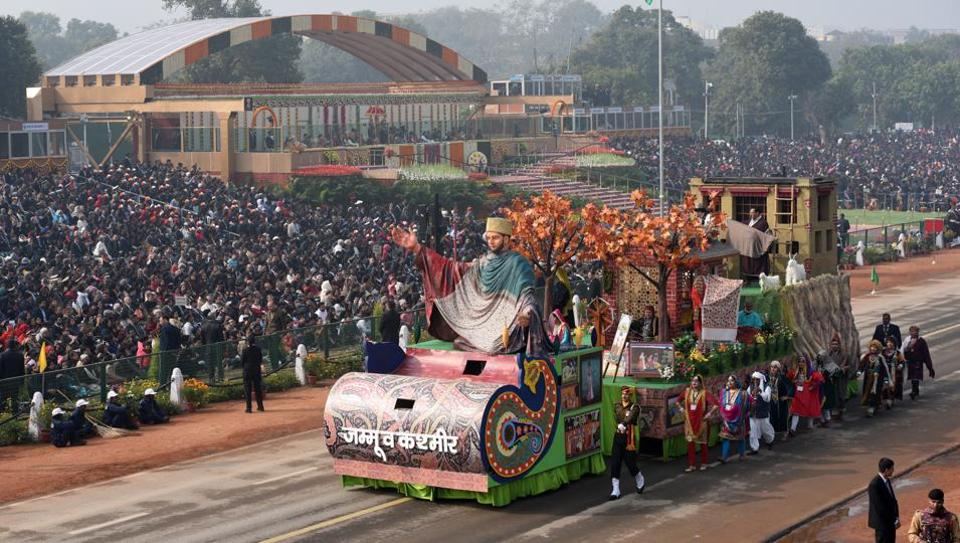
The states and UTs that are part of the parade this year are: Assam, Goa, Gujarat, Himachal Pradesh, Karnataka, Uttar Pradesh and Meghalaya (all ruled by the Bharatiya Janata Party); Odisha and Tamil Nadu (ruled by the BJP’s friends and allies); the newly-declared UT of Jammu and Kashmir; the Congress-ruled states of Chhattisgarh, Punjab, Madhya Pradesh, and Rajasthan; and regional party ruled Telangana and Andhra Pradesh.
The ministry of defence statement on the tableaux said the selection was made after five rounds of meetings.
Last year too, there were 16 states and UTs that were part of the parade. In 2018, the number was 14, and in 2017 and 2016, 17.
This year, the government departments selected are the department of promotion of industry and internal trade, department of drinking water and sanitation, department of financial services, the National Disaster Response Force, the Central Public Works Department of the ministry of housing and urban affairs and the ministry of shipping.
A government officer said on condition of anonymity that usually, the government avoids repetition of states so as to give every state and UT “ a reasonable chance for representations.” Commenting specifically on the fact that the tableau from the drinking water and sanitation department has been selected twice in two years, the official added that this merely reflects the government’s priorities.
For 2020, the drinking water and sanitation department is promoting the Jal Jeevan Mission which aims to provide piped drinking water for all by 2024, and in 2019, it did a retrospective of four years of the nationwide cleanliness campaign Swachh Bharat Mission.
To be sure, West Bengal’s tableau was part of the parade in 2019, 2017, and 2016; Maharashtra’s in 2017, 2018, and 2019; and Kerala’s in 2018.
A former government official involved in the process of organising the parade for more than a decade said that the concept of the Republic is what guides the tableau. “The army, states and UTs, and different departments of the government are part of the parade. This is a competition where all states are equal, and the selection is done by an expert committee of eminent people,” said this person, speaking on condition of anonymity.
Proposals are first made in a concept form, after which the proposals have to be executed practically in the form of a prototype, the former official said. “The prototype will have to exhibit the granular details of the concept, and it is this stage where many applicants drop out,” said the former official.
This year, West Bengal was one of the first states to protest, with the ruling Trinamool Congress alleging that it was not selected as it has criticised the ruling BJP time and again.
In response, the defence ministry said that this was entirely on merit.
Kerala and Maharashtra, also ruled by non-BJP governments have voiced their protest too. NCP leader Supriya Sule has alleged “step-motherly” treatment from the Centre. Union Minister Ramdas Athawale, who hails from the state has said that he will take up the issue with the Centre.
Kerala politicians too, have alleged mistreatment as their tableaux has not been selected for the second consecutive year. State Law Minister AK Balan said that the decision to reject Kerala’s tableau was politically motivated, as the state assembly passed a resolution against the Citizenship Amendment Act (CAA).
After the Bihar tableau’s rejection, the Janata Dal (United), an NDA ally, and the senior partner in the NDA government in the state has not protested but the state’s opposition Rashtriya Janata Dal (RJD) has alleged that Centre is “humiliating” the people of Bihar.


