E-Paper



Air India crash probe panel set to meet today
The multi-disciplinary panel, chaired by the home secretary, is mandated to submit its report within three months

 Prefer HTon Google


A high-level government committee will hold its first meeting Monday to examine the Air India flight 171 crash that has claimed at least 271 lives, even as the first funerals of passengers killed aboard the Boeing 787 took place on Sunday while most grieving families continue an agonising wait for their loved ones’ remains.
The multi-disciplinary panel, chaired by the home secretary, is mandated to submit its report within three months and will focus on “formulating Standard Operating Procedures for preventing such occurrences in the future,” people aware of the matter said, according to PTI.
Also Read: Air India flight's 2nd black box recovered; cockpit voice recorder to aid probe
The committee’s formation comes as a separate technical investigation by the Aircraft Accident Investigation Bureau continues at the crash site.
In Ahmedabad, hospital authorities confirmed the identification of former Gujarat chief minister Vijay Rupani through DNA matching, with the state government announcing Monday as a day of mourning with the national flag flying at half-mast. Rupani’s remains will be handed over to his family Monday morning for funeral in Rajkot.
Also Read:Teen who recorded viral Air India crash video ‘very scared’, records statement
However, the identification process remains painfully slow for most families. Health officials said just 87 victims had been identified by Sunday evening, more than three days after the crash – leaving over 200 still to be confirmed.
“My 72 hours are over, but I’ve not heard from them so far,” Imtiyaz Ali said , where he has been waiting to receive the remains of his brother Javed, who died alongside his wife and two children.
At the BJ Medical College, where the plane crashed, PK Mishra, principal secretary to Prime Minister Narendra Modi, conducted a review of relief efforts, visiting the crash site, meeting bereaved families at Civil Hospital, and observing DNA matching processes at Gandhinagar’s Forensic Science Laboratory.
Also Read: Air India plane crash: In first presser, Centre reveals what exactly happened on June 12
During his Ahmedabad visit, Mishra “ directed authorities to ensure compassionate assistance,” according to a state government official. He also visited injured victims and instructed officials to prioritise their treatment.
Chairing a review meeting at Circuit House later, Mishra discussed relief and investigation efforts with Central and State officials, AAIB representatives, and Airport Authority officials.
International investigation
Technical experts from the UK and a Boeing team from the US visited the crash site on Sunday as the international investigation intensified. A team of seven Boeing officials, escorted by Indian investigators, spent nearly two hours examining the wreckage at the sealed BJ Medical College hostel complex.
“They were inside for almost two hours. The debris of the plane, including all its parts, are still inside,” said a police officer guarding the complex. The aircraft’s tail section, removed by cranes Saturday, remains at the site along with other debris, all covered by sheets for protection from Saturday night’s rain.
Aviation experts from the UK also arrived on Sunday afternoon, brought by Air India officials, as the AAIB opened a second office near the hostel complex to coordinate the investigation.
The AAIB is conducting the primary technical investigation while the US National Transportation Safety Board runs a parallel probe due to the American-made Boeing 787-8 Dreamliner aircraft.
“The AAIB has launched a detailed investigation, and the US National Transportation Safety Board (NTSB) is conducting a parallel probe under international protocols since the aircraft is American-made. Officials confirmed that the Flight Data Recorder (FDR) and Cockpit Voice Recorder (CVR) have been located and secured,” an official statement said.
Ahmedabad Municipal Commissioner Banchhanidhi Pani said the debris of the plane were still at the spot and being examined by experts. “The AAIB officials will tell us where it to be taken and when. The debris across the complex is being examined by the experts,” he said.
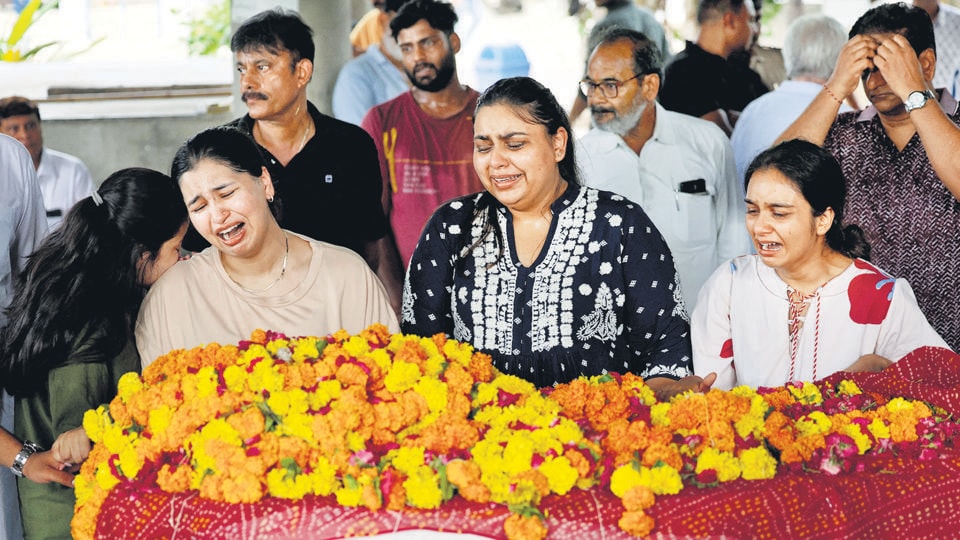
Sunday marked the first cremations of plane passengers after their remains, charred beyond recognition, were returned to families through DNA matching. Earlier, eight bodies were handed over on Friday but these were of people killed in the hostel and surrounding areas whose remains did not require DNA identification.
Families expressed growing frustration with both the identification timeline and airline response. Ali, whose brother was a passenger, said he understood the delay but criticised Air India’s support efforts.
“With Air India, the next day after this accident they should have appointed whoever they needed to ensure everything is available to us,” he said, noting he was assigned a support person only Saturday—a day after providing his DNA sample.
Air India CEO Campbell Wilson said in a video message Saturday that “over 200 trained caregivers are now in place, with each family assigned dedicated assistance.”
Recovery process
Hospital authorities have deployed extensive resources for the identification process, with three forensic science laboratory teams analysing DNA samples from relatives of 250 plane passengers so far. The process involves matching tissue samples from bones and teeth of victims with blood samples from family members.
The crash, which occurred Thursday afternoon just after take-off from Ahmedabad airport, represents India’s worst single-aircraft disaster in history, and the deadliest in three decades. The London-bound flight carried 169 Indian, 53 British, seven Portuguese, and one Canadian passenger, along with 12 crew members. Only one person—British national Vishwash Kumar Ramesh—survived.