
 E-Paper



Amid language row, RSS says all Indian languages are national languages
RSS asserts all Indian languages are national languages; emphasizes education in mother tongue amid protests over Hindi imposition. Peace efforts in Manipur discussed.

 Prefer HTon Google


The Rashtriya Swayamsevak Sangh, the ideological fount of the ruling Bharatiya Janata Party on Monday sought to quell the row over languages, and protests against the imposition of Hindi by asserting that all Indian languages are national languages and education should be imparted in the mother tongue.
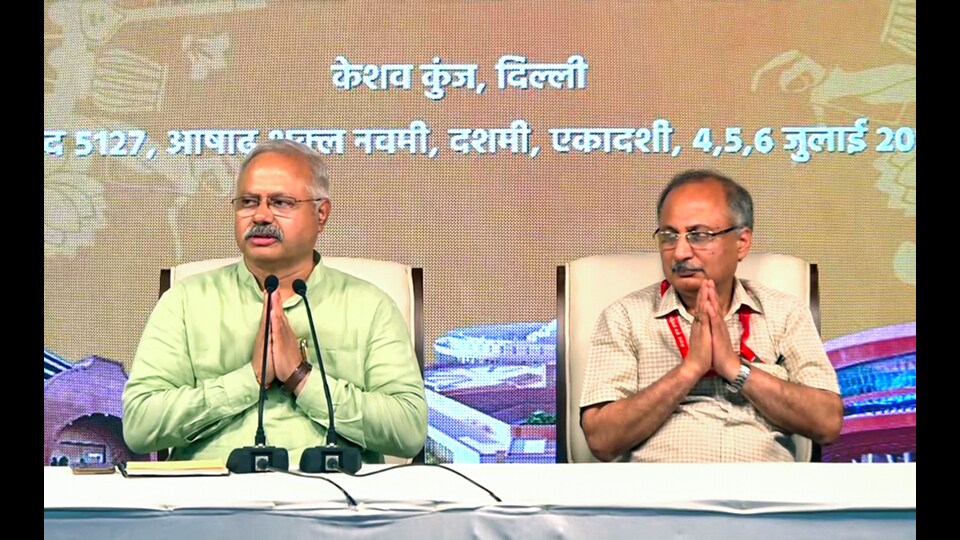
The organisation that will soon celebrate its centenary also discussed the schism between communities in Manipur and expressed hope that peace and normalcy will soon return to the strife-torn state.
“The Sangh has always believed that all Indian languages are national languages and education is being received in their own (mother tongue) language… This is already established in the Sangh,” Sunil Ambekar, the chief spokesperson of the RSS said addressing the media.
The Sangh functionary’s comment comes in the backdrop of several opposition ruled states including Karnataka and Tamil Nadu having accused the union government of pushing for the use of Hindi; and the state government in Maharashtra having to recall a circular on the teaching of Hindi as the third language in primary schools after protests. On Saturday, the two estranged Thackeray cousins, Raj and Uddhav came together and attacked the BJP-led Mahayuti government for imposing Hindi in schools.
To be sure, the RSS has consistently demanded that the mother tongue be the medium of instruction. The National Education Policy 2020 also emphasizes that the mother tongue be the preferred medium of instruction at least till Class 5.
Ambekar who was addressing the media on the conclusion of a three-day annual All India Pracharak meeting which was attended by the Sangh’s top brass including its chief Mohan Bhagwat said the discussions involved “organisational matters” and plans for the centenary celebrations that will begin with the Vijaydashami festival.
While Ambedkar declined to give details about discussions on key contemporary and political issues including the working of the BJP, the political arm of the Sangh, he said a discussion on Manipur was part of the agenda for the meeting.
“The current situation in Manipur was discussed…as was the work being done by our volunteers for social harmony,” he said.
Pointing out that it will take time for the restoration of normalcy in the Northeastern state, Ambekar said, “The Sangh’s volunteers are proactively working to restore peace and foster dialogue between the Meitei and other communities that are affected by the conflict…Notable positive developments are observed (on the ground), and in comparison to last year, normalcy has begun to return in Manipur. This is the beginning of peace.”
In strife-torn Manipur, which is presently under the President’s Rule, conflict between the Meiteis and the Kukis has left hundreds dead, and displaced thousands. In June last year, RSS general secretary Dattatreya Hosabale described the ongoing violence in Manipur as “painful” and “worrisome” and said the Sangh believes that the solution to any problem is possible only “through mutual dialogue and expression of brotherhood in a peaceful atmosphere.”
The meeting which had over 300 functionaries in attendance also took up the issue of India’s response to the terror attack at Pahalgam through Operation Sindoor which targeted terror camps and military installations in Pakistan and the attacks on Hindu temples in Canada, the US and Bangladesh.
The RSS, which lauded the union government’s new policy of designating terror attacks as acts of war, has been pushing for a muscular foreign policy and an intensified internal security mechanism. It has also consistently demanded that the government crack down on illegal immigrants. According to a Sangh functionary, there is a demand for implementing a national citizen’s register to check illegal entry which “poses a threat to internal security and demography.”
“In several states particularly in the border areas, illegal immigration has wreaked havoc with security and demography. Countries such as the US, have begun to take concrete measures to protect their soil and resources…It is imperative that Bharat also takes a look at the problem,” added the functionary on condition of anonymity.
On the Sangh’s centenary celebrations, Ambekar said an intensive outreach has been planned to take the ideology to the people and widen the social connection between the Sangh and citizens.
Hindu conferences will be organised as part of the centenary year across the country and in 1.3 lakh venues. Volunteers will also make door to door contact and reach out to people from across castes, professions and ideologies, he said.


