
 E-Paper



Amit Shah unveils National Cooperative Policy 2025 in Delhi
Shah said that the new cooperation policy is a historic step toward fulfilling Prime Minister Narendra Modi’s vision of “Sahkar Se Samriddhi” (prosperity through cooperation)

 Prefer HTon Google


Union home minister and minister of cooperation Amit Shah on Thursday unveiled the National Cooperative Policy 2025, which he said would play a key role in achieving the goal of Viksit Bharat by 2047, create large-scale livelihood opportunities, and ensure development at the grassroots level by bringing over 500 million citizens under its ambit.
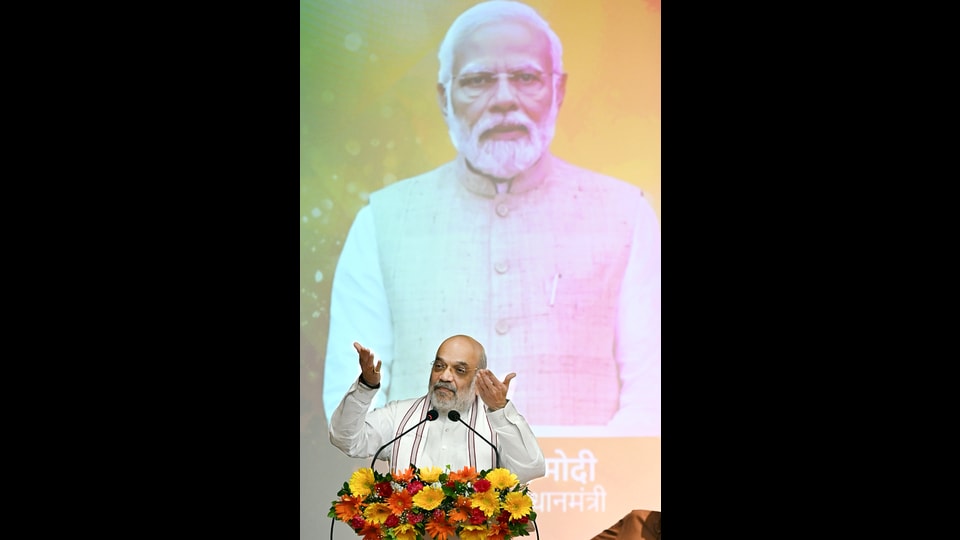
He explained that the mission of the policy is to promote small cooperative units that are professional, transparent, technology-enabled, accountable, economically self-reliant, and successful — and to ensure at least one cooperative unit is established in every village.
Shah said that the new cooperation policy is a historic step toward fulfilling Prime Minister Narendra Modi’s vision of “Sahkar Se Samriddhi” (prosperity through cooperation).
Shah said that at the core of the cooperation policy are villages, agriculture, rural women, Dalits, and Tribals.
“In 2002, the then government had brought in the cooperative policy for the first time. It was the BJP government under Atal Bihari Vajpayee. Today, in 2025, the new policy has also been brought by the Narendra Modi-led BJP government. PM Modi has set a goal of making India the third-largest economy in the world by 2027. India also holds responsibility of inclusive growth for 1.4 billion citizens. This is why, after 75 years of Independence, the cooperative ministry was set up by the PM,” he said during the launch of the policy.
The objective of the policy is to make cooperative institutions inclusive, manage them professionally, prepare them for the future, and create large-scale employment and livelihood opportunities, especially in rural India, he said. “By 2034, the National Cooperation Policy aims to triple the cooperative sector’s contribution to GDP, bring 50 crore active members into the fold, and connect youth with employment opportunities,” he added.
“In the last four years, the cooperative sector has been at par with the corporate sector at all levels, whether it is related to priority, taxation, or developmental funds for the sector. There was a time, sometime in 2020, when many experts had said that this is a dying sector. The same people now tell me that this sector has a future,” he said, adding that only the cooperative sector has the capacity to develop the nation’s economy inclusively with contributions from all 1.4 billion citizens.
The policy was prepared by a 48-member national-level committee headed by former Union minister Suresh Prabhu. This committee comprised members from national/state cooperative federations, cooperative societies at all levels and sectors, representatives of the relevant central and state government ministries/departments, and academicians.
Shah said that the end of 2025, there will be a remarkable start related to cooperatives in the taxi and insurance sector. “There will be a mechanism in which the profits will directly go to the driver,” he said.
Shah said that by 2047, every village will have at least one cooperative unit. He said that the ministry has used data to classify villages into different grades for implementation of the policy. This, he said, would ensure that gaps are identified and there is equal growth and development across the country.
“There can’t be a situation where the cooperative sector in one state is excellent, average in another, and below par in another state. We have prepared a road map to ensure the development in the cooperative sector is equal in all states. Based on data bank, we have graded them. There will be monitoring to see what states in each sector require. How can one state strengthen the other? We are working to open cooperatives in new sectors. This policy is far sighted and results-oriented. This has been prepared keeping in mind the needs and challenges of the mid-21st century. This is a member-centric model, the growth of the member is fundamental,” he said.
“There won’t be any panchayat where there is no cooperative. The cooperative societies at every level - grain, state or national - will be prepared for the challenges of the future…Cooperative societies will also be established in sectors like tourism, taxi services, insurance, and green energy through the National Cooperation Policy,” he said adding that the government under the new policy has key objective of having a 30% increase in the number of cooperative societies and the establishment of at least one cooperative society in every village.


