
 E-Paper



Ancient Chinese relics on display at National Museum as part of India, China pact
The Chinese exhibits are from the Chu civilization along the Yangtze, and made up mostly of ritual vessels and musical instruments of ancient China, dating from 5000BC to 300BC. A lot of the older exhibits are made of brass. Five Indian exhibits from the Harappan civilization have also been put up.


As part of a memorandum of understanding signed between India and China during the external affairs minister’s visit to China in August this year, the National Museum is holding an exhibition of over 100 exhibits of ancient cultural relics of the Hubei province. The relics are from the Hubei provincial museum in Wuhan that PM Narendra Modi had visited in August last year.
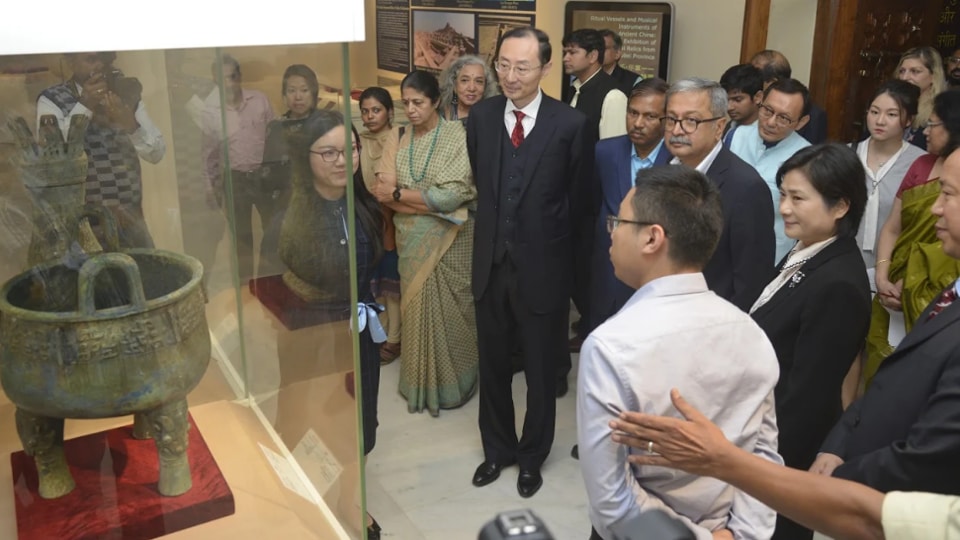
The Chinese exhibits are from the Chu civilization along the Yangtze, and made up mostly of ritual vessels and musical instruments of ancient China, dating from 5000BC to 300BC. A lot of the older exhibits are made of brass. Five Indian exhibits from the Harappan civilization have also been put up, including a lance head, mirror, weights and balances, a wheeled cart and a seal. The exhibition will be on display till January 2020.
Chinese ambassador Sun Weidong said that the Chu civilization thrived in the midst of the stretch of the banks of the Yangtze River that runs along over 1000 kilometers. “Hubei became the hub of the civilization, and most people in China believe that we are descendents of the Chu-Hang civilization. So every year, we trace our roots,” he said.
Hubei belonged to the state of Chu in ancient China and the Chinese developed a unique bronze casting technique during the Xia, Shang and Zhou dynasties which existed between 2100 BC to 221 BC
Speaking about a 230-year-old drum with a phoenix motif, the ambassador said that the exhibit, a musical instrument is an example of the unique Chinese style of bronze smelting. “The style is more than 2000 years old and it represents the highest level of Chinese bronze casting technique. There is an old saying in China where we say that the bronze alloy comes from the kingdom of truth,” said Weidong.
Raghvendra Singh, Chief Executive Officer at the Development of Museums and Cultural Spaces said that the collaboration will help in expanding the terms of reference and he hopes that the collaboration is not limited to one between India and Hubei and extends to other provinces of China and central museum institutions as well. “We are looking forward to collaborating on issues that concern us on conservation, curation, as well as issues that concern us deeply in terms of storage, visitor settings and security of the exhibits,” said Singh.
The Centre, Singh added, is working on creating a “reservoir of expertise of international best practices to draw from” for all museums across the country, including private museums.
A post-Shijiahe jade sculpture that represents the dawn of the late Neolithic period, bronzes unearthed from the Panlongcheng Site representing the bronze civilization of the Shang Dynasty in the Jianghan region, bronzes of the early period of the Western Zhou Dynasty unearthed from the Yejiashan site are part of the exhibition, as per a release from the National Museum. “It is the first time for the Yejiashan bronzes to be exhibited in a foreign country. Besides, significant archaeological discoveries at Jiuliandun Tombs and the Tomb of Marquis Yi of the State Zeng will be on show at the exhibition,” said the release.
On August 12 this year, the Indian ambassador to China Vikram Misri and Hubei Provincial Museum director Dr Fang Qin had signed a MoU in Beijing. As per the understanding, the Hubei Provincial Museum and National Museum will conduct exchanges of cultural exhibits between both countries, and both the countries are to hold exhibitions of relics of the other country. While India was to hold an exhibition in the later part of 2019 to display relics of the Chu civilization, China will hold a similar exhibition in early 2020 of relics of ancient India.
Exchanges on archaeological excavation, maintenance, protection and digital construction of cultural relics are to be held as well according to the understanding.


