
 E-Paper



Andhra govt faces uphill task to remove Kolleru Lake encroachments
The Supreme Court on January 16 directed the state government to submit a detailed status report by March 19 on the current state of encroachments in the Kolleru Lake and Kolleru Wildlife Sanctuary

 Prefer HTon Google


The Andhra Pradesh government is facing an uphill task in removing encroachments in the Kolleru lake, the largest natural freshwater lake in the country spread over three districts and a notified wildlife sanctuary, in the wake of the latest Supreme Court directions to protect the waterbody, people familiar with the matter said.
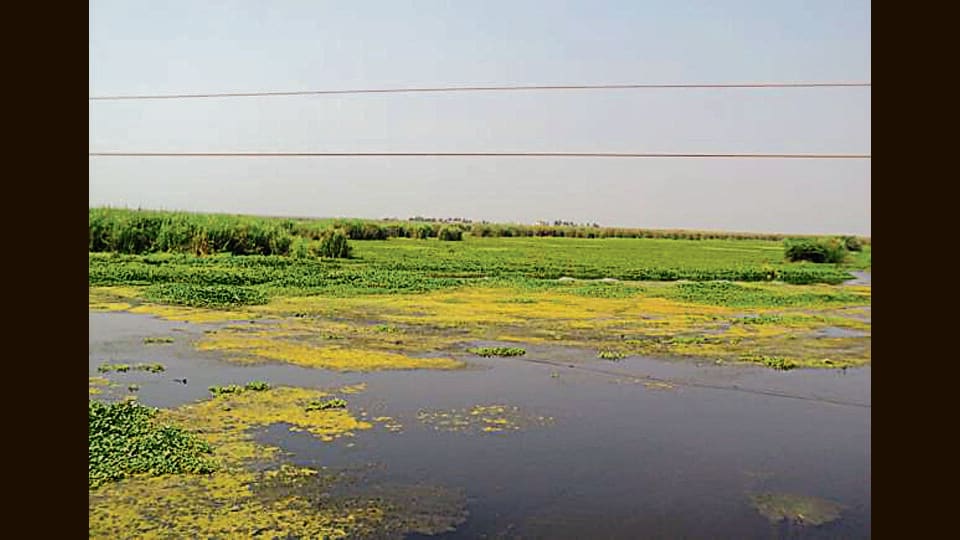
Acting on a public interest litigation filed by environmentalist K Mruthyunjaya Rao, the Supreme Court on January 16 directed the state government to submit a detailed status report by March 19 on the current state of encroachments in the Kolleru Lake and Kolleru Wildlife Sanctuary.
The Supreme Court bench, comprising Justice BR Gavai, Justice Augustine George Masih and Justice K Vinod Chandran, asked the government to explain the steps being taken to remove the encroachments, particularly aquaculture ponds and measures to ensure that no further encroachments take place in the lake, and protect the wildlife sanctuary from further damage.
Located between Krishna and Godavari delta regions in the erstwhile combined districts of West Godavari, East Godavari and Krishna districts, Kolleru lake was originally spread across 901 sqkm, covering 2.25 lakh acres at +10 contour level (10 feet above sea level), which is the identified wetland. It serves as a natural flood-balancing reservoir for these two rivers.
The lake is fed directly by water from the seasonal Budameru and Tammileru streams, and is connected to the Krishna and Godavari systems by over 68 inflowing drains and channels.
The lake was notified as a wildlife sanctuary in November 1999 under India’s Wildlife (Protection) Act, 1972, and designated a wetland of international importance in November 2002 under the international Ramsar Convention of Wetlands, 1971, as it is home to several vulnerable species and a variety of over 220 varieties of birds, including nearly 100 species migrating from the Palearctic region.
Mruthyunjaya Rao pointed out that Kolleru lake, India’s largest freshwater lake ecosystem, has been under severe threat due to large-scale encroachment of the lake by aquaculture ponds, thereby putting the flora and fauna of the sanctuary in danger.
“According to the forest department officials, nearly 15,000 acres of wetland has been converted into illegal aqua ponds within the Kolleru Wildlife Sanctuary by 2021. The aqua ponds have extended to not less than 50-60% of the sanctuary,” Rao said.
Following mushrooming of aquaculture tanks, besides unauthorised agriculture in the command area of Kolleru lake and large-scale fishermen colonies coming up in the area, the state government fixed the boundaries of the lake at +5 contour, covering an area of 308 sqkm, which is about 0.77 lakh acres.
Challenging this, environmentalists moved the court in 2001 to prevent further destruction of lake. In 2006, the Andhra Pradesh government executed “Operation Kolleru” as per the directives of the Supreme Court and demolished 1,776 aqua ponds spread over 43,000 acres within the Kolleru Wildlife Sanctuary (KWS).
The demolition of aquaculture ponds left thousands of local residents jobless, forcing several villagers to migrate to other states in search of work. However, with the 2009 elections approaching, the YSR government passed a resolution in the assembly recommending the UPA government reduce the Kolleru lake boundaries from +5 contour to +3 contour, thereby seeking to reduce the area of the lake further by another 40,000 acres of land which would help the fishermen.
According to retired IAS officer and environmentalist EAS Sarma, in the last 15 years, encroachments of Kolleru lake continue to take place and no steps were taken to remove them.
Last year, Mrutyunjaya Rao filed a contempt petition in the Supreme Court again charging the state government with wilfully disobeying the order of the apex court given in 2006, which directed the removal of all encroachments in a time-bound manner. The issue came up for hearing on January 16.
Removal of encroachments challenging
The removal of encroachments is easier said than done for the state government, as it is not only an issue of protecting the livelihood of thousands of fishermen, but also a big political issue, as it has always been a source of wealth for political parties.
“Regardless of which party comes to power, MLAs from the Kolleru region have been illegally excavating fish ponds and making crores of rupees. On the other hand, every political party promises to reduce the contour limit but backtracks once in power,” KN Raju, a local resident of Kaikaluru town in Krishna district, close to Kolleru lake, said.
“If the state government has to strictly follow the Supreme Court directions, the demand of the politicians to reduce the contour limit will have to be rejected,” he added.
During the recent hearing in the Supreme Court, senior lawyer Devadutt Kamat, who argued on behalf of the state government, admitted that there were certain difficulties on the ground, which would prohibit the government from demolishing aquaculture ponds.
“The 2006 Supreme Court order did not prohibit fishing by traditional methods, which means human activity cannot be curtailed within the lake area. This results in repeated encroachments, as more than 120 habitations exist within the lake area,” Kamat said.
On behalf of the state government, chief secretary K Vijayanand, while explaining the steps being taken to remove encroachments in Kolleru lake, pointed out that the bird population in Kolleru Wildlife Sanctuary has increased considerably. “The bird population saw about a 200% increase from 61,626 in 2018 to 182,516 in 2023,” Vijayanand said.
He, however, said the government was removing illegal encroachments and in the last three months alone, fish tanks over an area of more than 5,000 acres were removed. “However, efforts to remove encroachments are resulting in stiff resistance from locals,” the chief secretary said.


