E-Paper



Article 371 will not be touched, Amit Shah assures Arunachal Pradesh
Union home minister Amit Shah on Thursday said at a public meeting that he wants to assure the entire northeast that Article 371 will not be touched, allaying fears of tribal states.


Union home minister Amit Shah on Thursday said that the Centre will not scrap Article 371 of the Constitution, which accords special provision to most states in northeast to preserve their tribal culture.
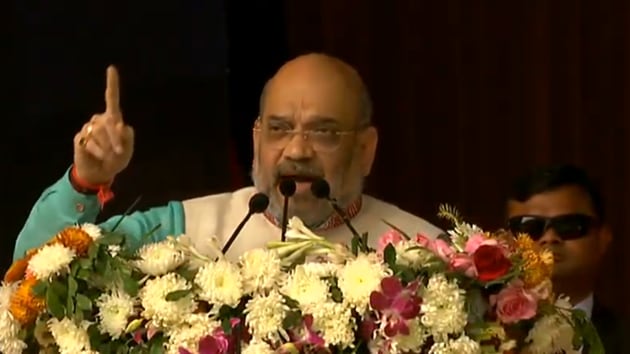
“Following revocation of Article 370 for Jammu and Kashmir in August last year, some people spread rumours that Article 371 would also be scrapped. Today I want to assure the entire northeast on the statehood day of Arunachal Pradesh and Mizoram that no one can remove Article 371 and there’s no such thought on it,” he said at a public meeting at Indira Gandhi Park in state capital Itanagar.
Shah had given the same assurance during his visit to Guwahati in September last year where he took part in a meeting of North East Democratic Alliance (NEDA), the BJP-led anti-Congress front in the region.
Watch | ‘Article 371 won’t be removed’: Amit Shah assures Arunachal Pradesh
Thursday’s event was attended by Governor BD Mishra, union minister for Development of Northeast Region (DONER) Jitendra Singh, union minister for sports Kiren Rijiju, chief minister Pema Khandu, deputy CM Chowna Mein and convenor of North East Democratic Alliance (NEDA) Himanta Biswa Sarma.
“In the last 6 years, development in Arunachal Pradesh has seen fast pace due to collaborative efforts of the government at Centre led by Narendra Modi and the state government headed by Pema Khandu,” Shah said.
Shah launched the state’s new industrial policy, inaugurated the Joram-Koloriang road constructed by Border Roads Organisation, laid foundation stones of the new police headquarters, housing complex for senior officers, a new truck terminal and flagged off sanitation vehicles.
The union home minister listed the development projects initiated by the Centre in northeast and specifically in Arunachal Pradesh in the past five years. He also listed the steps taken by the Khandu-led government.
“Our government has sanctioned road construction projects worth more than ₹50,000 crore in Arunachal Pradesh. An IIT campus in the state worth ₹430 crores has also been sanctioned,” Shah said.
Though it was the home minister’s first visit to the state after protests against the amended citizenship law started in Assam and other states of the region in December last year, he did not say anything on the issue.
In his speech, CM Khandu thanked Shah for approving the Hollongi airport — foundation stone of which was laid by Prime Minister Narendra Modi last year — and keeping the state outside the purview of Citizenship (Amendment) Act (CAA).
“Despite completing 33 years of statehood, Arunachal Pradesh doesn’t have a separate cadre for IAS and IPS. We need a dedicated team of bureaucrats as ours is a state full of challenges as well as potential,” Khandu said.
Arunachal Pradesh became a full-fledged state on February 20, 1987. Till 1972, it was known as the North East Frontier Agency (NEFA). In 1972, it became a union territory and was named Arunachal Pradesh. Mizoram, another northeastern state, also gained statehood on the same day 34 years ago.