
 E-Paper



Arunachal Pradesh-Assam border dispute to be settled by 2023: Amit Shah
Amit Shah said 9,000 militants from the region have surrendered during the last eight years of the Narendra Modi government at the Centre


Union home minister Amit Shah on Saturday said that the boundary dispute between Arunachal Pradesh and Assam is expected to be “resolved before 2023”, and asserted that the Centre is committed to bringing peace and development to the region.
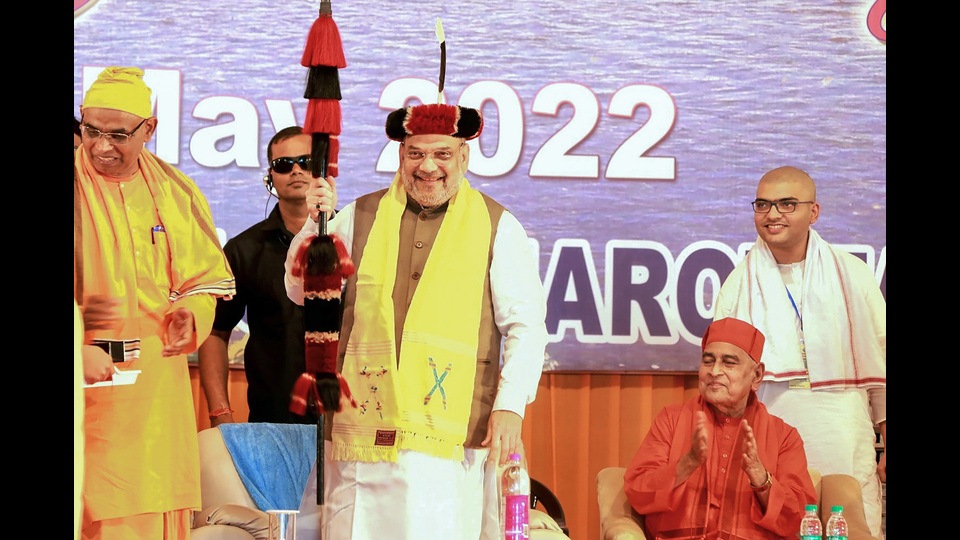
“Over 60% interstate border dispute between Meghalaya and Assam has been resolved. We hope that Arunachal Pradesh and Assam interstate border dispute will be resolved before 2023,” Shah said while speaking at the golden jubilee celebrations of Ramakrishna Mission School in Arunachal Pradesh’s Tirap district.
Assam shares an 804-km boundary with Arunachal Pradesh. Though there was no issue initially, over the years, allegations of residents of one state encroaching land on the other side have led to disputes and violence. A suit pertaining to the issue has been pending before the Supreme Court since 1989.
Last year, following the insistence of Prime Minister Narendra Modi and Shah, both states had resolved to an out-of-court settlement of their border dispute through dialogue.
Asserting that efforts are underway to make the Northeast insurgency-free, he said 9,000 militants from the region have surrendered during the last eight years of the Narendra Modi government at the Centre.
“Youths of Northeast no longer carry guns and petrol bombs. They are now carrying laptops and are launching startups. This is the path of development that the Centre has envisaged for the region,” he said.
“Manipur, which was earlier known for bandhs and blockades for more than 200 days a year, is now witnessing a sea of change without any bandh during the last five years of BJP rule in the state,” he added.
Shah said the insurgency in the Bodoland region of Assam was resolved through the signing of the Bodo Peace Accord.
“Surrender of militant groups in Tripura and resolving of the Bru refugee issue was undertaken by the Modi government. The Union home ministry has taken initiatives to bring peace to Assam’s Karbi Anglong,” he added.
The Union home minister further highlighted that a three-pronged agenda has been prepared for the development of the Northeast.
“Firstly, we would preserve and promote the indigenous cultures and languages of the region. Secondly, we want to end all disputes among the northeastern states and make it free from insurgency and thirdly, we want to make the eight states the most developed in the country,” he said.
Shah lauded PM Modi for “reducing the distance between New Delhi and the northeast ”.
“In the eight years journey of the BJP-led NDA government, the prime minister has reduced the distance between New Delhi and the northeast and treated the region as an integral part of the country which was previously not seen”. No former prime minister had frequently visited the northeast in a short span of time as Modi who did so more than 50 times in the last eight years, he added.
“With good road, air and train connectivity besides infrastructure development, Modiji has connected Northeast with the rest of India,” he said.
Shah, who is on a two-day visit to the northeastern state, also unveiled an 18ft statue of Swami Vivekananda on the premises of Ramakrishna Mission School besides inaugurating its new hostel building and administrative block.
During the address, Shah also hailed the New Education Policy (NEP) 2020 for aiming “to create youth who can compete with the youth from foreign countries”.
The border dispute between Arunachal Pradesh and Assam has its genesis in 1873 when the British started the inner-line regulation, creating an imaginary boundary between the plains and hill areas in the north of Assam. The inner-line regulation, which still exists, requires people from outside Arunachal Pradesh, to take permits before entering the state.
This area ‘separated’ from Assam was initially called the North-East Frontier Tracts and later North-East Frontier Agency (NEFA) and was under the administrative jurisdiction of Assam post-Independence.
In 1972, NEFA was renamed Arunachal Pradesh and granted the status of Union territory before becoming a full-fledged state in 1987. But before it got its present boundaries, a committee headed by former Assam chief minister Gopinath Bordoloi transferred around 3,650 sq km of territory, which was earlier with NEFA, to Assam.
This transfer done without consultations with the people or administration of NEFA is the main bone of contention between the two states, with Arunachal Pradesh refusing to recognise it.
In March, Assam and Meghalaya CMs had inked a deal in New Delhi in the presence of Shah to resolve six of the 12 points of dispute along their border.
The agreement between Assam and Meghalaya, which favours a give-and-take formula, was formulated after both states created several committees comprising ministers, visited the disputed areas and interacted with residents. According to the deal, Assam would get 18.51 sq km of the total 36.8 sq km disputed area while the rest would go to Meghalaya.
Besides Meghalaya and Arunachal Pradesh, Assam also has border disputes with Mizoram and Nagaland, which were also carved out of Assam.


