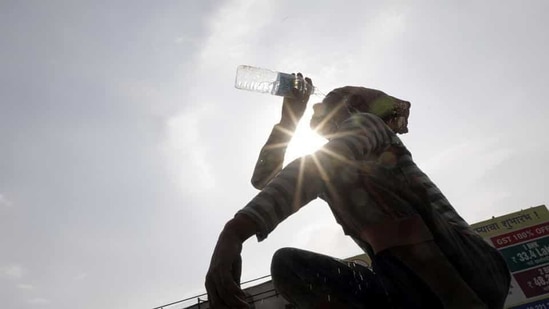
At 44.2 degree C, Bhubaneswar breaks 78 year record for temperature in March
In February too, Bhubaneswar's maximum temperature broke its last 58 years record as it soared past the 40-degree Celsius mark.
Bhubaneswar on Wednesday registered the highest temperature recorded in the month of March with the mercury reaching 44.2 degree Celsius in the city for the first time since 1948, when it was first made Odisha's capital. The city’s previous high of 42.2 degree C was recorded on March 21, 2016, said officials of the Regional Meteorological Centre.

Apart from Bhubaneswar, temperatures in 12 other cities in Odisha went past the 40-degree Celsius mark. Baripada, which recorded a temperature of 44.6 degree Celsius on Tuesday, the highest in the country, too sizzled at 43.6°C.
In February too, Bhubaneswar's maximum temperature broke its last 58 years record as it soared past the 40-degree Celsius mark.
Officials said the heat wave, which was likely to continue for another 24 hours was due to the influence of dry westerly winds prevailing in the lower levels and local heating and contraction of dry air near surface level.
According to the Met department officials, heat wave conditions were likely to prevail at many places along with severe heat wave at isolated places in as many as 21 districts of the state including Sundargarh, Sambalpur, Jharsuguda, Keonjhar, Mayurbhanj, Deogarh, Bargarh, Angul, Dhenkanal, Sonepur, Boudh, Kandhamal, Nuapada, Balangir, Kalahandi, Nayagarh, Khordha, Cuttack, Jajpur, Bhadrak and Balasore.
Earlier in March, the heat wave led to wildfires in Similipal tiger reserve of Mayurbhanj district, engulfing and endangering the flora and fauna in the park. According to officials, the forest fire spread to over 47 different areas under the south zone of Similipal forest range. On Tuesday, Baripada town of Mayurbhanj recorded 44.6 degree Celsius temperature, the highest in the country.
ABOUT THE AUTHORDebabrata MohantyDebabrata Mohanty is a senior assistant editor of Hindustan Times who works as state correspondent from Odisha covering the state's politics, governance, public policy, natural disasters, environment and its society for close to three decades. With his long years of reporting from the state capital of Bhubaneswar, Mohanty has been known as one of the most experienced and credible journalists covering Odisha for the national English dailies. His reporting combines on-ground detail with deep institutional knowledge detailing the state's changing politics, governance issues, administrative reforms and the functioning of its public institutions. He has regularly reported on issues ranging from legislative developments and public policy implementation. Politics is his core areas of expertise as he closely tracks Odisha's political landscape, including the rise and transformation of the Bharatiya Janata Party (BJP), the Biju Janata Dal (BJD), the two principal political parties in Odisha. His long association with the state's political establishment enables him to write on contemporary developments in a larger political context. Mohanty takes a deep interest in writing human interest stories, environmental issues and documenting the impact of cyclones, floods, heatwaves, and other climate-related events in one of the most disaster-prone states. His coverage extends to public health, governance reforms and stories on accountability of government institutions. Before joining Hindustan Times, Mohanty worked with The Indian Express, Mail Today, and The Telegraph, where he covered at least six general elections and as many assembly elections. In 2007, he was selected for the prestigious Chevening Young Indian Print Journalist Programme at the University of Lincoln, United Kingdom, where he received advanced training in print journalism. In 2009 he won the Press Institute of India-International Committee of Red Cross award on conflict reporting for his on-ground reportage of 2008 Kandhamal riots.Read More

E-Paper