E-Paper



At NAM meet, PM Modi calls for new order of globalisation
In line with his addresses at multilateral meetings held after the Covid-19 crisis began, Modi’s speech at Monday’s video conference too focused on the need to fashion a new world order after the pandemic.

 Prefer HTon Google


The coronavirus disease (Covid-19) crisis has exposed the limitations of the existing international system and the world needs a new framework of globalisation and international institutions that are more representative, Prime Minister Narendra Modi said on Monday.
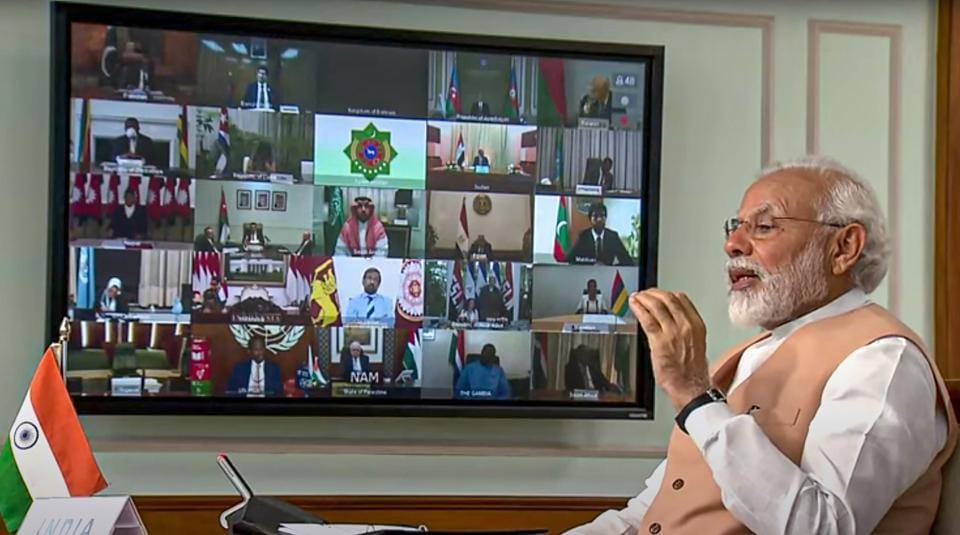
Addressing a summit of the Non-Aligned Movement (NAM) for the first time since he assumed office in 2014, Modi said efforts to promote human welfare will have to go side by side with measures for economic growth in a post-Covid-9 world order.
Modi, who has pushed efforts to organise a coordinated response to the Covid-19 pandemic in the region and beyond by organising a video conference of leaders of the South Asian Association for Regional Cooperation (Saarc) and joining a special summit of the G20, skipped the last two NAM summits in 2016 and 2019.
In line with his addresses at multilateral meetings held after the Covid-19 crisis began, Modi’s speech at Monday’s video conference too focused on the need to fashion a new world order after the pandemic. NAM, he said, can promote global solidarity at a time when humanity is facing its most serious crisis in many decades.
“Covid-19 has shown us the limitations of the existing international system. In the post-Covid world, we need a new template of globalisation based on fairness, equality and humanity. We need international institutions that are more representative of today’s world, we need to promote human welfare and not focus on economic growth alone,” Modi said.
India has backed initiatives to help fashion a better world order, such as the International Solar Alliance to “help our planet heal from the disease of climate change”, the Coalition for Disaster Resilient Infrastructure to “protect ourselves against climate and disaster risks”, and the International Day of Yoga, he added.
Without naming any country, Modi also said: “Even as the world fights Covid-19, some people are busy spreading other deadly viruses such as terrorism, fake news and doctored videos to divide communities and countries.”
Amid the Covid-19 crisis, he said, India has shown “how democracy, discipline and decisiveness can come together to create a genuine people’s movement”. India has helped other countries to counter Covid-19 and promoted coordination in its immediate neighbourhood, he said.
“India is regarded as a pharmacy of the world, especially for affordable medicines. Despite our own needs, we have ensured medical supplies to over 123 partner countries, including 59 members of NAM,” Modi said. India has also organised online training to share its medical expertise with others and is active in global efforts to develop remedies and vaccines.
“Many countries organise military drills but India had taken the initiative to organise disaster management drills in our region and beyond. NAM should call upon the international community and the World Health Organization to focus on building health capacity in developing countries,” he said.
The NAM should also ensure equitable, affordable and timely access to health products and technology and develop a platform where all member countries can pool their best practices, crisis management protocols, research and resources, he added.
“In the founding spirit of the movement, let us aim today to come together, not grow apart… Let us work as partners towards an inclusive and cooperative global response,” Modi said.
India played a major role in the establishment of NAM in 1961 but in recent years, the organisation of 120 developing countries has not been a key part of New Delhi’s multilateral diplomatic initiatives. India continues to have robust ties with key members of NAM from Asia, Africa and the Arab world but New Delhi’s decision not to join the organisation’s summits at the level of the prime minister after 2012 reflected the rebalancing of diplomatic equations.
Azerbaijan, the current chair of NAM, organised the virtual summit on Monday to forge a united response to the Covid-19 pandemic. It said the summit was aimed at mobilising NAM member states to fight Covid-19 and to strengthen multilateralism.
More than 30 heads of state and government and other leaders from Asia, Africa, Latin America and the Caribbean joined Monday’s meeting, which was also addressed by UN General Assembly president Tijjani Muhammed Bande, UN Secretary General Antonio Guterres, EU high representative Josep Borrell and WHO director general Tedros Ghebreyesus.
The NAM leaders identified requirements for remedies and called for action-oriented follow-up measures. Following the summit, the leaders adopted a declaration underlining the importance of global solidarity in the fight against Covid-19, and announced the creation of a task force to identify the requirements of member states in terms of medical, social and humanitarian needs.