
 E-Paper



At top panel meet on China border, India reviews troop pullback and possible red flags
The top panel assessed the deployment of Chinese troops close to the Line of Actual Control (LAC). A point made at the meeting more than once was that the PLA needs to withdraw from all areas along the 1,597 km LAC in Ladakh as well as along the 1,126 km LAC in Arunachal Pradesh.

 Prefer HTon Google


India’s top strategy group on China led by National Security Advisor Ajit Doval met on Wednesday to review the withdrawal of People’s Liberation Army (PLA) soldiers from the standoff points in eastern Ladakh and decide the government’s next steps.
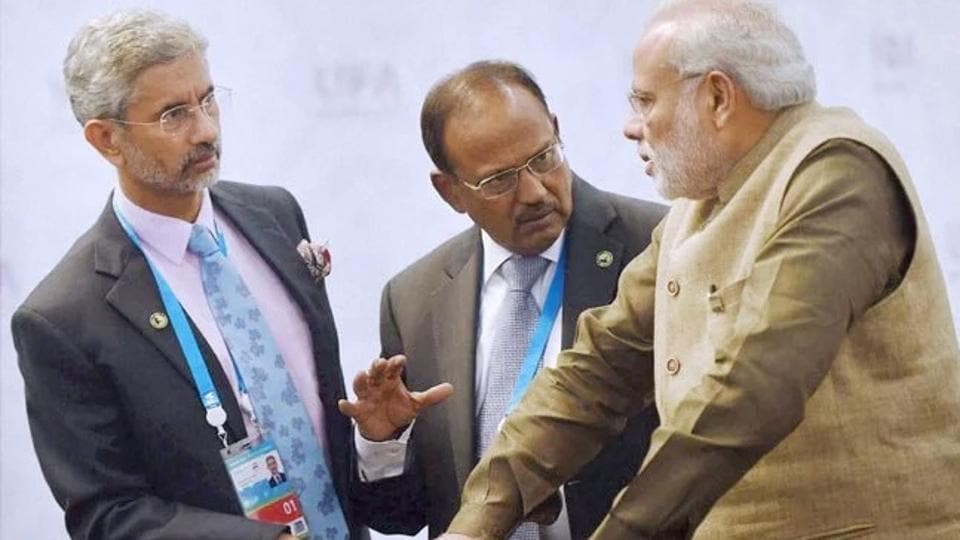
This was their first meeting after Chinese troops started withdrawing troops from three of the standoff points after Ajit Doval’s two-hour-long conversation with Chinese foreign minister Wang Yi on Sunday evening, people familiar with the development told Hindustan Times.
Doval will have a second conversation with Qang Yi in about three weeks when the two sides will discuss the border situation again before the next step of de-escalation is ordered.
Apart from the country’s top civil servant Cabinet Secretary Rajiv Gauba, officials of the ministries of defence, external affairs and home, Wednesday’s meeting of the China Study Group was also attended by some special invitees including some senior ministers.
Also Read: NSA Ajit Doval talks to China’s Wang Yi, troops pulled back along LAC: Read full statement here
Government and military officials said the Chinese troops are falling back from Patrolling Point 14 (Galwan Valley), Patrolling Point 15 (Hot Springs) and Patrolling Point 17 (Gogra) in Ladakh’s Galwan region. The Galwan Valley, or Patrolling Point 14, was the site of the violent scrap of June 15 that led to casualties on both sides. It is here that the Chinese PLA has withdrawn around 1.5km with its tents dismantled and armoured personnel carriers pulled back.
The thinning out of Chinese soldiers is the slowest around the fourth standoff point near Pangong Tso, the saltwater glacial lake spread across 700 sq km. It is here that, according to the Indian assessment, the Chinese forces had an edge over Indian troops since they have built a road up to Finger 4 - the finger area refers to a set of eight cliffs jutting out of the Sirijap range that overlooks the lake - and had set up bunkers, pillboxes as well as observation posts.
Field reports have indicated that the Chinese PLA Air Force activity has declined considerably in the Ladakh sector but the PLA ground troops are fully deployed, and on high alert in the depth areas of both Tibet and Xinjiang region. There is also a build-up across the Arunachal Pradesh LAC.
Also Read: ‘India on treasure hunt to find what happened in Galwan’: Chidambaram
At Wednesday’s meeting, government sources told Hindustan Times, the study group also made an assessment of the deployment of PLA troops close to the Line of Actual Control (LAC). A point made at the meeting more than once was that the PLA needs to withdraw from all areas along the 1,597 km LAC in Ladakh as well as along the 1,126 km LAC in Arunachal Pradesh.
For one, government and military officials pointed that the Chinese troops continue to remain in an aggressive posture in the Depsang Plains at 17,000 feet or the Raki nullah area. The Raki Nullah near Burtse is key to Indian patrolling in the Depsang plains and has seen incursions by the Chinese side on more than one occasion. One such incursion that was quickly detected by the border guards in April 2013 also led to a face-off between two sides. This Depsang incursion at Raki Nullah was designed to prevent the Indian patrols from reaching Points 10, 11, 11A and 13. Patrolling Point 12 lies outside the patrol line.
A top military commander said the army had also scaled up its presence in the area to match the adversary in troop numbers and support elements as a precautionary measure.
Also Read: Analysts in Beijing link Doklam to Galwan, say India aggressor in both cases
Government officials said it was on account of a gradual, and graded pullback of troops by the Chinese side that New Delhi had adopted a cautious approach and in the Ladakh sector, closely tracking troop movements around Pangong lake and Depsang plains as well.
Some officials believe that the softening in Beijing’s stand, which came a day after Prime Minister Narendra Modi’s Ladakh visit, could have been influenced by Washington deploying its two US supercarriers for exercises in South China Sea and the need for Beijing to focus its energies on that side of its boundary dispute with ASEAN, Japan and Australia.
There may not be a link between the American stepping up pressure over the South China Sea and the Ladakh standoff, an official said, “but it just turned out to be bad timing for the Chinese”.
The official suggested it is possible that China may believe that there was a link between India’s stand in Ladakh and the US belligerence in the South China Sea and could calibrate its troop withdrawal from Ladakh in line with easing of tensions with the US in the South China Sea.
The United States is working hard to mobilise support against China and will reach out to the European Union, US Secretary of State Mike Pompeo told a news conference on Wednesday.
Pompeo referenced the large number of boundary and maritime disputes that China had opened with its neighbours to accuse it of practising a revisionist approach to enlarge its territory. “There aren’t many neighbours that can satisfactorily say that they know where
their sovereignty ends and the Chinese community party will respect that sovereignty. That is certainly true now for the people of Bhutan as well,” Pompeo - who referenced his conversations with Foreign Minister S Jaishankar - said, underscoring that the world will come together to respond to China “in a way that is powerful and important”.
The Trump administration, who had earlier declared that the US was moving its military resources from Europe to focus on the threats from China, has already parked its two US aircraft carriers - USS Ronald Regan and USS Nimitz - to add muscle to its allies in southeast Asia. Analysts say that the US and PLA are using missions in the South China Sea to send a message to each other in the absence of any direct communication.
US aircraft carriers Ronald Reagan and Nimitz are exercising full spectrum in the South China Sea and clearly laying down red lines for China on Taiwan. Of particular interest is the Bashi Channel, the waterway between the Philippines’ Y’Ami Island and Taiwan’s Orchid Island from where undersea internet cables run down to South East Asia, and Taiwan. The channel is also an important passage for military operations by the US and China.


