E-Paper



Battered infra hobbles rescue ops in Uttarakhand; many missing
Relief teams recovered two bodies on Wednesday and personnel on the ground warned that this number would likely spiral. The toll from the diaster remained unclear

 Prefer HTon Google


Rescuers in Uttarkashi dug through mounds of mud and debris on Wednesday to unearth bodies and locate potential survivors, a day after flash floods ploughed through a clutch of villages in the upper reaches of Uttarakhand, wrecking dozens of buildings and sweeping away several people.
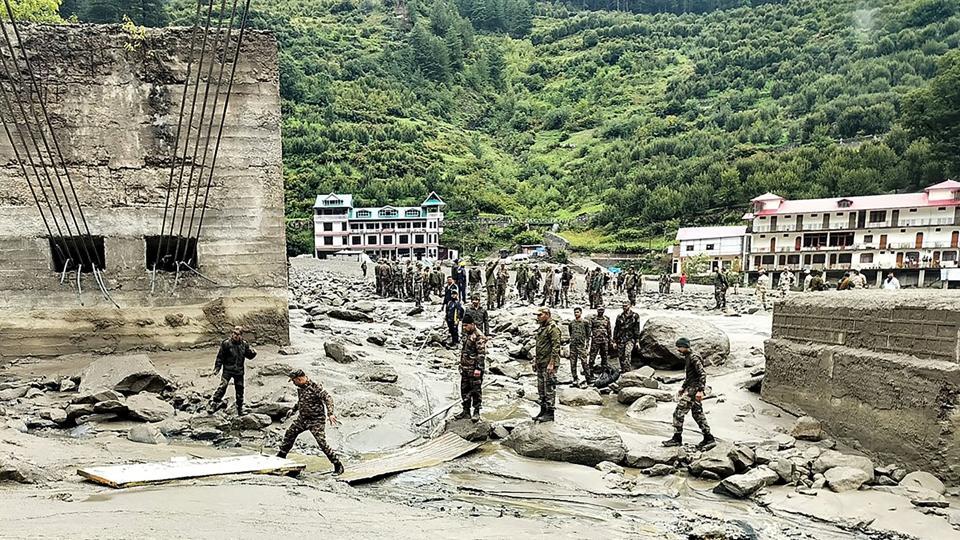
Relief teams recovered two bodies on Wednesday and personnel on the ground warned that this number would likely spiral. The toll from the diaster remained unclear.
The trigger for Tuesday’s carnage, initially seen as cloudbursts, was unclear; experts from the National Disaster Management Authority (NDMA) said they were examining the possibility that a glacier collapse upstream of the channel feeding Kheer Ganga set off the mayhem.
Arpan Yaduvanshi, SDRF commandant (Uttarakhand) said that till 6pm, around 190 people, including 11 army personnel, had been rescued in Dharali.
“The injured army personnel have been airlifted to Dehradun.”
Joint teams from state and central forces continued working to rebuild roads and bridges wrecked after the disaster. Families waited anxiously for updates, as officials underscored that the scale of the disaster made the chances of survival grim.
Rakesh Panwar’s brother, sister-in-law, and their three-year-old son are among those missing. “My brother Sushil had gone home for lunch, just a kilometre away. Moments after the cloudburst, he called me in shock, saying, ‘Nothing is left. Mukesh, Vijeta, and Anik couldn’t escape the deluge… ’,” said Rakesh, who works in Uttarkashi town.
Visuals showed entire houses caked in sludge, with vehicles, telephone lines and pieces of buildings sticking out of the mud, even as the swollen Kheer Ganga and Bhagirathi rivers roared furiously past the villages.
Heavy to very heavy rainfall will likely continue in Uttarakhand for the next 24 hours and but will likely reduce thereafter, the India Meteorological Department forecast. But light to moderate rain is likely to continue over the western Himalayas for the next seven days.
Hundreds of personnel from the Indian Army, Indo-Tibetan Border Police, Border Roads Organisation, State Disaster Response Force (SDRF) and local police were parachuted into Dharali, Harsil and Sukki, the villages worst hit by the rain and mudslides.
Connectivity to Dharali from Uttarkashi, 60km away, remained a major challenge. A 100-metre section of road at Bhatwari, 50km away, caved in and a bridge at Limchagad was washed away, cutting off the shortest access to the affected villages.
Authorities said efforts were underway to re-establish access, with six BRO officials and more than 100 labourers working to rebuild the damaged links. Teams from the Nehru Institute of Mountaineering and SDRF have begun constructing a temporary footbridge at Limchagad to allow relief material to be delivered.
Personnel navigated the damage with temporary pontoon bridges and using rope tied around stable ground. Authorities airdropped food, medicines and other essential supplies.
Chief minister Pushkar Singh Dhami visited Dharali village. “The entire state government stands firmly with the people of Dharali in this difficult time. Our priority is to provide relief to every affected person and restore normalcy at the earliest,” the chief minister said, adding that senior officials have been put on 24x7 emergency duty and are monitoring the situation closely from the State Emergency Operations Centre in Dehradun.
Earlier in the day, PM Narendra Modi spoke to Dhami over the phone and was briefed about the relief efforts.
Experts suggested that the heavy rains may have been down to a glacier burst. “There are indications that a glacial snout at 6,700 m detached some days ago and large glacio-fluvial debris deposits collected. Incessant rain over the past few days is believed to have led to loosening of the debris. Once critical mass was crossed, the massive collection of debris cascaded downstream with water in the Kheer Ganga, accelerating due to the steep gradient up to Dharali,” said Safi Ahsan Rizvi, Advisor (Mitigation), NDMA and executive director, National Institute of Disaster Management.
The state was rocked by a GLOF on February 7, 2021, when a failure of huge rock mass along with dislodgement of a glacieret caused an air blast and dust clouds in the higher reaches of Garhwal Himalayas (Nanda Devi ranges).
This event brought an unprecedented level of debris flow in the Raunthi Gadhera, Rishiganga, and Dhauliganga river valley in the Jyotirmath block of the Chamoli district, according to NDMA, killing over 200 workers who were stuck in tunnel of the under construction Tapovan Vishnugad Hydropower project.