Beginning Saturday, the Punjab Police launched a massive crackdown on Khalistan secession campaigner Amritpal Singh, 30, the chief of “Waris Punjab De”. The events since that day have been as dramatic as Singh’s life that saw him return from Dubai in 2022 to assume leadership of the organisation once led by actor Deep Sidhu, and lead calls for a separate Khalistan, drawing the ire of state and central agencies. Since Saturday, over 114 Waris Punjab De members have been arrested; guns and ammunition recovered; and five members charged under the National Security Act, 1980, and moved to a jail in Assam’s Dibrugarh.
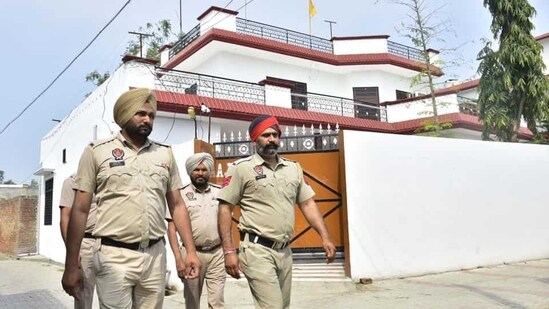
Punjab police personnel walk in front of house of Waris Punjab De Chief Amritpal Singh at village Jallupur Khera, Amritsar.
Since Saturday, there has been an internet shutdown in Punjab, and flag marches by police in multiple cities and villages. There’s no news of Singh himself, though, with some claiming that he has already been detained under NSA, and others that he has thus far evaded arrest, allegedly dodging the police after a car chase through villages and towns in Punjab, with the police describing his arrest as a “matter of time”.
But the operation to arrest Singh and round up his organisation, HT has learnt from multiple stakeholders both in Punjab and the Centre, was put into motion weeks in advance with multiple agencies involved in drafting and executing a plan that would avoid any collateral violence particularly in a security sensitive state such as Punjab. To be sure, some experts have questioned the wisdom of the state waiting for three weeks after the violence at Ajnala to act against the radical.
Officials told HT that the crackdown on Amritpal’s supporters is being coordinated by New Delhi, and executed by the Punjab Police. Over the past three weeks, particularly since the violent scenes in Ajnala where Amritpal Singh led a violent horde of supporters to lay siege to the police station to demand for the release of an aide accused of kidnapping and assault, the Intelligence Bureau, Research and Analysis Wing (RAW), other intelligence agencies and the Punjab Police have been working on a plan that could be effected before things “became uncontrollable”.
As reported by HT, intelligence agencies believe that Amritpal Singh was in touch with Pakistan’s spy agency Inter Services Intelligence when he was in Dubai, and was even sent to Georgia for training before he arrived in India in 2022. “Avtar Singh Khanda, Amritpal Singh’s handler, is also a close aide of Paramjit Singh Pamma, associated with Babbar Khalsa International (BKI) and is known for holding theoretical radical training classes for Sikh youth. The idea was to destabilise Punjab through ideological indoctrination and give Amritpal influence in the region,” HT reported on Saturday, citing an unidentified intelligence operative.
Officials in central agencies said that though they are “not on the ground themselves”, they are in constant touch with their Punjab Police counterparts in the manhunt for Singh, relaying information about his possible movements, or any attempts to mobilise supporters. “Since September 2022 itself, RAW, IB and other agencies have been gathering information about Amritpal’s history, his associates and handlers abroad, funding pattern, and it was clear from various assessments that he was propped up by the ISI,” said an official in one of the intelligence agencies at the Centre.
“After his recent statements propagating violence, taking up arms and threatening political leaders including Union home minister Amit Shah and Punjab chief minister Bhagwant Mann as well as the Ajnala police station attack, Punjab police was on the same page with central agencies that he needs to be tackled before time runs out,” the officer added.
It is believed that the genesis of the plan dates back to March 2, during a meeting between Union home minister Amit Shah and Punjab chief minister Bhagwant Mann. Accompanying Mann to Delhi on that day was Punjab director general of Police Gaurav Yadav, who held meetings separately with senior officials of central agencies to map the operation. Last week, the Union home ministry sent 18 companies of central armed paramilitary forces to Punjab in “aid of the state government during law and order activities”. Of the 18 contingents, eight have been drawn from the Rapid Action Force.
The decision to take key Waris Punjab De members to Assam was also a considered strategy, discussed in meetings between the state and central agencies, intelligence officials said. On Sunday morning, four people — fund raiser Daljit Singh Kalsi, Bhagwant Singh, Gurmeet Singh and “Pradhanmantri” Bajeka — flanked by a Punjab Police team were flown to Assam and are now lodged in Dibrugarh central jail. “As a strategy, it was decided to keep key players out of Punjab to avoid any attack or mass protests by Amritpal’s supporters. A similar approach was taken during crackdown on the Popular Front of India (PFI) as well in September 2022, when most of the senior leaders of now-outlawed radical outfit were brought to Delhi,” said a second official.
Assam, police officers said, was chosen for two main reasons — it has a marginal Sikh population (0.07% according to the 2011 Census), and is far from Punjab. Delhi, for instance, also ruled by the Aam Aadmi Party, was ruled out in light of the sustained farmers protests, and proximity to Punjab.
On Sunday, Assam chief minister Himanta Biswa Sarma called the detainees being brought to Assam an example of “police to police cooperation”.
“When at one point there were arrests in Assam, we had flown some accused to Bihar’s Bhagalpur jail due to security reasons. Punjab police may have thought it is better for the suspects to be in Assam,” Sarma said. On Monday, Assam’s inspector general of police (law & order) visited Dibrugarh Central Jail to review security arrangements.
A senior Punjab government functionary said, “Keeping them in Punjab was not safe at all as state jails are infamous for notorious activities. Union Government officials also rejected the idea of keeping the detainees in Tihar jail as it has several Khalistan sympathisers already lodged in that prison.”
The decision to invoke the NSA against five functionaries itself was an important element in the security operation. On Monday, the Punjab’s inspector general of police (headquarters) Sukchain Singh Gill announced that the act had been invoked against the four men that were flown to Assam, as well as Harjit Singh, who surrendered early on Monday morning. Harjit, who is Amritpal’s uncle, is also likely to be taken to Assam, officers said.
Under the NSA, any central or state government may detain a person “with a view to prevent him from acting in any manner prejudicial to the security of the State; acting in a manner prejudicial to the maintenance of public order; or from acting in a manner prejudicial to the maintenance of supplies and services essential to the community”. Importantly, Section 5 states that detainees may be removed from one place of detention to another state. “The maximum period for which any person may be detained in pursuance of any detention order which has been confirmed under section 12 shall be twelve months from the date of detention,” the act adds.
Officials said that the Union home ministry first sounded out the Assam government on the plan, and that Punjab sent a formal request a day before the operation was launched. “Punjab Government requested the Assam government and they admitted our detainees. We have followed all due procedures that are bound to be followed under NSA,” Sukchain Singh Gill said on Monday.
With Amritpal still on the run, home minister Amit Shah on Monday instructed BSF and the SSB to remain on alert, ministry officials said. The two paramilitary forces guard the borders with Pakistan, Bangladesh and Nepal. Home ministry officials said that photos of the fugitive have been shared with the two forces, and BSF officials confirmed they are on high alert to prevent a possible escape attempt.

 E-Paper