E-Paper



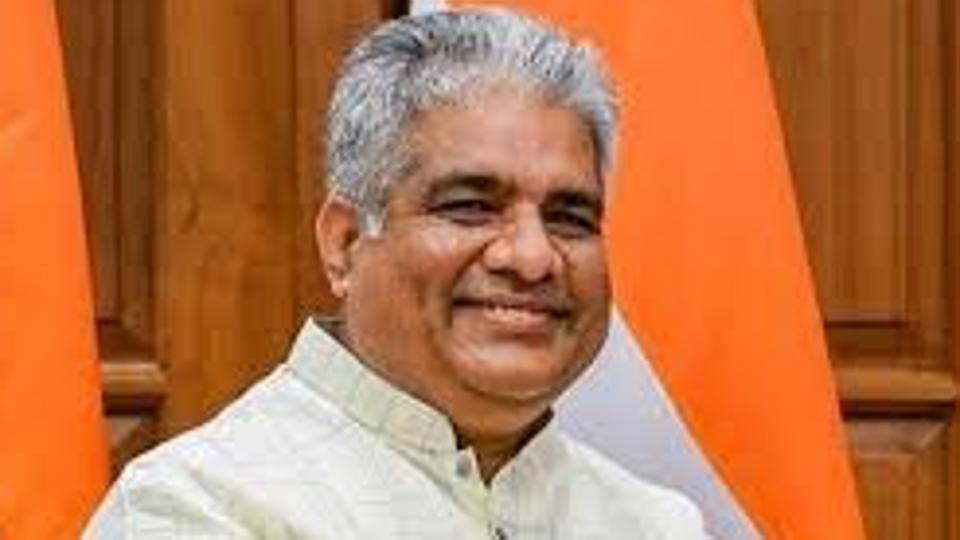
Bhupender Yadav to attend Pre-COP30 in Brasilia, G20 climate meetings this week
Union environment minister Bhupender Yadav will attend pre-COP30 meetings in Brasília on October 13–14, followed by the G20 environment ministers’ meeting in Cape Town on October 16–17

 Prefer HTon Google


New Delhi:Union environment minister Bhupender Yadav will attend pre-COP30 meetings in Brasília on October 13–14, followed by the G20 environment ministers’ meeting in Cape Town on October 16–17, where India is expected to outline its climate strategy.
Although it is not part of the official United Nations Framework Convention on Climate Change (UNFCCC) event calendar, the pre-COP is part of a series of meetings held throughout the year in preparation for the Climate Conference. The ministerial-level gathering will bring together climate negotiators and seek to facilitate consensus on key issues for COP30, which will be held in Belém, Pará, from November 10 to 21, according to the COP30 Presidency.
Around 65 delegations from UNFCCC member countries have been invited to attend the event, which is traditionally organised by the host country about a month before the Climate Conference.
More than 600 participants are expected, including delegates and observers. The meeting will be held at the Brasil International Convention Center (CICB). “Pre-COP30 offers an opportunity for countries to collectively reflect on the 10 years of the Paris Agreement’s entry into force, as well as on its challenges and opportunities. The meeting will also address topics such as adaptation, the just energy transition, and a follow-up on the Global Stocktake (GST), as well as key issues for climate action, such as forests and renewable energy,” the COP30 Presidency has said.
The opening of the meeting is expected to be attended by President Lula da Silva; minister of foreign affairs Mauro Vieira; minister of the environment and climate change Marina Silva; minister of indigenous peoples Sonia Guajajara; and minister of finance Fernando Haddad. In addition to these and other authorities, the president of COP30 ambassador André Corrêa do Lago; executive director of COP30 Ana Toni; and secretary for climate, energy and environment ambassador Mauricio Lyrio, will also be present.
COP30 is about to take place amid geopolitical disruption, as the US—the largest historical greenhouse gas emitter—has withdrawn from the Paris Agreement. The European Union, which otherwise plays a lead role in climate negotiations, is yet to submit its nationally determined contributions (NDCs).
HT reported on October 8 that India has finalised its first national adaptation plan, which is likely to be unveiled ahead of or at the UN Climate Meeting (COP30) in Brazil’s Belém.
The national adaptation plan and an update to India’s NDC for the 2035 period are currently under review and expected to be taken up for Cabinet approval very soon, people aware of the matter said.
India has already achieved one of its NDCs under the Paris Agreement five years ahead of schedule. It has crossed its target of installing 50% of its power capacity from non-fossil sources, the Union Cabinet said in July.
According to India’s updated NDCs under the Paris Agreement submitted in August 2022, the country aims to reduce the emissions intensity of its GDP by 45% by 2030 from 2005 levels; increase the share of non-fossil fuel-based energy resources to 50% of its installed power generation capacity by 2030; and create an additional carbon sink of 2.5 to 3 billion tonnes of CO2 equivalent through additional forest and tree cover by 2030.
As of June 30, India’s total installed capacity was 484.8 GW, with 242.04 GW (49.92%) from thermal/coal; 8.78 GW (1.81%) from nuclear; and 234.00 GW (48.27%) from renewable sources, including large hydro, according to data from the Ministry of New and Renewable Energy.
Officials from the ministry of new and renewable energy have said that discussions are currently underway among stakeholder ministries on whether India can increase its installed capacity from non-fossil sources.
Also Read: Bhupender Yadav meets COP30 President, discusses climate agenda
“There was some discussion on whether India will be adding another NDC. That is a political call. The NDC updates may be modest,” an energy and climate analyst said. India has been considering the 2047 Viksit Bharat scenario, which would imply significant development in the coming decades. “A key contention has been balancing this high-growth scenario with emissions moderation,” the analyst added.
The union environment minister on June 5 told HT that India’s goal of becoming a developed country by 2047 is of paramount importance, and the country’s climate actions should align with that. He explained India’s stand on climate change negotiations amid geopolitical disruptions.
India will require more than USD 10 trillion by 2070 to meet its net-zero target. The Reserve Bank of India in 2023 estimated that India will spend about ₹85.6 trillion ($1.05 trillion) by 2030 to adapt industries to climate norms, minister Yadav said at the Federation of Indian Chambers of Commerce & Industry (FICCI) LEADS 2025 last month.
India is expected to focus on climate finance discussions and seek a strong outcome, observers said—especially after India and other developing countries were extremely disappointed with the COP29 outcome in Baku. COP29 led to the adoption of a New Collective Quantified Goal (NCQG) text, which decided to set a goal of at least $300 billion per year by 2035 for developing country parties for climate action, with developed countries “taking the lead” in contributing. The text also launched the “Baku to Belém Roadmap to 1.3T”, aiming to scale up climate finance to developing countries to $1.3 trillion. Developing countries said it was too little and too late.
One of the key issues that developing countries, including India, are expected to raise at COP30 is Article 9.1.
The HT reported on June 18 that India and several developing countries expressed disappointment after a key climate finance discussion was excluded from the Bonn Climate Talks agenda, vowing to raise the issue at November’s COP30 summit in Brazil.
The dispute centred on Article 9.1 of the Paris Agreement, which mandates that developed countries provide financial resources to assist developing nations with both mitigation and adaptation efforts. The exclusion of this discussion from the agenda led to a 30-hour delay before talks could begin.
“We are extremely disappointed with the reluctance of developed countries to discuss their legal obligations to provide finance to developing countries,” said Amandeep Garg, additional secretary at the Ministry of Environment, Forests and Climate Change, who represented the Indian delegation at Bonn.
The Like-Minded Developing Countries (LMDC) group and the G77 and China had proposed agenda items on both the legal obligation of wealthy countries to provide climate finance and another on unilateral trade measures. However, these were not adopted after the European Union and other developed nations refused to agree.