
 E-Paper



BJP hopes to win tribal votes with Murmu’s nomination
Tribal communities that make up 8.6% of country’s population are an important constituency for the BJP that banks on a coalition of castes


Projecting Droupadi Murmu’s nomination as the National Democratic Alliance’s (NDA) presidential candidate as a testament of its inclusive politics, the Bharatiya Janata Party (BJP) is hopeful that it will consolidate its position and address a perceived leadership deficit among tribal communities.
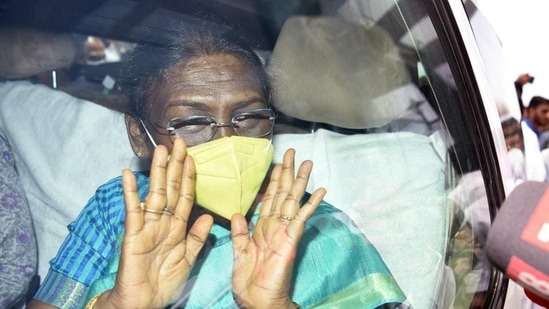
Murmu is a tribal leader from the Santhal tribe in Odisha.
Tribal communities that make up 8.6% of country’s population are an important constituency for the BJP that banks on a coalition of castes, especially the socially and economically marginalised communities, to cement its votebank. The party’s ideological mentor, the Rashtriya Swayamevak Sangh (RSS) has over the years focused on building networks with tribal communities, which it fears are vulnerable to proselytisation by non-Hindu faiths.
In recent years, the BJP’s defeats in states such as Jharkhand and Chhattisgarh and loss of vote share and seats in Gujarat and Madhya Pradesh, where tribal communities influence electoral outcomes, were attributed largely to a disconnect between the party and tribal communities.
The BJP is now hoping to reverse the losses and cement its position ahead of assembly elections in Gujarat later this year. Scheduled tribes make up 14.8% of the state’s population. The BJP is also expecting a favourable outcome in Jharkhand, which goes to the polls in 2024 and where STs are 26.8% of the population; and in Chhattisgarh where elections will be held in 2023 and scheduled tribes are 30.6% of the population.
“In states such as Jharkhand, where tribal communities are powerful, the party picked a non-tribal as the chief minister (Raghubar Das), and when the government was in place, it failed to address several critical issues such as the demand for grant of land titles to tribals, who are hugely dependent on land and forest produce. The problems were exacerbated by the lack of leadership and a feeling of no representation,” said a party leader. With Murmu’s nomination, the leader said the party could be seen as “making amends”. The party hopes to win over the Santhal tribe, considered politically powerful in Jharkhand and West Bengal.
The BJP, however, is not only resting on the nomination to build bridges with tribal communities. In Madhya Pradesh, for instance, where tribal communities are about 21.1% of the population according to the Census 2011, the party has been focusing on political empowerment of Dalits and STs by appointing representatives in various committees, or morchas, and giving them leadership roles.
It has also been felicitating iconic personalities from the communities and focusing on projects that are specifically aimed at social groups that come within the SC and ST ambit.
“The Congress government never cared to highlight the role of tribal freedom fighters. No effort was made to mainstream the tribal communities from the Northeast and other parts of the country either. It is only the BJP that has not only recognised tribal leadership but instituted policy decisions that have improved the lot of the people. And the nomination of Droupadi Murmu shows the respect that the party has for STs,” said Samir Oraon, BJP lawmaker and the head of the party’s ST Morcha.
He said the BJP also has eight ministers in the Union council who represent various tribes and that too is an indication of the party walking the talk on empowerment.
The RSS, which has hailed Murmu’s nomination, has been pitching with help through the Vanvasi Kalyan Ashram (VKA) to forge better ties between the party and the tribes. “The role of the VKA was instrumental in helping the BJP gain a foothold in the Northeast where conversion is a major concern. It is imperative for the party to nurture leadership among the communities so that conversion by deceit or through inducement is stopped,” said a VKA functionary.
Over the years, the party’s efforts to woo tribal communities saw its performance in the general elections improve in the tribal belt. In 2019, of the total 47 ST reserved seats, the party won 31.
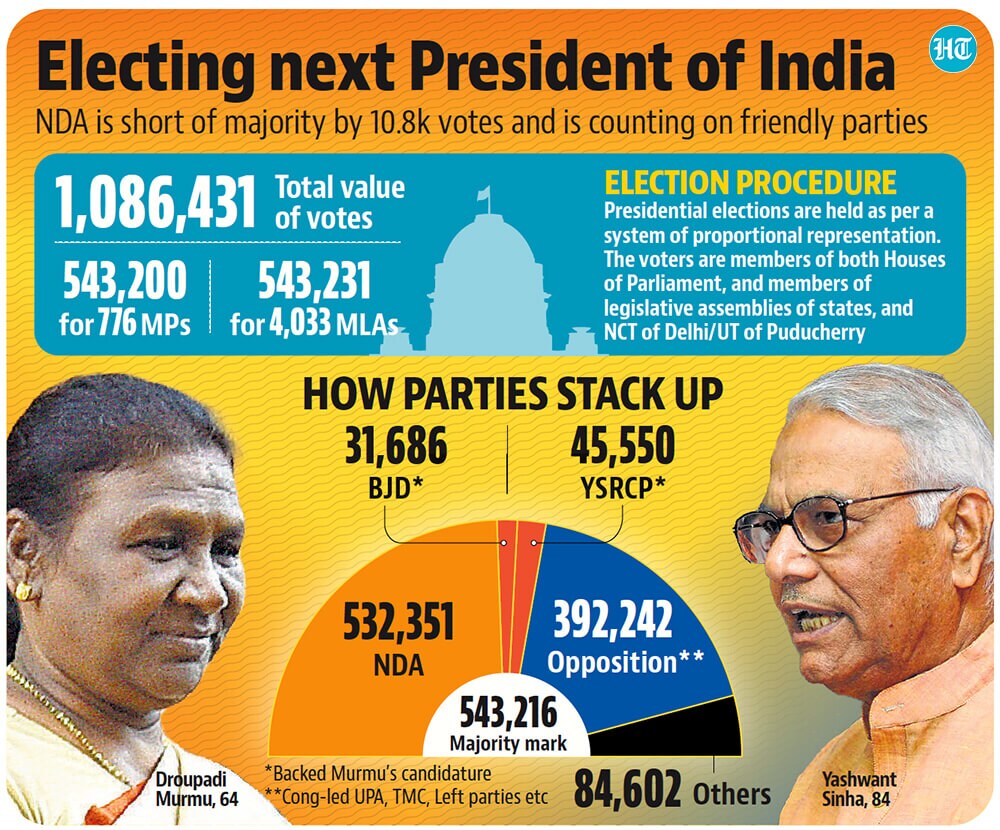
At present, there are 412 Lok Sabha constituencies reserved for the general category, 84 for the scheduled castes and 47 for the scheduled tribes. In the states, of the total 4,033 assembly seats (excluding Jammu and Kashmir), 545 are reserved for STs.


