
 E-Paper



BJP tightens hold on the Hindi heartland
With governments in several states and a strong presence in the LS, the BJP is bolstering its chances in the upcoming Lok Sabha elections.


New Delhi: The Bharatiya Janata Party (BJP) on Sunday re-established its dominance in the Hindi heartland as it renewed its pact with the Janata Dal (United) or JD(U) to form a coalition government in Bihar.
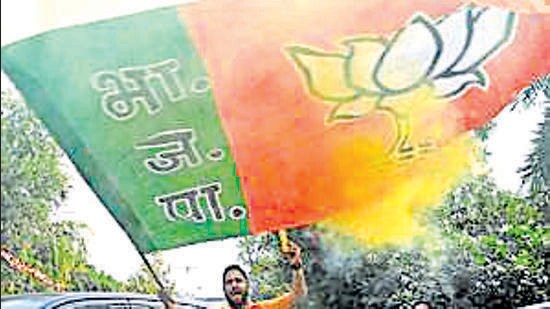
With governments in Bihar, Chhattisgarh, Haryana, Madhya Pradesh, Rajasthan, Uttarakhand and Uttar Pradesh, the BJP has burnished its credentials as a hegemon in the region, outwitted the coalition of opposition parties and bolstered its bid to win the Lok Sabha elections three times in a row, party leaders said.
In the Lok Sabha, the BJP has 170 of the 218 seats from the Hindi heartland states.
To strengthen its position in Bihar, where it has 17 of the 40 seats, it has opted for political expediency and compulsions of electoral arithmetic by overlooking the betrayal by JD(U) leader Nitish Kumar, who walked out of the BJP-led National Democratic Alliance (NDA) on two occasions – once in 2013, when he opposed Narendra Modi’s nomination as the prime ministerial candidate, and then again in 2022.
Bihar sends 40 lawmakers to Parliament. As of Sunday, the JD(U) has 16 and the Lok Janshakti Party has six lawmakers.
READ | BJP looks to bring old allies on board, cement new ties ahead of Lok Sabha polls
BJP leaders, who spoke on condition of anonymity, said the party’s tally in Bihar is set to improve, but the impact of the developments will have a wider ramification on the political landscape, where the Opposition has been trying to overcome inherent differences to emerge as a single bloc against it.
“The blow inflicted to the INDIA (Indian National Developmental Inclusive Alliance) bloc and the decimation of the Congress in particular will give BJP headwinds. Nitish Kumar was the prime mover to bring the coalition together, and breaking ties and returning to the BJP is a political message that will benefit us,” said a senior party leader.
Kumar’s return to the NDA, coupled with other parties wanting to join the alliance, will be used to discredit the INDIA parties, the leader said. “The Opposition’s coalition is on the verge of collapse… they cannot agree on seat sharing or a leader. It is a motley group that has been formed only to prevent the re-election of Modi,” added the leader.
The BJP’s intent to pull the plug on the Opposition’s attempts to prevent a split in their votes and coalesce their respective votebanks seems to have succeeded with Kumar’s return. The BJP, including the Prime Minister, have often referred to the INDIA bloc as a “Ghamandia Gathbandhan” and a coalition of dynastic parties.
Kumar’s statement about the difficulties he faced in the coalition has also come as a shot in the arm for the BJP. “I had quit an earlier alliance for a new tie-up. But the situation was not okay. So, I have resigned. I was facing difficulties in working with this alliance. When I explained this to party members, they advised me to resign,” he said after quitting the alliance with the Rashtriya Janata Dal (RJD) and resigning on Sunday.
READ | BJP launches campaign for Lok Sabha polls with 'Modi ko chunte hai' slogan
The immediate gain that the BJP is hoping to accrue is support from Kumar’s votebank, the Kurmis, who form about 3% of the Bihar electorate. “Apart from JD(U)’s vote bank, we are banking on our own social engineering, with the appointment of Samrat Choudhary and Vijay Sinha as deputy chief ministers,” said a second party leader.
While Choudhary is a Kushwaha (Koeri), which forms 6.4% of the electorate, Sinha is a Bhumihars who account for 2.86%.
The BJP is confident that the pact with the JD(U) will deflect attention from the demand for a caste census that was incidentally supported by Kumar, party leaders said. Bihar became the first state to release a caste survey last year, pushing the BJP to articulate its stand on the issue of revisiting the quota distribution.
The Opposition’s unanimity on conducting a caste census, a demand that resonated in other states as well, nudged the BJP to shed its ambivalence on the issue and cite its social engineering matrix as an example of its inclusive politics. The BJP’s social engineering formula is based on giving political representation to different castes, particularly the numerically and socially disadvantaged.
The BJP, which is hoping to break its own record of winning a spectacular 303 seats in 2019, is confident of breaching the fortress that the southern states have proved to be in addition to maximum gains in the heartland states.
“Even when we had lost the state elections in Rajasthan, Chhattisgarh, Madhya Pradesh and Jharkhand (in 2018 and 2019), we won with a resounding victory (in 2019 Lok Sabha polls),” said the second leader.
“Political analysts had commented on how the BJP has lost its hold over the region. More recently, they said Mandal will trounce the Kamandal...the truth is that BJP now has both the Mandal and Kamandal in social engineering and Ram Temple,” added the leader.


