
 E-Paper



7.5km added to Bengaluru Metro’s western extension line
The chief minister said that the route till Kengeri should be extended till Ramanagara, Magadi and Rajanakunte and has directed officials to draw up plans to execute the same which would take the total to 317 kms.


Bengaluru Karnataka chief minister Basavaraj Bommai and Union minister of housing and urban affairs Hardeep Singh Puri, on Sunday inaugurated the extended 7.5 kms line of the Bengaluru metro between Nayandanahalli and Kengeri on Mysuru Road after roughly two months of delay. The extension will connect two biggest cities in Karnataka.
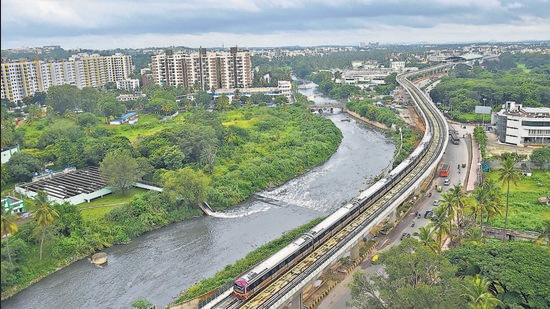
“The government is pursuing all efforts to make Bengaluru truly an international hub. The metro should have the capability to ferry many more people. There is a target to construct around 317 kms of routes,” Bommai said after the inauguration.
The chief minister said that the route till Kengeri should be extended till Ramanagara, Magadi and Rajanakunte and has directed officials to draw up plans to execute the same which would take the total to 317 kms.
The total length of the metro that is operational in Bengaluru is 56 kms in over 13 years. He said that another 36 kms would be completed by next year.
Bommai said that the government can keep up timelines for the new proposed routes if there is early planning and perfect implementation.
“Accountability of these major projects is more important than anything else,” he said, adding that the chief minister’s office (CMO) will supervise all mega projects in the city from now on.
Bommai also said that within the next 20 days, a dashboard with information on all mega projects in the city will be up and ready where the monitoring of such large infrastructure initiatives will be done.
“I will dedicate my first working hour of the day for supervising these mega projects of Bengaluru,” he said.
Officials said that the extended line of the metro is estimated to serve around 75,000 people on average per day and connects the south-western part of the city in a direct line to the eastern corridor of KR Puram.
Speaking at the inauguration, Puri said, “Bengaluru is one of the major engines of economic growth for the entire country, with (a) strong presence in information technology, biotechnology and applied sciences research. The city accounts for nearly 38% of total IT exports from the country. The Inauguration of the Western Extension Metro Line today is a step towards enabling faster commute and smart mobility options in the city.”
“Journey of Bengaluru metro started with the sanction of Phase 1 in 2006 which is 42.3 km with an approved revised cost of ₹13, 845 crores. The first section of 7 km of Phase 1 commenced in October 2011 and daily passenger boarding of about 12, 500 per km of the Phase 1 pre-Covid-19 is comparable to the busiest metro network in the country next to Mumbai and Delhi,” Puri said.
He added that the operational punctuality of the Bengaluru metro is 99.8% which is among the best in the country.
“Since the inauguration of (the) first metro line in Delhi in 2002, today about 730 kms of metro lines are operational in 18 different cities. About 1,049 kms of metro rail / RRTS projects are under construction in various cities,” Puri added.
However, the slow pace of work has made it more difficult for the average Bengalurean to depend on the metro services since it has taken over 13 years for the construction of just under 60 kms line in a city that is around 800 square kms in radius.
The metro gets one of the biggest share in Bengaluru’s public expenditure but delays have escalated project costs.
According to Bengaluru metro authorities, each year of delay adds 5% more to the project costs, which amounts to thousands of crores. The delays have forced people to depend on private vehicles which was exacerbated by the Covid-19 pandemic. The fear of contracting the virus in public transport has forced many people to use private transport. This has added to the problem of the growing number of vehicles on the road in a city that was adjudged to have the worst traffic in 2019 globally. There are 9.4 million vehicles in Bengaluru, according to government estimates. The poor quality of roads, inadequate public transport, increase of private vehicles has added to the city’s crumbling infrastructure with promises on mass mobility solutions remaining a distant and delayed dream which has caused more hardships due to addition of bottlenecks to the already nasty traffic snarls. With most of the roads dug up currently in Bengaluru in the name of “smart city” and other developmental projects, the dust and vehicular emissions have taken a toll on the general quality of life due to air and water pollution.


