Booker for Lankan ‘afterlife noir’ caps huge year for S Asian writing
Karunatilaka’s Booker win, coming close on the heels of the International Booker Prize for a Hindi novel by Geetanjali Shree (Tomb of Sand, translated by Daisy Rockwell) marks a big moment for South Asian writing, and the small press.
The question every writer from Sri Lanka, the island nation with a three-decade-long history of civil war, has grappled with is: Should they dig up the past or bury it? Shehan Karunatilaka, 47, who became the second writer of Sri Lankan descent (Michael Ondaatje, won it 30 years ago for The English Patient; the book also won the Golden Booker in 2018) to have won the Booker Prize — announced at London’s Roundhouse on Monday night, and attended, among others, by the Queen Consort and popstar Dua Lipa — chose to dig in it for his second novel, Seven Moons of Maali Almeida. Brought out by Sort of Books, a London-based indie publishing house, it appeared in the subcontinent as Chats with the Dead (2020).
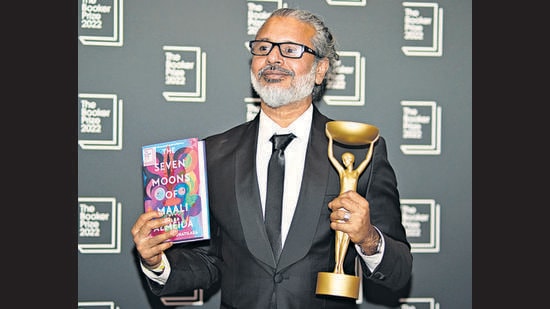
Author Shehan Karunatilaka holds the Booker Prize during a photo call after the announcement of his victory, at the Roundhouse, in London. (AP)
Karunatilaka’s Booker win, coming close on the heels of the International Booker Prize for a Hindi novel by Geetanjali Shree (Tomb of Sand, translated by Daisy Rockwell) marks a big moment for South Asian writing, and the small press. “The novel has been on a phenomenal journey across many drafts and years. It’s surreal to experience such an outpouring of love since the announcement. It’s still slowly sinking in, but I am absolutely ecstatic,” said Karunatilaka, in a written statement from London on Tuesday.
The prolonged conflict between the Sinhalese-dominated government and the separatist militants of the Liberation Tigers of Tamil Eelam (LTTE) in Sri Lanka has informed the writings of several Sri Lankan writers, including Romesh Gunesekera, whose debut novel, Reef, was shortlisted for the 1994 Booker Prize, and Anuk Arudpragasam, who made it to the 2021 shortlist with his second novel, A Passage North. In Seven Moons of Maali Almeida, Karunatilaka gets a cast of ghosts to talk about the country’s past. “These ghosts come from all the conflicts that raged on in Sri Lanka. A ghost is an obvious metaphor for the fact of not dealing with our past. Digging the past and all its unprocessed souls became easy because we are not short of massacres in this country, not unlike India. In South Asia, we have that past,” Karunatilaka told Hindustan Times.
Every ghost in the novel, says Karunatilaka, is based on a real character, including Maali Almeida, the novel’s eponymous protagonist, Colombo’s photographer, socialite, closet gay and political activist. Told in second person, the novel is divided into seven moons (nights) to show the soul’s journey to the next realms, drawing on the Buddhist concept of Bardo, the liminal state between death and rebirth, which has also been employed by another Booker winner, George Saunders, in his Booker Prize-winning Lincoln in the Bardo. “When I was reading through the records, I looked for some murders that occurred during various conflicts. I resurrected some of these assassinations. And that is how I came to the story,” said Karunatilaka.
Almeida’s journey is the central thread that propels the novel. “For all these assassinations, I don’t know if anybody ever went to jail or was persecuted. There are investigations that are open and shut, and yet none of these murders were solved,” said the author, who recently came out with a collection of stories, The Birth Lottery and Other Surprises (Hachette India). His debut novel, Chinaman: The Legend of Pradeep Mathew (2011), is a fictionalised account of a Sri Lankan cricketing virtuoso.
The Booker Prize jury chair Neil MacGregor described Seven Moons of Maali Almeida as “a metaphysical thriller, an afterlife noir that dissolves the boundaries not just of different genres, but of life and death, body and spirit, east and west”. He added: “It is an entirely serious philosophical romp that takes the reader to the world’s dark heart: the murderous horrors of civil war Sri Lanka. And once there, the reader also discovers tenderness and beauty, the love and loyalty, and the pursuit of an ideal that justifies every human life.”
In his acceptance speech, Karunatilaka expressed hope that one day the political situation in Sri Lanka will be such that his novel, instead of being labelled as a dark and searing political satire, will “sit on the fantasy shelves of bookshops”. Speaking briefly in Tamil and Sinhalese towards the end of his speech, he said: “I write these books for you… Let’s keep sharing these stories.” Sri Lanka, which is reeling under the worst economic crisis since its independence in 1948, learns from its stories, he said.
By bequeathing life into ghosts, Karunatilaka has done what some of his favourite writers, including Kurt Vonnegut, Douglas Adams, George Saunders and Cormac McCarthy have done in the past: used the device of a dead narrator to remember what should not be forgotten.
Follow India news real-time updates and the latest news covered on Hindustan Times, featuring today's critical updates on Sonam Wangchuk LIVE and more across India.
Home/India News/Booker For Lankan ‘afterlife Noir’ Caps Huge Year For S Asian Writing

 E-Paper