E-Paper



Bridge too far? In a tiny Goa island, fissures over a link to the mainland
Goa has long walked the tenuous line between the benefits of tourism that brings in an estimated ₹4,300 crore per year to the state, and the loss of a way of life

 Prefer HTon Google


It is 6 am, and on the outskirts of Panaji, less than a kilometre away from the newly-built concrete-paved Mumbai-Mangalore highway, the diesel engine of a bright blue ferry grunts into life, carrying twenty people, three cars, a rickshaw and 10 two-wheelers. It shudders and groans as it backs up from the ramp where it was berthed, before slowly waddling across the dull, grey waters of the Mandovi estuary. Ten minutes later, it slowly grinds to a halt on the other side, on a riverine island.
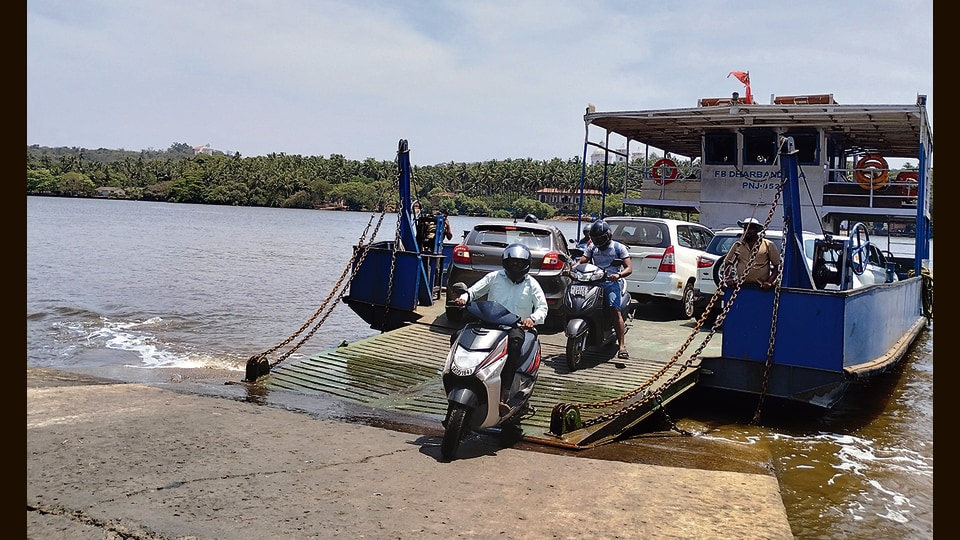
Men, women, children and their paraphernalia disembark, and for a little while, the pace becomes hurried. The turnaround must be quick. As people leave the stout, flat bottomed ferry, the design of which has not changed in six decades, there are more residents and their vehicles waiting to get on, impatiently waiting to get to the mainland. There is no workaround; no other mode of transport available. For the river island of Divar, with its 12,000 residents, there is no other connection to the rest of Goa except these state-run boats.
It is a solitude that has been unbroken for decades, yet there is a conflict brewing within.
On March 11, Narayan Verlekar, a resident of Divar and a member of the Maharashtrawadi Gomantak Party (MGP), submitted a memorandum to the area legislator, asking for a bridge to be built across the river for ease of access between Divar and the mainland. A bridge, that some argue, will take the island from isolation to aspiration; from calm stagnation to the twinkling lights of modernity.
But on the other hand, is an argument that is not new to Divar, or even to Goa, which has long walked the tenuous line between the benefits of tourism that brings in an estimated ₹4,300 crore per year to the state, and the loss of a way of life. As one resident says, “If a bridge is built, and everything changes, is Divar still Divar?”
THE ISLAND
Step off the blue ferry, and Divar is a different world—where time moves slowly, men and women sit chatting unhurriedly at street corners, and young children play in the streets, unafraid of traffic. Narrow undulating roads lead to traditional single storeyed Goan homes with expansive verandas and highlighted windows.
Divar is one of seven islands that lie surrounded by the waterways that make up the Mandovi river system just before they reach the Arabian Sea in Panaji. Five of these -- Chorao, St Estevam, Cumbarjua, Corjuem and Calvim have been connected to the mainland by at least one bridge. The last two holding out are the island of Divar and its sister island of Vanxim.
Formed through the accretion of silt and sediment around two main rocky hillocks that form the core of the island, 40% of the island’s area is made up of the khazan lands (low lying floodplains) that are used to plant rice and vegetables. These floodplains are protected from the saline waters of the estuary by a network of embankments and tide gates that regulate the flow of water ensuring the lands around the island remain fertile. There are two village panchayats, Piedade and São Mathias, and the island has two sets of celebrations for every event where its residents mingle, including a unique festival known as Bonderam, the Portuguese word for flag, that has its origins in a fight centuries ago, where the two villages demarcate their own territories with flagpoles, as the other tries to displace them in an effort to “gain territorial advantage”.
Most residents live off either agriculture or fishing, and unsurprisingly life on the island revolves around the ferries. There are two high schools that teach till class 10, but for any education higher than that, travel to the mainland is unavoidable. There is no hospital either, but residents have evolved a system of visiting doctors who visit on particular days, or when called. For more serious cases, or emergencies, again, the ferry is the only way out.
“For us the ferry is something we incorporate in our daily schedules. Children use the ferries to go to school, young people use it to go to work, and businessmen use it to ship their wares in and out of the island. There is nothing we don’t get on the island itself. We have supermarkets, traditional bakeries, hardware stores, and fish and vegetables are sourced from within the island itself. We are a self-reliant island,” said Marius Fernandes, a native resident.
THE CONFLICT
In one corner of Divar, right next to the banks of the Mandovi, is a decade old foundation stone, damaged and forlorn, standing testimony to the island’s dilemma. In 2011, the then Digambar Kamat government proposed constructing two four-lane bridges between Ribandar(Panjim) and Divar, and Divar to Chorao, costing an estimated ₹600 crore. The plan set off protests in the island; the foundation stone was vandalized; and land for the bridge was never acquired, Goa government officials said.
Even as the demand for a bridge continued bubbling under the surface, and in the corridors of power in Goa, the Divar panchayat staunchly stood against the construction of the bridge, ; something they communicated officially to Goa Governor PS Sreedharan Pillai when he visited the island in November 2022. “The sarpanch of Divar came with a proposal that they do not want a bridge. It was the first time I had heard of a village saying this. When I asked why, they said that people from the mainland will arrive in the island, create a nuisance, and ruin their happiness. Officially, they requested for a bridge not to be sanctioned,” Pillai said to reporters then.
But in the middle of February, the question of the bridge reared its head again, in a heated village council meeting. “At the meeting, there was a clear division. One group of residents said that the young people were suffering because of the inaction of previous generations and were being cut off. The other group suggested that the beauty of the island was paramount. There were loud disagreements, and no resolution was adopted at all,” one island resident said, asking not to be named.
Verlekar was one of the loudest advocates for the revival of the bridge project. The MGP, which fought the 2022 elections in alliance with the Trinamool Congress, won two seats in the assembly elections in March 2022, broke off its alliance, and issued a letter of support to the Chief Minister Pramod Sawant-led BJP government.
On March 11, Verlekar submitted a memorandum to the local Congress turned BJP legislator Rajesh Faldessai to pursue a project for the bridge. “We live in the 21st century where people want to move forward. We cannot afford to live in the past just because some people would like to preserve their ideals,” Verlakar said.
He said that the absence of a bridge meant that rushing a person to a hospital in Panjim was “next to impossible”, and travel across the river was a daily inconvenience for those that had to travel to the mainland for work. “Some time ago, a doctor from the village Dr Atmaram Pilgaokar suffered a heart attack, but passed away before he could be taken to hospital. During the monsoons when the currents are especially strong and the river is swollen the island remains cut off from the rest of the state. That also happen if the ferry workers go on strike,” Verlekar said.
Faldessai, the Cumbarjua MLA however said that the project would not be carried forward unless there is consensus. “I had taken up the matter with the chief minister three months back and he told me that unless there is a consensus we should not needlessly ‘spoil’ the island. If there is a decision, he said, the government would have no problem taking the project forward,” Faldessai said.
THE ARGUMENTS AGAINST
59-year-old Effie Silveira-de-Melo says she has travelled nearly every day from her home in Divar to Panjim, where she works as an accountant, for close to four decades. That journey, she says, takes her not more than half an hour each day, even accounting for the ferry trip that includes a charge only if she’s travelling by car. “I have been doing this for the past 40 years, and have not faced any major issue. To this day, I have not come across anyone that has been adversely affected by the ferry. Importantly, where will the bridge be built? Nobody wants to lose their land or their home for a bridge that will not really bring any benefit,” she says.
In fact, one of the primary arguments that those against the bridge in Divar make is not just the loss of a way of life, but that it will affect its draw for tourists. “Today Divar is one of the few villages in Goa that attracts tourists solely because it has been untouched by commercialisation seen in other villages. When visitors come here, they walk or cycle about the village, admire the lack of high-rises, and taste completely local fare. We have always found ways around the lack of a bridge, such as patients and wedding parties being given priority on the ferry. Once you build a bridge, all that will be left is a suburb of Panaji,” Marius Fernandes said.
Varun Hegde, a travel operator who organizes tours to the island, said that there is “no doubt” that a bridge would mean the loss of Divar’s USP. “The character of the island will change irreversibly. From a tourist operator point of view, it will be bad for our business and the kind of tourism we are promoting.”
Building a bridge will take more than just getting the village to agree. With the Mandovi River a crucial navigation channel, no bridge that affects this will be considered, government officials said. Beyond this, ecologically sensitive mangrove lands on either side of the river will have to be factored in . In the neighbouring island of St Estevam, the government’s move to build a second bridge in 2022 was stayed by the National Green Tribunal over fears that the bridge would adversely affect mangrove thickets and tidal flats.
“Divar is one of the last remaining islands where the khazan lands have been largely protected. A bridge will involve burying the land with construction debris ruining the fields and mangrove forests,” Hyacintha Aguiar, the chairperson of the local biodiversity management committee said.
Prakash Pereira, a businessman from the village says that the administration needs to think “out of the box.” “Everyone can agree that it is an inconvenience not to have a bridge. But is the bridge the only solution to the convenience faced by the villagers? We can have a better designed RORO (roll on, rool off) ferry that can carry more passengers and vehicles at a time,” he says,
Among the suggestions mooted by the village panchayat is a 10-bed nursing home with a night duty doctor to help in case of exigencies, and higher capacity ferries that can carry more passengers and vehicles at a time. “The island can be the ideal example of a self-sustaining village, with eco-tourism like in Venice promoted. We need to promote this way of living, rather than destroying what we have always been,” Fernandes said.