
 E-Paper



BRO makes Kailash Mansarovar Yatra easier for pilgrims
Hundreds of pilgrims travel to the 6,638-metre Mount Kailash, located near Mansarovar Lake in the Tibet Autonomous Region, every year with the belief that circumambulating the holy mountain brings good fortune.


The Kailash Mansarovar Yatra is set to become easier and smoother for pilgrims than ever before, with the Border Roads Organisation (BRO) completing a key road in Uttarakhand that will cut travel time drastically as people will no longer have to undertake a grueling trek to reach the sacred place, the defence ministry said on Friday.
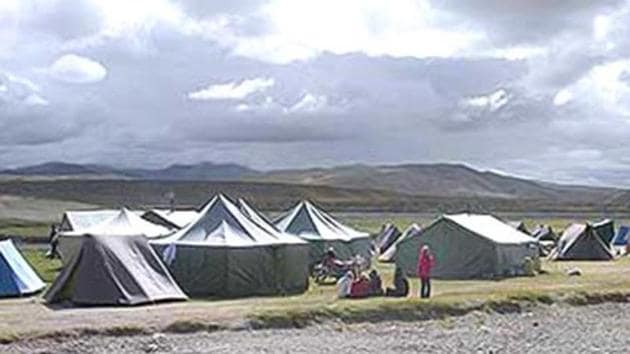
Hundreds of pilgrims travel to the 6,638-metre Mount Kailash, located near Mansarovar Lake in the Tibet Autonomous Region, every year with the belief that circumambulating the holy mountain brings good fortune.
The BRO has built a road from Dharchula to Lipulekh (the gateway to Kailash-Mansarovar) --- a stretch of 80 km --- at an altitude ranging from 6000 feet to 17,060 feet, creating the shortest route for the Yatra, the ministry said in a statement.
“Now, people can drive up to Lipulekh in vehicles. They will no longer have to trek for five to six days,” said a senior government official. The new road is an extension of the Pithoragarh-Tawaghat-Ghatiabagarh road.
Defence minister Rajnath Singh said the new road link will allow pilgrims to complete the Yatra in just one week compared to two to three weeks it took earlier. He inaugurated the road through video conferencing.
“While combating Covid-19 pandemic, the BRO in Uttarakhand has connected Kailash Mansarovar route to Lipulekh pass at a ht of 17,060 ft; thus providing connectivity to border villages and security forces,” the minister said on Twitter.
“The arduous trek through treacherous high-altitude terrain can now be avoided. At present, the travel to Kailash-Mansarovar takes around two to three weeks through Sikkim or Nepal routes. The Lipulekh route had a trek of 90 km and the elderly yartris faced lot of difficulties,” the statement said.
The routes through Sikkim and Nepal require the pilgrims to travel 20% of their journey on Indian roads and 80% on Chinese roads. “With the opening of new road, this ratio has been reversed. Now pilgrims will traverse 84% land journey on Indian roads and only 16% in China,” the defence ministry said.
Singh said with the crucial road link had fulfilled the decades-old dreams and aspirations of local people and pilgrims.
BRO chief Lieutenant General Harpal Singh said the construction of the road was a challenging task due to a raft of factors such as constant snow fall, high altitude and extremely low temperatures --- factors that restricted the annual working season to five months.
One of the biggest challenges for the BRO is to arrange a large labour force to carry out construction of key roads and tunnels in far-flung areas as Covid-19 sweeps through the country, as reported by Hindustan Times on April 28.
The BRO’s peak working season extends from May to November. Migrant workers are a key part of the BRO’s workforce involved in building strategic roads, along the country’s northern border with China, scattered across Arunachal Pradesh, Jammu and Kashmir, Sikkim, Uttarakhand and Himachal Pradesh.


