
 E-Paper



Budget 2020: Tax devolution to states unchanged
The 14th Finance Commission had recommended a 42% share for states in the divisible pool of taxes.


The 15th Finance Commission (FC-XV) has kept devolution to states unchanged in its interim report for 2020-21 even as their cumulative share shrank marginally to 41% after the number of states was reduced to 28 because of the reorganisation of Jammu & Kashmir (J&K) into two Union Territories (UTs).
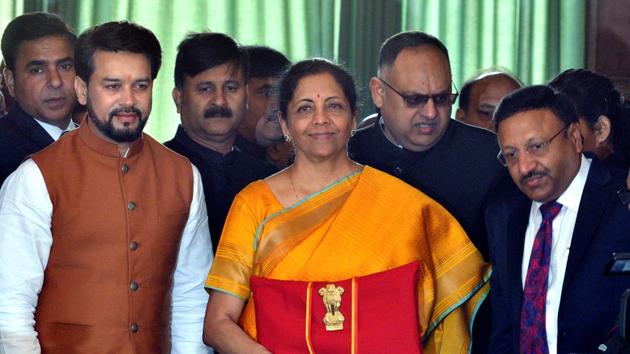
The 14th Finance Commission had recommended a 42% share for states in the divisible pool of taxes.
“Keeping in view the fact that there has to be a certain degree of predictability and stability in federal finances, our approach to vertical devolution mirrors that of our predecessor Commissions with modifications due to the change in the status of Jammu & Kashmir,” the FC-XV report said.
The Commission retained the devolution to states at the same level as the 14th Commission, but the total share appears marginally lower because of separate provisions for the newly created UTs, J&K and Ladakh, a spokesperson said.
However, the final report of the Commission, which is expected by October 2020 for 2021-26, may tweak the devolution formula depending on changes in key macro parameters, the report said. The Commission is headed by former bureaucrat NK Singh.
Finance minister Nirmala Sitharaman, while presenting the union budget for 2020-21 in Parliament on Saturday, said the 15th Finance Commission has given its first report for 2020-21.
“In the spirit of cooperative federalism, I am pleased to announce that we have, in substantial measure, accepted the recommendations of the Commission. The Commission will submit its final report to the President during the latter part of the year, for five years beginning 2021-22,” she said.
In December 2019, states locked horns with the Centre for about four months delay in paying compensation to them for shortfall in their Goods and Services Tax (GST) revenues. The Central government, on December 16, released ₹35,298 crore to compensate states for revenue losses for two months ahead of the meeting of the powerful GST Council.
The Union Cabinet on November 27, 2019 extended the tenure of the Commission till October 2020 and asked it to submit two reports -- one for the year 2020-21, and another for the five-year period between 2021-22 and 2025-26. The tenure was extended to examine various comparable estimates for financial projections in view of reforms and the new realities, such as the reorganisation of J&K after the nullification of Article 370. The Commission is of view that the share of J&K should be raised from 0.85% to 1% to meet special needs of the two newly constituted UTs. “Since this enhancement has to be met from the Union’s resources, we recommend that the aggregate share of states may be reduced by 1 percentage point to 41 per cent of the divisible pool,” it said. The report said several uncertainties, such as an economic slowdown and weak revenue collection, have made it difficult to make “credible projections” for five years using the current year as the base and runs the risk of turning out to be “excessively aspirational and inaccurate”. “Given the uncertainties of some key macro areas, our recommendations in the final report would undergo changes and adjustments as appropriate, in the light of subsequent data and analysis,” it said.
Dr DK Srivastava, chief policy adviser, EY India, said, “By assuming nominal GDP growth rates at 10% for FY20 and 11% for FY21, the 15th Finance Commission has made optimistic assumptions.” In determining the vertical devolution, the Commission has effectively reduced the share of states from 42% which was applicable for 29 states to 41% which is applicable to 28 states, he said. “This is due to rounding off of Jammu and Kashmir’s share which was 1.854% in a total of 100%, which amounts to close to 0.8% out of 42%,” he said, adding that the rounding off works marginally in favour of the Centre.
For horizontal distribution, the Commission has introduced tax effort as a criterion in addition to the factors used by the Fourteenth Finance Commission and given it a weight of 2.5%. The Commission reduced the weight of the distance criterion from 50% to 45% and introduced a criterion of demographic change, giving it a weight of 10%. The demographic change is a performance-based criterion where data for the state-wise total fertility rate has been used, Srivastava said.


