
Sign in

Bumper crop production proving to be a bane for Indian farmers

Recent trends show more farmers growing vegetables, setting off a vicious cycle of glut followed by falling prices.

Updated on: Jun 9, 2017, 13:39:25 IST
New Delhi, Hindsutan Times | By
Share
Share via
  • facebook
  • twitter
  • linkedin
  • whatsapp
Copy link
  • copy link

Indian farmers are currently faced with a problem of plenty. A bumper crop has led to procurement prices plunging, pushing them deeper into the depths of despair.
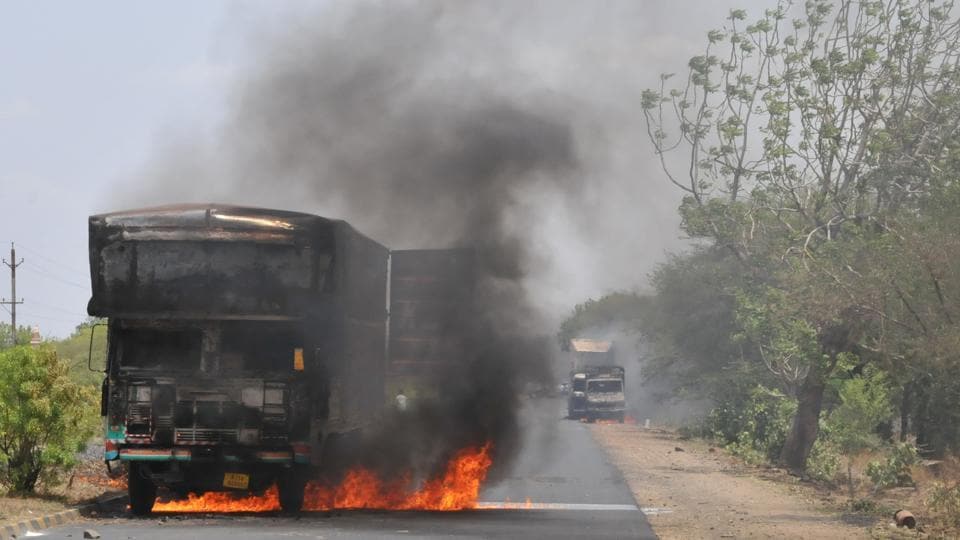
Villagers burn vehicles on the Mhow-Neemuch highway in Mandsaur. (HT File)

The crisis has been compounded by inept state governments. Onion growers in Madhya Pradesh have been on the streets for days demanding better prices for their produce, but the administration failed to respond in time. It finally woke up after protests turned violent this Tuesday, leaving at least five farmers dead.

Ironically, the bumper production which ought to have been a boon is proving to be a bane.

The agricultural ministry estimates that 273 million tonnes and vegetables will be produced this year, but it is unlikely that either the farmers or the consumers will benefit. Only middlemen stand to gain since the Agriculture Produce Marketing Committee laws bar farmers from selling their produce directly in local markets. They can sell only through commission agents.

The Reserve Bank of India has already sounded an ominous warning, stating that the crisis could spread further with the market price of pulses hovering well below the minimum support price (MSP).

Further, the horticulture sector is not even covered by the MSP system, leaving a vast majority of farmers vulnerable. The Centre’s price mechanism covers only 14 of the 51 major crops. It includes staple food items such as wheat, rice and cereals but not vegetables.

Vegetables are perishable and growing them entails a fair degree of risk. But recent trends show more farmers growing vegetables, setting off a vicious cycle of glut followed by falling prices. Last year, farmers in Madhya Pradesh, Maharashtra, Andhra Pradesh, Uttar Pradesh and Punjab dumped their winter crops such as potato and tomato on the road. This year, farmers in Rajasthan and Maharashtra are facing a similar desperate situation.

Farm sector still employs 60% of India’s population even though contribution of agriculture to gross domestic product (GDP) has fallen from 18% in 2013-14 to less than 14% in 2016-17. The National Institution for Transforming India (Niti) Aayog estimates a further fall to 10-12% by 2025, meaning that the farm sector will expand at a much slower rate than the overall economy.

So, there is understandably growing clamour for loan wavers for farmers. The calls have grown louder especially in BJP-ruled states since Uttar Pradesh’s new chief minister Adityanath announced such a measure.

But data suggests that loan waivers are at best a temporary balm and cannot bail out farmers in the long term. India has a capacity to store just 35% of its total produce and 40% of agri-produce worth an estimated 96,000 crore rupees is wasted every year.

What can make the difference though are better storage facilities and steps to do away with middlemen. Hard labour must be rewarded and the farmers certainly deserve better price for their produce. They are the country’s backbone and we cannot continue to fail them.

  • Chetan Chauhan
    ABOUT THE AUTHOR
    Chetan Chauhan

    Chetan Chauhan is the National Affairs Editor looking into all aspects of news and features from across India. A Chevening scholar with over three decades of experience in reporting and news management, Chetan has extensively covered all important aspects of the social sector, political economy, environment and climate change nationally and internationally. He did a journalism course at the Reuters Institute of Journalism in Oxford and Digital Media training at Nanyang Technological University in Singapore. He started as a reporter with The Statesman in 1996 and joined the Hindustan Times in 2000 in the metro bureau covering environment, crime and Delhi politics. He covered hot local news, from the Jessica Lal murder case to the rebellion of Delhi Congress MLAs against then Chief Minister Sheila Dikshit, to the replacement of toxic vehicle fuel with cleaner compressed natural gas (CNG) in the national capital. Some of his stories on air pollution became part of the Supreme Court’s landmark MC Mehta versus Government of India case in the National Capital Region (NCR), forcing the government to take corrective measures. As part of the national political bureau since 2004, he covered important central sectors such as environment, education, social justice, labour, rural development, water resources, renewable energy, agriculture, broadcasting and the Planning Commission for more than a decade producing several exclusive and investigative breaking stories. His specialisation is the environment, having covered at least a dozen United Nations global conferences on climate change, biodiversity and wildlife including climate summits in Paris, Copenhagen and Bali. He also covered India’s two five-year plans ---11th and 12th and reported on drafting and execution of right based laws such as Right to Education, Right to Information and rural job guarantee law, MG-NREGA, now being introduced in new format as VG-RAM-G Act. He has in-depth knowledge of social sector issues. He was one of the first to report on tigers vanishing from Sariska and Panna wildlife reserves in 2004 and 2008, respectively, leading to the setting up of the National Tiger Conservation Authority (NTCA) and the introduction of stringent penal provisions for poaching. He has written extensively on the rising human-animal conflict in India and the degradation of India’s biodiversity hotspots because of mining and other activities. Since 2004, Chetan has covered Parliament comprehensively and participated in training on the nuanced coverage of Parliament proceedings. He has travelled extensively across India to cover national and provincial elections since 1998, especially in the Hindi heartland states, considered India’s road to power. He writes a regular column for Hindustan Times, Ecostani, on important national politics, economy, Himalayan ecology and environmental issues. His other responsibilities include providing inputs for edits and edit page articles for the publication, apart from managing news flow from across India.Read More

Get the latest India News, breaking headlines and real-time updates from across the country. Stay informed about politics, government policies, crime, weather and major national developments.