
 E-Paper



Cabinet nod to 5.5% MSP hike for wheat
The Union Cabinet on economic affairs chaired by Prime Minister Narendra Modi on Tuesday approved hikes in minimum support prices (MSPs) for rabi or winter-sown crops (2023-24).


The Union Cabinet on economic affairs chaired by Prime Minister Narendra Modi on Tuesday approved hikes in minimum support prices (MSPs) for rabi or winter-sown crops (2023-24).
Wheat is one of the crops planted in winter, and harvested in late spring of the following year, and this year’s harvest was affected by extreme weather in March, trimming output, and forcing the government to curb exports.
Also Read: Will the government’s MSP calculations hold?
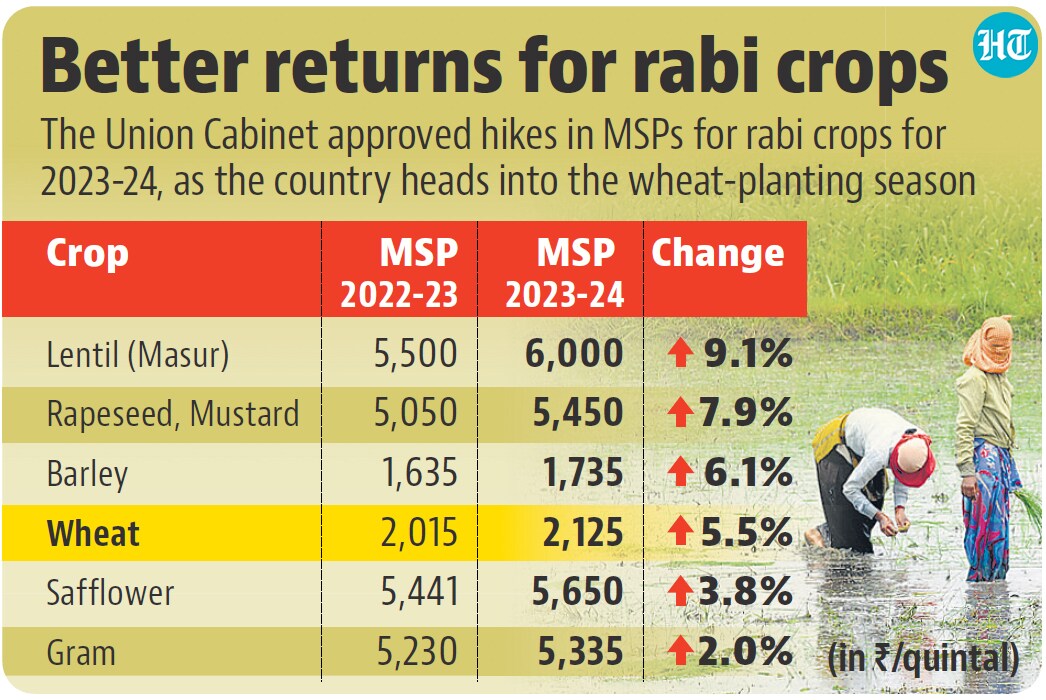
In percentage terms, the government has increased the MSP on wheat by 5.5%, the highest in three years, to ₹ ₹2125 a quintal (100 kg). The highest increase in MSP was for lentils (masur), grown mostly during winters. Its MSP was set at ₹6000 over the previous year’s ₹5500 a quintal, a rise of nearly 9%. The second-highest raise was for mustard, whose floor rates were increased to ₹5450 a quintal, up 7.9% from the previous year’s ₹5050. The MSP for safflower, another key oilseed, was increased by ₹209 to ₹5650 a quintal from ₹5441 a quintal earlier, up 3.8%. The floor rate for gram (channa) was increased from ₹5230 to ₹5335, an increase of ₹105 a quintal.
“PM Narendra Modi has consistently worked to raise farmers’ incomes. Therefore, the new MSPs for rabi season are set to give up to 104% returns over cost,” Union minister Anurag Thakur said at a briefing.
The upcoming wheat crop, sown in November and harvested in April, will be crucial for the country’s food security as carry-over stocks from previous harvests are at their lowest level in five years. The government on Monday said it expects normal wheat production during 2023-24.
On April 1, 2023, the government aims to have at least 11.3 million tonnes of wheat, against a mandatory reserve stockpile of 7.5 million tonne, food secretary Sudhanshu Pandey said on Monday. By the same data, the government hopes to keep 23.7 million tonne of rice, against a required buffer of 13.6 million tonne. The government purchases cereals from farmers to run the world’s biggest food handout programme that offers subsidised cereals to about 810 million Indians.
The top bureaucrat said India sufficient stocks of rice and wheat and the government would sell wheat in the open market “if needed” to control prices.
Market prices of wheat so far have gone above MSPs, as farmers preferred to sell to private traders than to the government due to an export boom, as supplies from war-torn Ukraine and Russia were impact.
As a result, the government could not buy half of its targeted quantity of wheat in the 2022-23 season due. This prompted the government to ban overseas wheat shipments, as domestic prices rose.
That ban could help its procurement.
“If the export ban stays until next year, then wheat prices will come down to nominal levels. This will help the government meet its procurement target,” said Rahul Chauhan of IGrain Pvt Ltd.
The government has set the rates at a minimum of 50% over costs of cultivation, effecting larger hikes for lentils and oilseeds, which are scarce essential items, compared to the main winter staple wheat.
The MSP increases translate into 104% returns for mustard over cultivation costs, 100% in the case of wheat, 85% for lentils, 66% for gram (channa), 60% for barley and 50% for safflower, an oilseed.
MSPs are federally-determined floor prices for crops aimed to avoid distress sale by signaling a minimum rate to private traders and ensure farmers don’t sell at a loss.
India’s wheat crop is at increasing risk of early onset of summers, which experts say are characteristic of the climate crisis.
In March 2022, a sudden rise in temperatures in mid-March shrivelled the country’s wheat crop, the world’s second-biggest producer of the staple, as output fell by 3 million tonne to 106 million tonne from a year ago. “I hope there won’t be a repeat of weather disruption this winter. Due to late rains, I am still harvesting rice although it’s time sow wheat,” said Maninder Singh Uppal, a farmer from Punjab’s Ludhiana.
The MSP system tends to benefit mainly cereal growers because the government, through the state-run Food Corporation of India, buys sufficiently large quantities of cereals at MSP rates and distributes them to beneficiaries via the public distribution system.
The government uses a measure of cost of cultivation known as A2+FL, which includes all paid-out costs, plus the value of family labour. Farm unions protesting the government’s agricultural policies want authorities to adopt a wider measure that included the notional value of owned capital and rent on land.
“Input costs are increasing faster than MSP rates. So, these MSP increases are not sufficient,” said Rakesh Tikait, a Bharatiya Kisan Union leader, over phone from Meerut.
If current price trends hold and wheat remains in short supply globally, there will be high demand for the Indian staple in international markets. In such a scenario, farmers would find it lucrative to sell to export-oriented traders than to the government.
Analysts said much depends on the final total output and how long restrictions on exports are enforced. Wheat exports plunged from 7.2 million tonnes earlier to 4.2 million tonnes between May and September, post the ban, food secretary Sudhanshu Pandey said at briefing on Monday.


