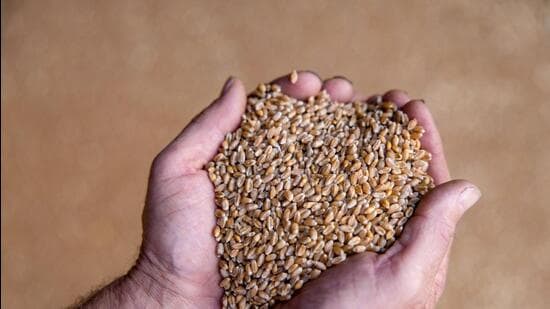
There is good reason to ask whether the latest MSP hike will be enough to meet the government’s requirements. Open market prices of wheat are quite high and the government has already eaten into its excess stocks.
The Union Cabinet announced the minimum support price (MSP) for wheat and other Rabi (winter) crops for the 2023-24 Rabi Marketing Season (RMS) on Tuesday. For wheat, the most important Rabi crop from the viewpoint of procurement, the MSP has been increased from ₹2015 per quintal (100 kg) to ₹2125, an increase of 5.5%. The latest hike in MSP for wheat is higher than what it was last year when it was increased by just 2%. In fact, the latest hike in wheat MSP is the highest since the 6.1% increase in the 2019-20 RMS (it was announced in 2018, the year before the 2019 elections). However, there is good reason to ask whether the latest MSP hike will be enough to meet the government’s requirements. Open market prices of wheat are quite high and the government has already eaten into its excess stocks. Here are three charts which explain this in detail.
(Bloomberg)
International wheat market continues to be tight
International wheat prices started rising significantly even before the Russia-Ukraine war erupted in March. The IMF primary commodity price database shows that wheat prices, which fell to $169.7 per tonne in June 2020 increased to $238.7 by June 2021 and reached a peak of $444.2 by May . While prices have come down a bit – latest available data from the IMF shows a price of $322 in July – they continue to be significantly higher than pre-pandemic levels. Elevated prices in global markets have increased the incentive for Indian farmers to export. Even though India imposed a ban on wheat exports in mid-May, wheat exports have doubled in the April-August period this year, as reported by Indian Express on October 17. Export of rice and wheat is a direct competition for the government’s procurements targets.
Even domestic wheat prices have increased
Farmers sell their produce at MSP to the government because it generally offers a higher rate than what they would get in the open market. This means that a faster rise in open market prices can dissuade farmers from selling their crop at MSP. This is exactly what seems to be happening for wheat. One way to measure the relative attraction of MSP for wheat is to look at the ratio of wholesale wheat prices in the open market and MSP. Using wholesale price data from the Centre for Monitoring Indian Economy (CMIE) database one can see that MSP operations suffered a sharp fall in their relative attraction vis-à-vis market prices in the 2022-23 RMS. For making this comparison the wholesale price for June quarter in a particular RMS has been taken as most of wheat procurement takes place in the months of April and May. If one were to assume a 10% wholesale price inflation for wheat between June 2022 and June 2023 (cumulative wholesale inflation for wheat in the April-September period is 13.2%), the ratio of MSP to open market wholesale prices will be the second lowest since RMS 2016-17. This is not good news for procurement response.
Government’s food stocks are running thin
In RMS 2022-23, total wheat procurement was 18.8 million tonnes. This was not only significantly lower than the 43.3 million tonnes of wheat procurement in RMS 2021-22 but the lowest wheat procurement since RMS 2008-09. The fact that international wheat prices jumped right during the procurement window and the wheat crop was badly affected by a premature heat wave acted as a double whammy for procurement. The shortfall in wheat procurement in RMS 2022-23 – to be sure, there are no officially announced procurement targets – happened at a time when the government had undertaken a large additional food distribution commitment under the Pradhan Mantri Garib Kalyan Yojna (PMGKKY). Data available on the Food Corporation of India’s (FCI) website shows that the 35.2 million tonnes of wheat have been distributed under the scheme between April 2020 and September . The additional distribution with a lower procurement has meant that government’s food stocks are just enough to meet buffer stock requirements at the moment and significantly lower than what they have been in the recent past.
All of this, when read together, suggest that the government has taken a calculated risk in announcing what looks like a lower than warranted (given the wheat inflation scenario) hike in MSP for wheat. Obviously, fiscal considerations for this year and the fact that a higher hike will have to be announced next year given the 2024 general elections, must have played a role. Whether or not the government will run into a crisis in managing the food grain economy – it must have enough food stocks to meet its food security commitments – will depend on two important factors. The first is the damage to rice crop this year due to erratic rains -- they have hurt the crop in different places due to late rains during sowing and unseasonal rains just before the harvest. A lower rice production, if it leads to low procurement will put further pressure on the food stock situation. The second factor, of course will be international and domestic inflation scenario for not just cereal but also agricultural input prices. If the government seeks to neutralise the former’s effect on MSP procurement (via exports bans) without compensating suitably for the rise in latter, it might end up worsening the terms of trade for farmers (and making them angry) in what is the beginning of the long election cycle in the run up to 2024 general elections.

 E-Paper