E-Paper



Capital in a chokehold as air quality plummets to ‘severe+’
At 4pm, 38 of Delhi’s 39 active stations were “severe,” with only Shadipur in “very poor.” Wazirpur topped 500 – the upper limit of CPCB’s monitoring; Rohini and Ashok Vihar also breached it, while Jahangirpuri, and Mundka hit 499

 Prefer HTon Google


Delhi’s air breached the “severe plus” category on Sunday for the first time this winter — with a 24-hour average air quality index of 461 — making it the second worst AQI reading for December since the system was launched in April 2015. However, the average number was only a glimpse of the crisis as at least three stations maxed out at the 500-mark at various points on the day.
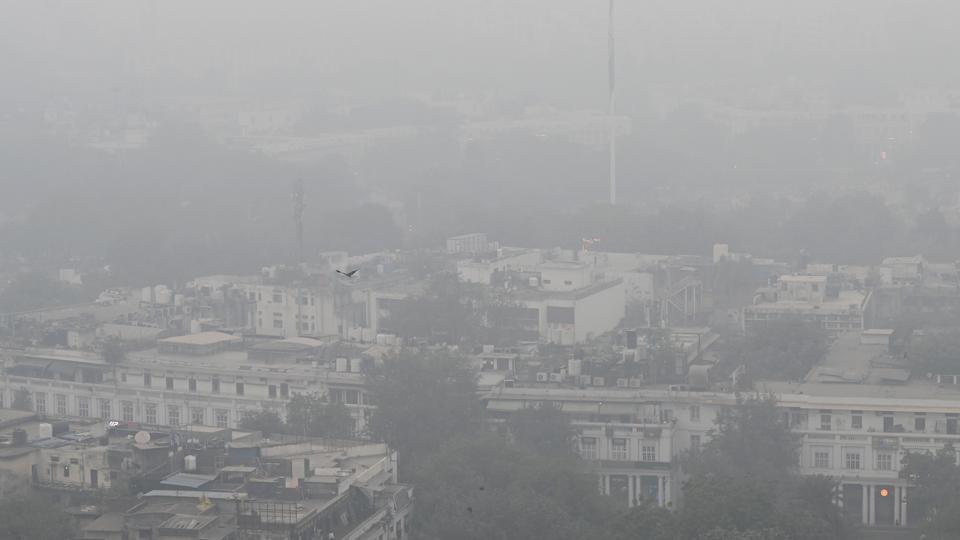
At 4pm, 38 of Delhi’s 39 active stations were “severe,” with only Shadipur in “very poor.” Wazirpur topped 500 – the upper limit of Central Pollution Control Board’s monitoring; Rohini and Ashok Vihar also breached it, while Jahangirpuri, and Mundka hit 499.
CPCB classifies air quality as “moderate” when the AQI is between 101 and 200, “poor” between 201 and 300, and “very poor” between 301 and 400. Beyond 400, air quality categorised as “severe”. For the purpose of Grap, 450+ is termed as “severe plus” with CPCB values not going beyond 500 -- a threshold already considered seriously dangerous by the pollution agency.
The only time December recorded a higher AQI than Sunday’s was on December 21, 2017, when the reading stood at 469. At that time, Delhi only had eight active air quality monitoring stations, compared to the number now. This makes Sunday’s average far more alarming for this time of the year as it is easier to breach this threshold in terms of average AQI with a fewer stations, compared to the same average with more stations.
Surface pollutants stayed trapped under slow winds, dipping temperatures, and an “inversion” layer, even as a weak sun failed to disperse them. Residents complained of laboured breathing and burning eyes — which have now become all too normal — and the weather conditions served as a reminder of collapsing systems that fail to mitigate the yearly health crisis that descends on the Capital. This marked the fifth severe air day this year.
Though forecasts by theIndia Meteorological Departmentshow winds are expected to pick up post noon on Monday, experts said improvement will only be gradual, meaning instant respite was unlikely.
Experts noted an inversion Sunday, with sunlight barely peeking through as cooler surface air sat under warmer aloft. “Typically, when the sun comes out, AQI improves as winds pick up but on Sunday, that also did not happen and winds did not cross 5-6 km/hour,” said Mahesh Palawat, vice president at private weather agency Skymet.
The highest ever average AQI recorded in Delhi is 497, on November 6, 2016. The second worst air day came last year on November 18, when a similar spell of inversion and smog pushed the AQI to 494. The last time Delhi recorded a “severe plus” day was on December 19, 2024, when AQI touched 451.
Experts said while the pollution spike in November is usually down to a combination of poor meteorological conditions, stubble smoke and Diwali, more localised NCR sources are to blame towards December.
“Such high levels in December are a testament to the fact that pollution emission load reduction at source has not been pursued aggressively enough. What we need is an overhaul in regulations and governance for air pollution, setting absolute emission load targets in an accountability driven framework,” said Sunil Dahiya, founder and lead analyst at Envirocatalysts.
Additionally, this deterioration comes despite all four stages of the Graded Response Action Plan (Grap) now in place. Under stages 3 and 4 of Grap presently in place, there is a ban on all construction and demolition activities, curbs on private four wheelers (BS3 petrol and BS4 diesel); a ban on entry of trucks into Delhi and mandatory shifting of classes up to 9 and 11 to hybrid mode. The state government also issued a notification asking both private and government offices in Delhi to run with 50% office strength.
Authorities in Noida, which had crossed the 450-mark on Saturday, and Ghaziabad, ordered online classes for pre-nursery to Class 5 and hybrid classes for grades 6 to 12.
Despite the spike, forecasts from the Centre’s Air Quality Early Warning System (EWS) for Delhi shows the AQI may “improve”, touching “very poor” on Monday.
“Delhi’s air quality is likely to be in the ‘very poor’ category from December 15 till 17. The outlook for the subsequent six days -- from December 18 -- also shows AQI is likely to be in the ‘very poor’ category,” the EWS said in its daily bulletin. IMD has a yellow alert in place for “moderate to dense” fog in the early hours of Monday.
The EWS has missed multiple forecasts this season, including Saturday’s spell, for which a forecast of “very poor” air was issued on Friday. On Saturday, the India Meteorological Department issued an alert for possible dense fog in the city on Sunday morning. However, the lowest visibility was 350 metres at Palam and 200 metres at Safdarjung, IMD said.
“Palam reported visibility less than 1000 metres and in the sallow fog category since 9pm on Saturday. It was down 500 metres at 3am, 400 metres at 7am and further down to 350 metres at 8am,” said an IMD official. “Safdarjung meanwhile recorded 300 metres at 5.30am and further touched 200 metres at 8am,” the official added.
Delhi’s maximum stood at 24°C on Sunday, which was a degree above normal. The minimum was 8.2°C, around normal for this time of the year. The minimum and maximum are expected to remain in this range on Monday, with shallow to moderate fog likely in the early hours of the day. “An easterly wind direction will transition back to northwesterly winds from Monday, so the impact of fog and moisture will decrease,” Palawat added.