The landmark population enumeration phase of the 2027 Census will kick off on Monday with self-enumeration in the Union Territory of Ladakh and the snow-bound areas of Jammu and Kashmir, Himachal Pradesh and Uttarakhand, covering remote villages, mountainous communities and treacherous terrain.
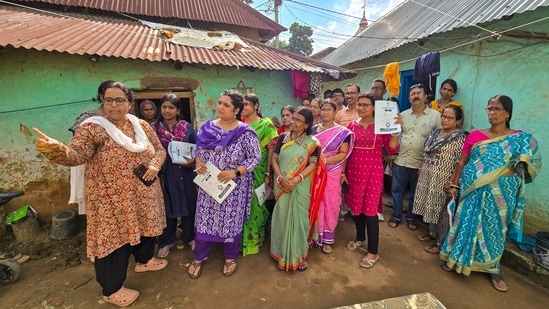
Between August 17 and 31, residents in these regions can fill their details online. After this, census enumerators, armed with 40 questions notified last week – including those on the respondent’s caste, parental details and identity documents – will launch a door-to-door exercise from September 1 till September 30. The counting of the population for the rest of the country will take place in February next year.
“The census data will be recorded through a paper-less exercise, similar to the houselisting exercise, using a mobile app in snow-bound areas. Before population enumeration is done, self enumeration will be done on https://se.census.gov.in,” said chief principal census officer and director, census operations, J&K and Ladakh, Amit Sharma.
The operation will cover the around 274,000 people in Ladakh across seven districts. In Jammu and Kashmir, the exercise will comprise about 8.81 million people across 16 districts, including Doda, Poonch and Kupwara.
High altitude, unever terrain among other challenges
Challenges include villages in Zanskar with little road connectivity, Yingchen village in Leh comprising only 11 members from two families (seven hours by foot from the nearest hamlet), and Hanle village in Changthang, which sits at an altitude of around 15,000 feet.
{{/usCountry}}Challenges include villages in Zanskar with little road connectivity, Yingchen village in Leh comprising only 11 members from two families (seven hours by foot from the nearest hamlet), and Hanle village in Changthang, which sits at an altitude of around 15,000 feet.
{{/usCountry}}“Certainly, there are peaks and high altitude areas where there will be few houses but we have deployed more special charges, especially where our forces, be it army or ITBP, are located…Even if there is one family in a remote village atop a difficult terrain, our officials will go and record their data,” said Sharma.
Also Read I Census as a registry of citizenship
The directorate of census operations hopes to first record the data of lieutenant governor VK Saxena, MP Hanifa Jan, chairman of the Kargil hill development council Mohhamad Jaffer Akhoon and chief secretary Ashish Kundra on Monday morning.
“The people of Ladakh are very enthusiastic …the census gives us requisite parameters of development and socio-economic growth. We get an overall view for futuristic planning,” said Akhoon.
Census operations in Himachal Pradesh
In Himachal Pradesh, the exercise will cover three districts, including Komik, one of the world’s highest motorable villages at an elevation of 15,049 feet in the Spiti valley. With 130 people in 2011, the village is home to the 500 year-old Lundup Tsemo Gompa Buddhist Monastery.
“Census 2027 will be the 16th census of India and the eighth after Independence. For the first time, citizens will have the option of participating through a self-enumeration facility,” said principal census officer and director of census operations Deep Shikha Sharma.
“For this around 6,903 snow-bound villages and areas of Himachal Pradesh have been identified for advance enumeration due to harsh winter conditions that make access difficult during the regular census period…the reason is Himachal’s difficult winter conditions as snow-bound villages and areas where heavy snowfall can make travel and access difficult during the winter months. Therefore, population enumeration in these areas will be completed before the onset of severe winter,” added Deep Shikha Sharma.
The census reference date for these areas is October 1, 2026. The early census is particularly important for remote areas such as Kinnaur, Lahaul-Spiti and Pangi-Bharmour in Chamba.
Process and personnel deployed
Deep Shikha Sharma said that the census data will be collected through dual mode through an app, named Census 2027-PE, and through self enumeration. Residents can complete the census online through the official self-enumeration portal from August 17 to August 31, 2026, after which they will receive a self-enumeration ID that can be shared with census officials during field verification. Sharma clarified that no OTP will be asked during the census process.
To conduct the exercise, around 20,390 enumerators and supervisors will be deployed across Himachal Pradesh. Officials said the digital census will be supported by the mobile application and a dedicated census management and monitoring portal, enabling real-time monitoring of field operations.
The mobile application will function in both online and offline modes, ensuring smooth data collection even in remote and network-deficient areas. “So, Himachal’s early census is primarily a weather and accessibility-driven exercise, aimed at reaching remote communities before winter makes these areas difficult to access,” she said.
Civilian and military census in Uttarakhand
In Uttarakhand, the exercise will cover around 52,000 people across 131 villages and three towns in four districts – 69 villages in Uttarkashi, 23 in Chamoli, four in Rudraprayag and 35 in Pithoragarh. The three towns are Gangotri, Badrinath and Kedarnath. “Compared to other hill states, Uttarakhand has a relatively small snow-bound area,” said Eva Srivastava, director of census operations, Uttarakhand.
“Our preparations are underway for population enumeration in snow-bound areas. We have completed training for master and field trainers. Training for charge officers is underway, followed by training for enumerators and supervisors,” Srivastava said.
Also Read I 'I ask for an hour of yours': PM Modi's big appeal to youth for Census
Around 162 enumerators and 34 supervisors are expected to be deployed for the exercise in the snow-bound areas. A simultaneous population enumeration of military and paramilitary units in snow bound areas will also be conducted during the period. Nodal officers for the same are being appointed at the state level, while special charge officers will be notified by the respective units. Enumerators and supervisors will then be appointed for the exercise.
“Because of security reasons, the enumeration for military and paramilitary units will be carried out in paper mode. The data will subsequently be entered digitally at the offices of the special charge officers,” Srivastava said.
11 additional questions included, including caste
Last week, the Union government notified 40 questions, including a query on caste for the first time in independent India, to be asked of respondents. The order from Registrar General of India Mrityunjay Kumar Narayan notified 11 questions more than the 2011 Census, the last time the exercise was conducted in India. Among the new questions were those asking for parental details, and others on passports, Aadhaar, Voter ID and mobile number, driving licence, and Covid-19 vaccination details, and permanent residential address –– which raised privacy concerns.
The question on caste was listed as question number 10 in the notification –– as “scheduled caste/scheduled tribe/caste” –– in open ended format, which means Census officers will record the caste of a person as declared, without any requirement to match it to pre-prepared lists.
An officer said the self-enumeration was part of the digital transformation of the census and allowed residents to enter details of members of their household online before an enumerator visits them. “It is intended to reduce the time required for the door-to-door exercise and improve the efficiency of data collection,” he said. In the first phase - houselisting and housing data collection - too, the self-enumeration facility was given to all the residents.
Also Read I 11 more questions, caste, Aadhaar, mobile number, Covid-19 vaccine status: What’s new in Census 2027
Originally scheduled for 2021, the census was initially postponed due to the Covid-19 pandemic. Data collection is targeted to conclude by March 1, 2027, but officials say the collation and publication of results will take two to three years. The exercise is likely to stamp India’s status as the world’s most-populous nation.
“Once the entire exercise is over next year, we will have the first comprehensive population data in more than a decade, including detailed information on caste, education, employment, migration and other socio-economic characteristics of India’s population,” said a second government official.