
 E-Paper



Central teams chart Covid plan with states, flag gaps
The latest batch of experts has been rushed to 10 states from where maximum cases currently are being reported: Gujarat, Tamil Nadu, Uttar Pradesh, Delhi, Rajasthan, Madhya Pradesh, Punjab, West Bengal, Andhra Pradesh and Telangana.


The Centre has sent at least 50 health and disaster response teams to various states since March when cases of the coronavirus disease (Covid-19) started rising to assist state governments in managing cases and containing the spread of infection.
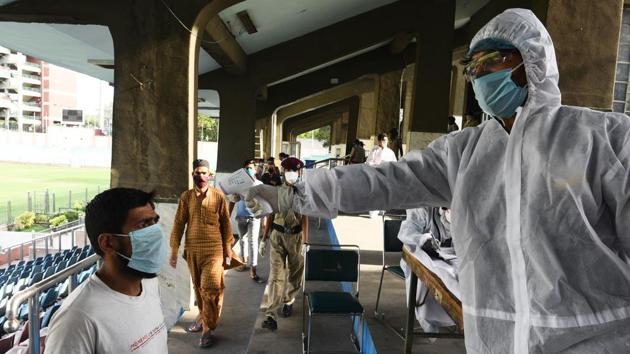
The latest batch of experts has been rushed to 10 states from where maximum cases currently are being reported: Gujarat, Tamil Nadu, Uttar Pradesh, Delhi, Rajasthan, Madhya Pradesh, Punjab, West Bengal, Andhra Pradesh and Telangana.
The team in Andhra Pradesh from the All India Institute of Hygiene and Public Health (AIIHM & PH) visited Kurnool town, and expressed concern over the growing number of cases.
Kurnool accounts for maximum number of 566 of the 1,980 cases and 16 of the 45 deaths reported in the state so far.
The team members, Dr Madhumita Dubey and Dr Sanjay Sadhukhan, held a meeting with senior officials of the district to review the situation in the state in general, and Kurnool in particular.
Dubey said the state government should come out with new appropriate strategies to contain the fast spreading virus in tune with the growing number of cases. She suggested that testing, tracing, isolation and quarantine should be done faster and if necessary, the government should take the help of non-governmental organisations (NGOs) for contact tracing.
She advised the government to enhance the capacity of human resources, quarantine centres, Covid-19 care centres and hospitals to face the challenges effectively in case there was a large-scale outbreak of the virus in the coming days.
So far, the state government has conducted 173,735 tests, including 8666 tests in the last 24 hours alone.
Dubey said the central team had come to Kurnool to extend handholding to the state and the district administration in preventing spreading of the Covid-19 further. “After examining the situation in all aspects, we shall make appropriate recommendations to the state government,” she said.
Prof Sadhukhan said since it was not possible for the government to continue lockdown for an indefinite period, the government should mentally prepare the people to live with Coronavirus after the lifting of the lockdown. “We need to educate the people on how to maintain self-restraint to prevent the spread of the virus,” he said.
District collector G Veerapandian explained the efforts being made by the Kurnool district administration in containing the virus and bring down the death rate. He said though the number of cases was going up in the district, the recovery was also equally faster.
The director of All India Institute of Medical (AIIMS), Dr Randeep Guleria, led a two-member team that visited Gujarat to assess the situation in the state that has reported over 7,000 cases and has a death rate of around 6%, which is nearly double of country’s death rate of about 3.3%.
The AIIMS, Delhi, chief, has attributed high mortality rate to underlying medical conditions in most of the admitted patients and also delay in seeking treatment.
“Late reporting to hospital due to stigma seems to be one cause and comorbidities in patients for high mortality rate in Gujarat,” said Dr Guleria.
Earlier, another set of 20 central teams were sent to 20 high disease burden districts on May 3.
“The main objective of sending the teams of experts is to assess the situation on ground and advise the state government accordingly on how best to implement containment measures and manage cases so that they do not turn critical. Their job is to see if there are any loopholes, and help the states plug these,” said Lav Agarwal, joint secretary, health ministry, on the teams being sent to states.
Agarwal last week had led a second team of experts that visited Mumbai in the past one month as the city has been reporting high number of cases since past few weeks.
Apart from the health teams, the central government had also constituted Interministerial Central Teams (IMCT) to look into other aspects such as implementation of lockdown, market activities etc. and sent to places from where more cases were being reported.
One of the teams was sent to Mumbai, the main problem is of congested spaces because of which maintaining social distancing successfully can be difficult.
“The experts had found in many congested areas people share community toilet for which people have to come out of their homes despite the lockdown, especially in slums like Dharavi.It was suggested creating separate toilet structures. And to ensure people did not stay in close proximity, the teams had suggested moving people to different areas in make-shift quarantine facilities,” Puniya Salila Srivastava, joint secretary, home ministry, had said on the feedback.
In Indore, Madhya Pradesh, the Covid-19 testing capacity was found to be inadequate, and lockdown measures not followed properly, by the team. “One of the main reasons initially for high cases testing positive in Indore was that the chain of transmission couldn’t be broken as people didn’t really stay indoors during the initial lockdown period. What we saw in subsequent weeks has been a result of that,” said a team member, requesting anonymity.
“Mostly the problems that have been found in states where the numbers are high or death rate is high that either lockdown measures were not followed properly, or they weren’t following the testing protocol, or late hospitalization,” the expert added.


