
 E-Paper



Centre deploys teams to 15 states to help manage Covid-19 crisis
The health ministry has said that these teams are working in the field and visiting health care facilities to support the State health departments in implementation of containment measures and efficient treatment of Covid-19 patients.


The Centre has deployed a three-member multi-disciplinary team each in 50 districts of 15 states that are laden under a high burden of the coronavirus disease (Covid-19) for direct monitoring of the situation, and assist in the management of the pandemic.
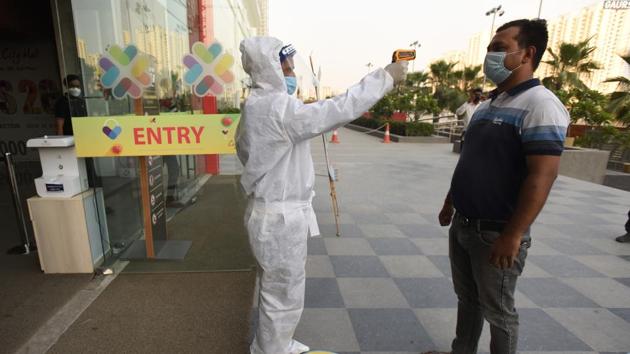
The 15 states that have reported a surge in cases over the past few weeks are Maharashtra (7 districts), Telangana (4), Tamil Nadu (7), Rajasthan (5), Assam (6), Haryana (4), Gujarat (3), Karnataka (4), Uttarakhand (3), Madhya Pradesh (5), West Bengal (3), Delhi (3), Bihar (4), Uttar Pradesh (4), and Odisha (5).
“There are about 15 states where large clustering has been reported in some districts that needs meticulous implementation of containment strategies. The teams will review the situation, and look into ways that can be adopted for better containment and clinical management of cases. They will be in direct contact with the respective state governments on ground to chalk-out areas-specific plans,” said a health ministry official.
The three-member teams consist of two public health experts—an epidemiologist and a clinician— and a senior joint secretary level nodal officer for handholding states on administrative matters related to Covid-19 management and also technical support for assisting in containment measures.
“Whatever bottlenecks are faced on ground in terms of getting approvals to follow certain protocols or specific measures needed to manage the situation it will be quickly addressed,” said the official, who requested anonymity
The health ministry in a statement also said, “These teams are working in the field and visiting health care facilities to support the State health department in implementation of containment measures and efficient treatment/clinical management of cases within the districts/cities.”
“In order to ensure better coordination, quick action on the ground, adoption of a more granular strategy, it is proposed that these districts/municipalities should regularly remain in touch with central teams which are already coordinating with the States. Such frequent interaction would further strengthen the surveillance, containment, testing and treatment related action on the ground,” the statement said.
The focus areas of the teams are to address gaps mainly in testing, especially low tests that are performed on per million population, high confirmation rates, risk of capacity shortfall over the next two months and potential bed shortage, apart from looking at the growing case fatality rate, high doubling rate, sudden spike in active cases, etc.
Many districts and municipalities have already constituted a dedicated core team at the district level consisting of district level medical and administrative officials to coordinate over regular basis directly with the central team for better flow of information.
Experts say area-specific strategies should have been started early on when there was noticed a surge in cases.
“That is how epidemics are contained by going back to the drawing board and devising strategies that are specific to a particular geographical area. What works in one state may not work in another, so the plan has to created accordingly. And there should be no communication loss between the centre and the states when dealing with an outbreak situation,” says Dr Jacob John, former head of virology, Christian Medical College, Vellore.
As the lockdown is being lifted, Union health minister Harsh Vardhan urged everyone to download the Aarogya Setu app to help in self risk assessment and in protection against the disease while chairing the 16th meeting of the high-level group of ministers (GoM) on Coronavirus disease (Covid-19) on Tuesday.
At least 1.25 billion people in the country have already downloaded the app so far, and according to the experts the app will be most effective when maximum number of people download it. “It can be an effective surveillance tool but how effective the app is will depend on how many people have downloaded it,” said a senior health ministry official.
The health minister also said that there was no space for complacency as curbs were being eased.
“…as we enter into the Unlock1.0 phase where restrictions have been eased and curbs have been lifted, we need to be more disciplined in our COVID appropriate behaviour to ensure that all follow norms of physical distancing, make use of masks and face covers in all public places, adhere to norms of hand hygiene and follow protocols of respiratory etiquette. There is no space for complacency,” said Harsh Vardhan, in a statement.
The meeting was attended by S Jaishankar, minister of external affairs, Hardeep Puri, Civil aviation minister, Nityananda Rai, minister of state for home affairs, Mansukh Lal Mandaviya, minister of state for shipping & chemical and fertilizers, Ashwini Kumar Choubey, minister of state for health and family welfare and Bipin Rawat, chief of defence staff.


