
Sign in

Centre likely to lift ban on cattle trade, tweak rules

The government imposed a ban on the sale of cattle for slaughter at animal markets in May, but the Madras high court stayed the implementation in Tamil Nadu and the Supreme Court stayed it across the country.

Updated on: Sep 6, 2017, 07:27:22 IST
Hindustan Times, New Delhi | By , New Delhi
Share
Share via
  • facebook
  • twitter
  • linkedin
  • whatsapp
Copy link
  • copy link

The Centre is likely to lift a ban on the sale of cattle for slaughter at animal markets, following legal opinion that its role is limited in livestock trade which is a domain of state governments.
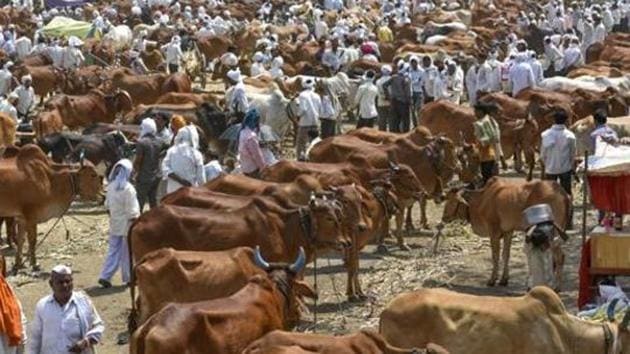
Villagers at a weekly cattle market at Parbhani in Maharashtra. The government said it will remove all misunderstandings as it does not intend to affect slaughterhouses or influence the food habits of people. (HT Photo / Satish Bate)

The government imposed the restriction in May, triggering outrage as the decision was viewed as a hardline Hindu move to foist a nationwide ban on slaughtering cows for beef and influence people’s choice of food.

Senior officials in New Delhi said the government realised it cannot put additional curbs on cattle trade through the Prevention of Cruelty to Animals (Regulation of Livestock Markets) Rules 2017.

Environment minister Harsh Vardhan dropped hints on Monday about plans to tweak animal trade rules.

“We will remove all misunderstandings as the government does not intend to directly or indirectly affect the slaughterhouses or harm farmers or even influence the food habits of the people,” he said.

According to a source, officials of the Animal Welfare Board of India overstepped their brief while framing the rule and had not taken the environment ministry’s approval.

“They went beyond the jurisdiction of the board,” he said.

The rules stipulated ending the role of intermediaries in livestock trade and a series of approvals for transporting cattle. The rules also said an animal could be sold only to a farmer.

Governments in West Bengal, Kerala and Meghalaya objected, saying the matter was a “state subject”. As the row raged, the Madras high court stayed the implementation of the central order in Tamil Nadu and the Supreme Court stayed it across the country, despite the government’s argument that the rule was meant to create a “regulatory regime” for preventing cruelty and not aimed at banning the sale of cows.

Sources said the about-turn stemmed from a growing feeling within the government that the livestock rules went beyond the ruling BJP’s cow-protection agenda and that these could be misconstrued as an assault on the poor engaged in the trade.

Animal markets are mostly concentrated in small towns and the countryside.

Besides, the government has been facing criticism over Hindu hardliners and self-proclaimed cow vigilante groups increasingly asserting themselves.

Such groups have been accused of assaulting and lynching men they accuse, often without proof, of killing cows or carrying the animals to abattoirs.

The Centre’s restrictions fuelled criticism as these were seen as a ploy to alienate Muslims who dominate the Rs 100,000-crore meat business in India.

The slaughter of cows, considered sacred by many Hindus, was banned in most states but seldom implemented strictly until the BJP won power at the Centre in 2014 and won several assembly elections thereafter.

The party’s ideological parent, the Rashtriya Swayamsevak Sangh, has long pushed for a nationwide ban on cattle slaughter and trade.

  • Chetan Chauhan
    ABOUT THE AUTHOR
    Chetan Chauhan

    Chetan Chauhan is the National Affairs Editor looking into all aspects of news and features from across India. A Chevening scholar with over three decades of experience in reporting and news management, Chetan has extensively covered all important aspects of the social sector, political economy, environment and climate change nationally and internationally. He did a journalism course at the Reuters Institute of Journalism in Oxford and Digital Media training at Nanyang Technological University in Singapore. He started as a reporter with The Statesman in 1996 and joined the Hindustan Times in 2000 in the metro bureau covering environment, crime and Delhi politics. He covered hot local news, from the Jessica Lal murder case to the rebellion of Delhi Congress MLAs against then Chief Minister Sheila Dikshit, to the replacement of toxic vehicle fuel with cleaner compressed natural gas (CNG) in the national capital. Some of his stories on air pollution became part of the Supreme Court’s landmark MC Mehta versus Government of India case in the National Capital Region (NCR), forcing the government to take corrective measures. As part of the national political bureau since 2004, he covered important central sectors such as environment, education, social justice, labour, rural development, water resources, renewable energy, agriculture, broadcasting and the Planning Commission for more than a decade producing several exclusive and investigative breaking stories. His specialisation is the environment, having covered at least a dozen United Nations global conferences on climate change, biodiversity and wildlife including climate summits in Paris, Copenhagen and Bali. He also covered India’s two five-year plans ---11th and 12th and reported on drafting and execution of right based laws such as Right to Education, Right to Information and rural job guarantee law, MG-NREGA, now being introduced in new format as VG-RAM-G Act. He has in-depth knowledge of social sector issues. He was one of the first to report on tigers vanishing from Sariska and Panna wildlife reserves in 2004 and 2008, respectively, leading to the setting up of the National Tiger Conservation Authority (NTCA) and the introduction of stringent penal provisions for poaching. He has written extensively on the rising human-animal conflict in India and the degradation of India’s biodiversity hotspots because of mining and other activities. Since 2004, Chetan has covered Parliament comprehensively and participated in training on the nuanced coverage of Parliament proceedings. He has travelled extensively across India to cover national and provincial elections since 1998, especially in the Hindi heartland states, considered India’s road to power. He writes a regular column for Hindustan Times, Ecostani, on important national politics, economy, Himalayan ecology and environmental issues. His other responsibilities include providing inputs for edits and edit page articles for the publication, apart from managing news flow from across India.Read More

Get the latest India News, breaking headlines and real-time updates from across the country. Stay informed about politics, government policies, crime, weather and major national developments.