
 E-Paper



Centre seeks 9-judge Supreme Court bench for Delhi tussle
A five-judge Constitution bench headed by Chief Justice of India (CJI) Dhananjaya Y Chandrachud reserved orders on the petitions filed by the Delhi government seeking legislative and executive control over officers working for the Delhi government in the Capital.


New Delhi The Centre on Wednesday sought that a larger bench of nine or more Supreme Court judges adjudicate the power tussle between the Union and the Delhi government over the control of bureaucracy in the city-state, arguing that the matter deals with the national capital and the Union government should not go down in history as one that handed over the city to “complete anarchy”.
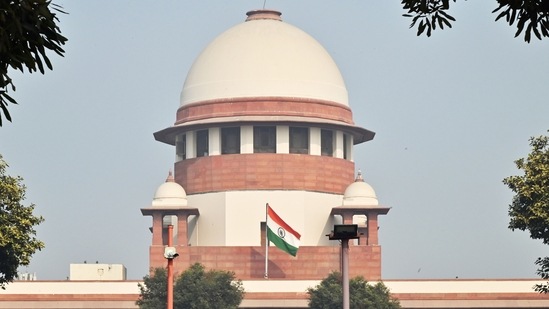
The submission was made by Solicitor General (SG) Tushar Mehta about an hour before the five-judge Constitution bench headed by Chief Justice of India (CJI) Dhananjaya Y Chandrachud reserved orders on the petitions filed by the Delhi government seeking legislative and executive control over officers working for the Delhi government in the Capital.
A notification issued by the Union government in May 2015 — three months after the Aam Aadmi Party (AAP) started its second term — suggested that the elected government can exercise no control over the appointment and transfer of officers since Delhi is a Union territory. The court is hearing a challenge to this notification by Delhi, which has argued that the move was contrary to a 2018 top court judgment that gave primacy to the elected government on all issues except public order, police, and land.
The court on Wednesday expressed surprise at the Centre’s request coming at the fag end of the hearing, and the bench — also comprising justices MR Shah, Krishna Murari, Hima Kohli and PS Narasimha — asked Mehta why this submission was being made for the first time though hearings began last week.
“We would have looked at the matter differently if there was an argument of reference. There was no argument made by you (Centre). Such an argument had to be made at the outset,” the bench said. However, the bench allowed Mehta to file a note containing the point of reference as it said, “You can give your note. It is a question of law.”
An application by the Centre seeking a reference to a larger bench was filed in December last year, prior to the matter being taken up by the Constitution bench. It said that the Constitution bench decision of 2018 on the Delhi-Centre dispute went against a 1997 top court ruling by a nine-judge bench in the NDMC case, which held that Delhi is a Union territory and not state despite having a legislative assembly. Citing this judgment, the Centre sought the issue of control over services to be referred to a bench of nine or more judges.
“We are dealing with the Capital of the country. We are on the future course of action. We may not be remembered in history to have handed over the Capital to a complete anarchy,” Mehta said on Wednesday. He added that the reference to a larger bench was required to decide the broad contours of federalism between the Union and Union territories.
The Delhi government, led by senior advocate Abhishek Manu Singhvi, opposed the submission by the Centre, terming it “hugely dilatory”.
“Today we have gone into all submissions and there is not one word on this. Even during the time of reference, no argument was made. It will be unprecedented for the constitutional bench to allow this,” Singhvi said.
He said that the judgment relied upon by the Centre was examined by the 2018 Constitution bench, and the question raised was already answered. He further said that the reference application was identical to a review petition filed by Centre in May 2021 against the 2018 decision.
In the previous hearing on Tuesday, the Centre brought the issue of the recent protests by the AAP government in the city, arguing that constitutional functionaries should avoid resorting to “theatrics” when a matter is pending in court. He found a strange coincidence in the protests being held at a time when a five-judge bench was considering the issue of control over services.
Singhvi, who concluded his submissions on Wednesday, said, “A picture is being made that someone is hijacking the Capital. There is difference between Parliament and the central government. The Solicitor General is reading both together. The 2015 notification is by the central government, while Parliament needs to make a law to trump the exercise of power by Delhi assembly.”
The bench told Singhvi that Article 239AA allows Parliament to legislate on the entire subjects in the State List in relation to Delhi. But Singhvi, assisted by advocate Shadan Farasat, attempted to illustrate that Delhi has been treated to be at par with states. Delhi has a civil services board and a chief secretary akin to states, he said, pointing out that civil servants under the AGMUT cadre — comprising some states and Union territories —who are working in Delhi are allocated by a joint cadre authority (JCA) whereDelhi is represented by the chief secretary as compared to other UTs which are represented in JCA by the ministry of home affairs.
The Delhi government had argued that it should have power to transfer and post officers working under the Delhi government and the control over them cannot rest with the Centre. It argued that policies of the elected government are to be implemented by the officers and the government is answerable to the people of Delhi who have elected them. It stated that by denying them control over officers, the will of people in having an elected government was negated. Except for land, police and public order, the AAP government urged the court to rule that the elected government in Delhi will have legislative and executive control over all other subjects in the State List.
The Centre opposed the petition on the ground that the Constitution never envisaged a services for Union territories and the officers posted in UTs, including Delhi, are officers of the Centre on whom Centre exercises disciplinary and administrative control relating to allotment, posting and transfer. Denying Delhi’s claim that lack of executive control on officers leads to insubordination, the Centre produced annual appraisal reports of officers over the past three years where all officers were invariably given excellent grading by the Delhi chief minister. The Centre said that since 1991, when Article 239AA was inserted in Constitution, there was harmonious working between governments at the Centre and Delhi, though belonging to different political ideologies, but the present petition was meant to achieve something else.


