E-Paper



Chamoli glacier burst: Sonar system being used to locate bodies in muddy water
Chamoli Police have also issued an alert of rising water level in Alaknanda and appealed to people to remain vigilant, especially those living near its banks


Rescue and search operations were stopped at Tapovan dam tunnel and downstream at around 2.30 pm on Thursday after Chamoli police issued an alert for water level rising in Alaknanda river and appealed to people to remain vigilant, especially those living near its banks, said Praveen Alok, SDRF spokesperson.
“Rescue and search operation will resume after water level normalises,” he said.
A senior official, wishing not to be named, said, “From the tunnel we are approaching now, we have to reach 180 metres, then take right, where there is a pocket, where the NTPC officials are expecting trapped workers. At around 74 metre in the approaching tunnel, there is another tunnel around 11 metres below. We are trying to put a camera into that tunnel... But it is taking time”, said a senior officer involved in the rescue operation, wishing not to be named.
SDRF commandant Navneet Bhullar said 25 to 35 workers are still trapped inside the Tapovan dam tunnel, where rescue operation is underway. He said the muck has been removed from over 100-metre length of the tunnel so far.
Also Read | Over 85% of Uttarakhand districts hot spots of extreme floods: Analysis
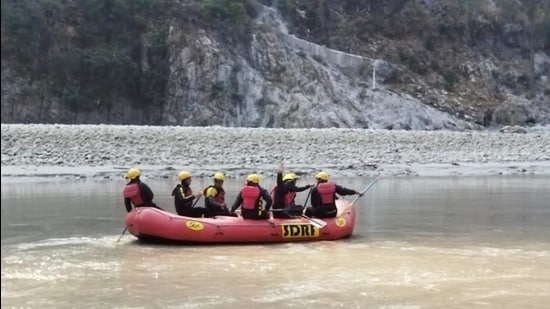
He said downstream, SDRF personnel are using underwater sonar systems on a boat to track bodies in muddy waters in the vast waters of Srinagar Dam reservoir. “SDRF has two drones which are being used for geo-mapping of the Tapovan dam tunnel. NDRF has also brought some high endurance drones which are also being used. So we are using all possible means- drones, dog squad, binoculars in the search operation,” he said.
Thirty- five bodies have been recovered so far in affected areas of Chamoli district, with 169 people still missing including the workers inside Tapovan dam tunnel, , said officials
SDRF spokesperson Praveen Alok said that on Thursday, one more body was recovered downstream at Galnav neat Karanprayag, taking the death toll to 35. “Ten bodies have been identified so far while efforts are on to identify the rest of the 25 bodies.
“Around 7.30am on Thursday, Indian Air Force chopper from Dehradun brought seven drone operators, one NDRF and three SDRF personnel, apart from relief materials, to Chamoli,” he said
Alok added that 100 SDRF personnel, 178 NDRF personnel, 425 personnel of ITBP, one team of Seema Suraksha Bal and 124 army personnel, 16 firemen, 20 revenue officials, and six medical teams are carrying out the rescue and relief operations in the affected areas of Chamoli.
Bodies are being recovered by eight teams of SDRF downstream Reni village in areas that include Tapovan, Joshimath, Ghochar, Karnprayag , Rudraprayag, Dharidevi and Srinagar.