
 E-Paper



Check this out, mate: A history of chess chairs
In the World Chess Championship, chair choices reflect players' preferences, impacting comfort and performance, as seen in past dramatic matches.

 Prefer HTon Google


Bengaluru Even before the first move was played in Game 1 of the World Chess Championship on Monday, the playing arena behind the soundproof glass panel offered a striking contrast. At one end of the board was an intimidatingly large gaming chair – complete with cushioned neck and head rest, and all the frills. On the other, was a simple office chair. The first belonged to challenger D Gukesh, and the other to Ding. Each player had selected a chair of their choice from seven options provided to them by the organisers.
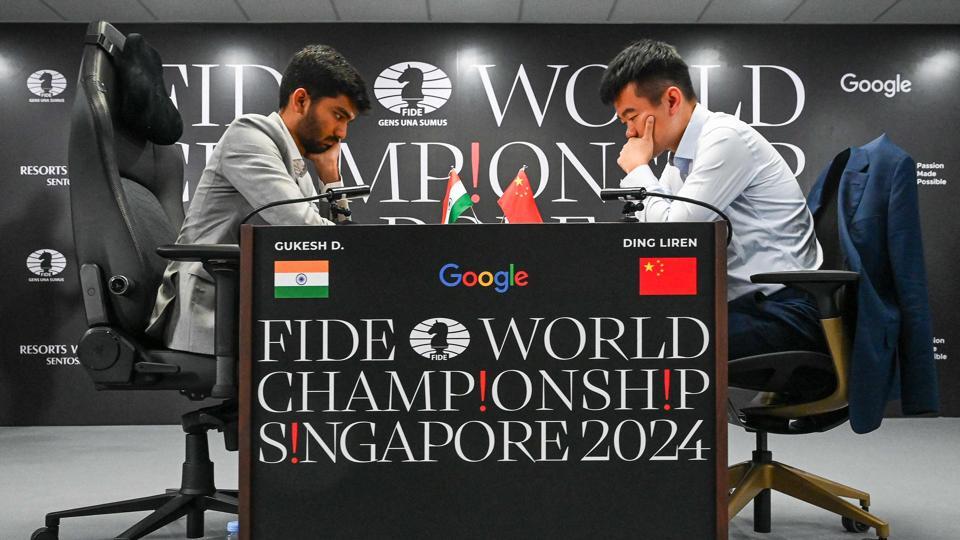
Player chairs have, on multiple occasions, been contentious pieces of furniture in World Championship matches. In a contest that lasts for weeks, with each game spanning hours, players spend a sizable amount of time sitting. No one wants to be stuck in an uncomfortable chair.
One of the earliest episodes surrounding chairs arose during the 1972 match between Bobby Fischer and Boris Spassky in Reykjavik, Iceland. A notoriously picky Fischer approved none of the chairs that the Icelandic organisers offered him. Instead, he had a special leather, swivel armchair designed by Charles Eames flown in from New York. The chair was originally designed for the lobby of the Time-Life building in New York. Col Edmund Edmondson, executive director of the United States Chess Federation, and Icelandic officials spent hours trying to track down the chair. Fischer had used the Eames-designed chair earlier during the 1971 Candidates Final match in Buenos Aires, where he defeated Tigran Petrosian.
Herman Miller, the Michigan manufacturer of the chair, gave the Icelandic match organisers a $50 discount on its $524 official price as a “token of friendship”. Fischer’s Soviet opponent Spassky, meanwhile, started the match with a regular upholstered wooden chair with armrests. Somewhere after Game 6, with Fischer in the lead, the Soviet camp began to believe that Spassky’s chair and posture – having to sit upright in a wooden chair, while Fischer sat back and swivelled in his fancy leather chair, was proving to be disadvantageous. By the start of Game 7, the same Eames chair that Fischer was using was brought for Spassky too.
The ill-tempered political thriller of a match between the blue-eyed boy of the Soviet establishment Anatoly Karpov and Soviet dissident and defector Viktor Korchnoi in Philippines in 1978 took chair drama to bizarre levels. Korchnoi brought his own chair with him — it was an olive-green Stoll Giroflex -- and Karpov asked to have it X-rayed for any hidden devices.
The chair was taken apart and X-rayed at the central hospital in Baguio, Philippines, and all that the nonplussed radiographer found was foam and rubber. After the first couple of games, the shorter Karpov complained that his chair was too low. The organisers arranged for a cushion, which the Soviet player said made the chair too high. and turned it down. According to one account, a duplicate of the original chair, brought over from Manila, was specially modified to make it four centimetres higher. This, too, didn’t meet Karpov’s approval and finally he used a smaller cushion on the original chair. During one of the later games, Korchnoi complained against Karpov for making a move and then standing behind his chair, looking at the position. “If he doesn’t want to keep his seat, he can go to his private relaxation room off stage,” Korchnoi said. The chief arbiter agreed with the objection.
Korchnoi ended up losing the match. “I often wonder how much better Korchnoi would have done if he hadn’t invested so much energy responding to Karpov’s provocations,” former world champion Garry Kasparov said.
For his 1987 match against Karpov in Seville, Kasparov reportedly inspected 40-50 chairs before picking one he liked. Much to the disappointment of Kasparov’s British manager Andrew Page, he chose a simple stationary chair, turning down a heavy, throne-like chair from the regal Alfonso XIII hotel. “The psychological value of sitting in a chair like that would have been enormous,” Page is quoted to have offered in lament.
Kasparov went on to win that match and retain his title.


