
 E-Paper



CJI Khanna turns down plea for full online shift of SC amid Delhi pollution crisis
Senior advocate Gopal Sankaranarayanan pointed out that the Graded Response Action Plan (GRAP) mandating stringent anti-pollution measures does not cover the judiciary


Chief Justice of India (CJI) Sanjiv Khanna on Tuesday turned down a request by senior lawyers to move the Supreme Court to a fully online system in response to the severe air pollution crisis gripping Delhi and the National Capital Region (NCR).
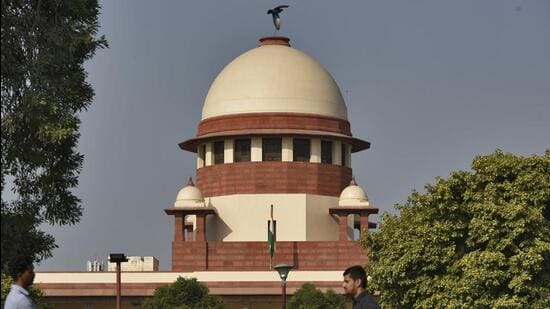
The plea came as air quality in the region reached alarming levels. Thousands of people visit the Supreme Court daily.
The discussion on pollution unfolded during the morning session in the first court. Senior advocate Kapil Sibal, also the president of the Supreme Court Bar Association, highlighted the gravity of the crisis. “Pollution is getting out of control,” he said.
Senior advocate Gopal Sankaranarayanan echoed Sibal, pointing out that the Graded Response Action Plan (GRAP), which mandates stringent anti-pollution measures, does not cover the judiciary. “GRAP 4 has been triggered but GRAP does not cover courts. There are at least 10,000 people, including lawyers, clerks, and other staff, visiting this court daily, in addition to the vehicles entering the premises. Let this court move to a completely online system,” said Sankaranarayanan.
CJI Khanna responded saying he was aware that GRAP 4 measures have been put in place. “See, we need the cooperation of the lawyers too. We have already told the lawyers that they can request to attend hearings online.”
At this point, solicitor general Tushar Mehta intervened to support the request, suggesting that the court consider shifting entirely online during the pollution crisis. “The request is that if it [GRAP 4] can be extended to courts also...in principle,” said Mehta.
Sankaranarayana pointed out that the current system in the Supreme Court allows making requests for online hearings and that the plea was for a complete shift.
Responding to the suggestions, CJI Khanna noted that the Supreme Court had directed judges to accommodate requests for online hearings wherever possible. “We have said to all judges here to allow virtual hearings wherever possible,” he said, virtually refusing to impose a blanket online system.
During the Covid-19 pandemic, the Supreme Court transitioned to a completely online mode, conducting hearings virtually to ensure judicial functions continued uninterrupted. This successful shift highlighted the court’s ability to adapt to unprecedented challenges while prioritising safety and accessibility.
Another Supreme Court bench, comprising justices Abhay S Oka and Augustine George Masih, on Monday issued stringent directives to tackle the pollution crisis in the Delhi-NCR. The bench extended GRAP Stage 4 restrictions, which include bans on construction, halving workforce capacity in offices, and shutting down schools for certain classes, until further orders.
During the hearing on Monday, the bench censured the Commission for Air Quality Management (CAQM) for its delay in imposing Stage 3 and 4 restrictions under GRAP, which are triggered when the Air Quality Index (AQI) crosses 450. It berated the CAQM’s approach of waiting for improvements in weather conditions rather than preemptively imposing curbs.
The court directed the CAQM to continue implementing GRAP Stage 4 curbs even if the AQI drops below 450 and to consider additional measures to address the worsening air quality. It ordered the Union government to secure data on farm fires from geo-stationary satellites, following revelations that traditional satellite monitoring might be underestimating the number of incidents. The court emphasised the constitutional obligation of the Union government and states to ensure a pollution-free environment.


