E-Paper



Congress to give conditional support to Assam CM’s NRC legislative route, AIUDF opposes move
The NRC, first published in 1951 only for Assam, is being updated under the supervision of the Supreme Court (SC) with the intention of identifying Indians residing in Assam and weeding out illegal immigrants.

 Prefer HTon Google


Assam chief minister Sarbananda Sonowal’s statement that his government will consider legislative measures to address anomalies in the final list of National Register of Citizens (NRC) has led to mixed reactions in the state.
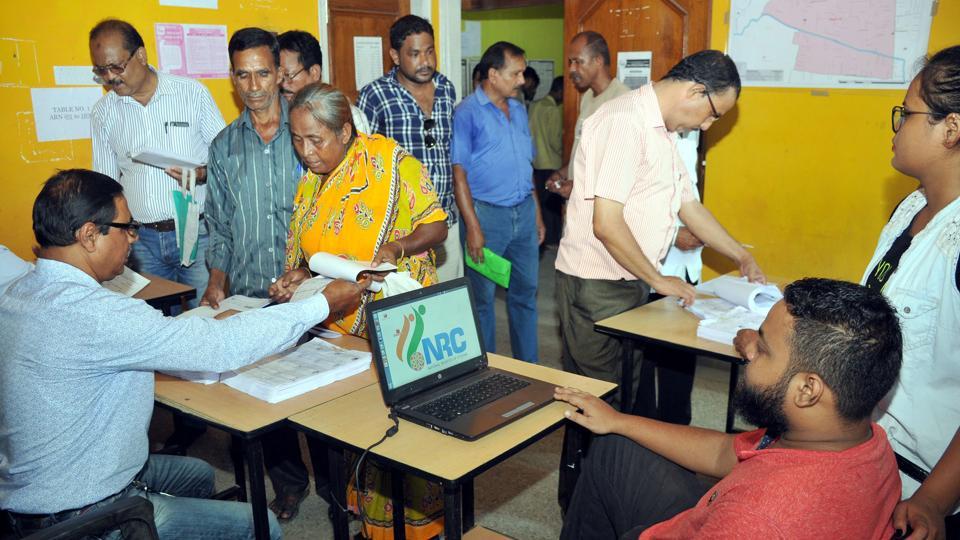
Talking to the media in New Delhi on Monday after a meeting with Union home minister Amit Shah on the NRC process, Sonowal had said the legislative measures could be taken to address wrongful inclusions of foreigners or exclusion of genuine Indian citizens from the list, which will be published on August 31.
“In a democracy, everyone has the right to ask questions. After the publication of NRC, if necessary in future, we will take whatever steps will be required,” PTI quoted Sonowal as saying after being asked whether any legislative steps would be taken.
The NRC, first published in 1951 only for Assam, is being updated under the supervision of the Supreme Court (SC) with the intention of identifying Indians residing in Assam and weeding out illegal immigrants.
The first draft NRC published in July last year had excluded 4 million of the 32.9 million applicants who had sought inclusion in the list. Another list published this June excluded 100,000 more applicants.
As per existing provisions, those left out of the final list can represent his/her case in foreigners’ tribunals (FTs). Under the provision of the Foreigner Act, 1946, and Foreigners (Tribunals) Order, 1964, only FTs are empowered to declare a person as a foreigner. Contrary to speculations, non-inclusion of a person’s name in NRC doesn’t by itself amount to them being declared as a foreigner.
The opposition Congress party has indicated it will give “conditional support”.
“Sonowal’s statement has created confusion as the existing rules are clear on what steps those left out of NRC can take. If the Assam government plans on taking some legislative measure, it should be fool-proof and unbiased,” said Ripun Bora, president of Congress’s Assam unit.
“The measures should ensure that no Indian citizen is left out and it should ensure that no one is unnecessarily harassed. Sonowal must divulge categorically what legislative measures he is talking about. We are willing to offer conditional support on the issue,” he added.
However, the All India United Democratic Front (AIUDF), the other prominent opposition party in the state, has expressed reservations.
“The NRC process is being monitored by NRC and barring a few exceptions, we expect an error-free final list. Existing rules already say what steps those left out of the list should take. But Sonowal’s statement on legislative measures seems to be a political conspiracy,” said Aminul Islam, general secretary of AIUDF.
“We have witnessed that FTs do pass faulty orders. If the BJP government in Assam had any goodwill, they should have approached the SC with the request that those left out should be allowed to approach civil courts for redressal. It seems the BJP is trying to extract political gain from the issue. We will oppose any legislative measure,” he added.
The FTs are quasi-judicial bodies, which exist only in Assam, and they decide on cases of suspected foreigners detected by the border unit of Assam police and also those who are declared doubtful voters (D-voters), due to suspicion on their nationality, in electoral rolls.
At present, there are 100 FTs in Assam. But considering that a large number of applicants could be left out of the NRC list, 200 more are being set up. Recently, 221 new members of these FTs were appointed.