E-Paper



COP27 pledge may repel West’s bid to skirt blame
The first draft of a deal being hashed out at the COP27 climate summit in Egypt appeared to repel efforts by developed nations to shift some of their onus of action and funding to developing countries like India and China, setting up what appeared to be a difficult dash for consensus before a Friday deadline.

 Prefer HTon Google


The first draft of a deal being hashed out at the COP27 climate summit in Egypt appeared to repel efforts by developed nations to shift some of their onus of action and funding to developing countries like India and China, setting up what appeared to be a difficult dash for consensus before a Friday deadline.
Released as a “non-paper”, or an unofficial draft, by Egypt’s COP27 president, the 20-page text retains the distinction between rich and poor nations, and highlights the Paris Agreement principles of “equity” and “common but differentiated responsibilities (CBDR)”, which relates to the fundamental understanding that countries will act as per their national circumstances and respective capabilities.
“We are at crunch time in the negotiations. COP27 is scheduled to close in 24 hours — and the parties remain divided on a number of significant issues,” said UN Secretary General, Antonio Guterres.
Also read | India, Australia to co-lead talks on climate finance at COP27
“There is clearly a breakdown in trust between North and South, and between developed and emerging economies. This is no time for finger pointing. The blame game is a recipe for mutually assured destruction. I am here to appeal to all parties to rise to this moment and to the greatest challenge facing humanity. The world is watching and has a simple message: stand and deliver,” he added.
Negotiators were spending the time till deadline to pore over every word of the text, which will lay down the shape of the global consensus on how to fight the climate crisis. The early draft, an observer from India said, was encouraging for developing countries.
“It is an extensive cover text that reflects the concerns of developing countries. It has highlighted the real gap in delivery of climate finance, it talks of the depleting carbon budget and the need for developed countries to attain net-negative emissions by 2030, it refers to India’s call on sustainable lifestyles and consumption, and, most importantly, it doesn’t rephrase the Paris Agreement goal which developed countries were trying to push for,” said this person, asking not to be named.
But, India’s proposal to not selectively single out sources of emissions among fossil fuels for action was not a part of the text. India and several other developing nations that rely on coal for energy pushed for requiring all fossil fuels to be phased down, a phrasing that would have included more expensive oil and gas that richer countries largely rely on.
The wording on coal
One of the developing country negotiators said this was not necessarily a setback for India because the recognition that even action on coal will have to be “in line with national circumstances” and the need for a “just transition”. “We had all put proposals forward. The process is by consensus of all. One of the things that is clear to us is that we cannot go any further than the language in Glasgow because of our national circumstances, energy and developments needs presently. This is work in progress. No conclusions can be drawn at the moment,” said a delegate from India, noting that the early draft reflects the language on equity and CBDR strongly.
A second developing country negotiator said that “several parties, including US and the Arab group, were opposed to the idea of calling for a phasedown of all fossil fuels. Statements and country positions are not the same. This too will be negotiated on tonight.”
“We have to understand why India agreed to Glasgow language to be repeated. It may be because the earlier call to phase down all fossil fuels was tactical as pressure from rich nations was also building up on expanding donor base etc and such a call was needed put the developed country groups on the backfoot,” said an expert who declined to be named.
An observer, who saw India’s intervention on Thursday evening, said: “All countries are sticking to their positions. But the text can change significantly tomorrow morning. India also said focus on only one fuel is prescriptive and it is not okay with such an approach. It is important to remember the same coal language is already in Glasgow Pact and in G20 communique so it is difficult to undo it completely.”
Most contentious
But talks on other contested issues, such as mitigation work programmes (matters related to reducing emissions in line with the Paris Agreement goals) and the Loss and Damage fund did not appear to have made any progress since these sections were only identified by placeholder text.
Rich countries have been pushing to expand the donor base to include developing countries like India and China for climate finance, particularly for Loss and Damage and for mitigation, according to observers. “The logjam over expansion of the donor base and taking on similar mitigation efforts is continuing behind doors. The Arab countries in particular are fuming because of being counted as high income countries. India and China are also being pushed. But Paris Agreement is paramount and no other country classification can be recognised other than how Paris Agreement classifies countries under its annexures,” said a third developing country negotiator, asking not to be named.
Experts said there were some positives from the early draft. “Important statements [have been made] on the issue of disproportionate use of carbon budget and the need for climate justice for mitigation and finance. I hope these are not diluted or removed in final draft,” said Sunita Narain, director general, Centre for Science and Environment, commenting on the so-called non-paper.
“The elements paper, which will form the basis of the cover text, has been a hard-to-navigate document. It lists down a lot but doesn’t stack up to anything that can be termed as progress so far. It puts placeholders in key agenda items like mitigation work programme. Offers no clarity on the fate of a financing facility for loss and damage, which was a key demand of this COP. A statement in the text acknowledges [the need for] scaled up finance to the tune of $4-6 trillion per year for global transformation to low carbon. Current estimates suggest a mobilisation of less than $1billion from all sources,” said Aarti Khosla, director and founder of Climate Trends, who is tracking the negotiations.
“The cover text decision in its present form recognises the low impact of NDCs that will be far short of [leading to] 45% emissions reduction by 2030. But, it suggests that global peaking is possible in 2030 if all conditional and unconditional NDCs are implemented fully. This implies additional financial flows. All fossil fuel phasedown is not mentioned but the failure of developed countries to reduce emissions and the urgency of their becoming net negative by 2030 is mentioned in the current text,” said RR Rashmi, distinguished fellow, The Energy and Resources Institute.
The place holder on Loss and Damage led to anxiety among small island countries bearing the worst impacts of climate change. “We are running out of time and patience. The developed countries have failed to mobilise $100 billion but they have unlimited money for pharmaceuticals and weapons but not for Loss and Damage. Our need is existential and waiting for two years is untenable,” said Ralph Regenvanu, minister of climate change, Vanuatu, in a press briefing.
“At the moment the cover text looks like a declaration and not a decision. It needs to be narrow and sharp,” said a negotiator from a South American country, asking not to be named.
1.5°C goal alive
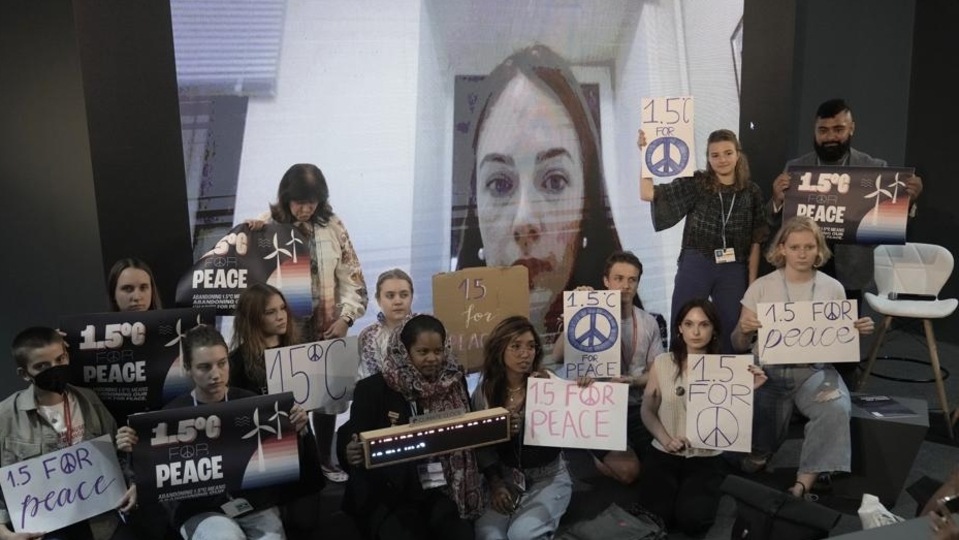
Key among the issues discussed was the 1.5°C goal. COP27 countries, the document said, “stresses the importance of exerting all efforts at all levels to achieve the Paris Agreement temperature goal of holding the increase in the global average temperature to well below 2°C above pre-industrial levels and pursuing efforts to limit the temperature increase to 1.5°C above pre-industrial levels,”.
It goes on to point out that developed countries have failed to mitigate emissions based on their fair share and historical responsibility, a portion that is likely to be of particular contention.
“Expresses deep regret that developed countries who have the most capabilities financially and technologically to lead in reducing their emissions continue to fall short in doing so, and are taking inadequate and unambitious goals to achieve net zero emissions by 2050, while they continue to emit and disproportionately consume the global carbon budget,” the draft said.
Overall, the cover decision encourages wealthy countries to increase support and align funding flows with the 1.5°C goal.
This is not the final text and it may change significantly. Egypt being a developing country itself has been trying to reflect the concerns of developing country groups.
“The Paris Agreement says in black and white. Under Article 2, it states that the entire Paris Agreement should be guided by based on equity and common but differentiated responsibilities. This is a conversation that takes place every year. We are patrons at this time and we are trying to find a common ground. We will have to find the right language to accommodate differentiation. We are aware of the various positions and we are working now to accommodate the parties’ views but also the legal agreement that we ratified together,” Egypt’s COP27 ambassador Wael Aboulmagd said on Wednesday evening when asked by HT on how the Presidency would address the push by rich countries to remove differentiation among countries.
Negotiators said the task to find consensus will be difficult. “It’s going to be quite a long and difficult journey to the end of this process,” European Union climate policy chief Frans Timmermans told a news conference. “Today, I’m afraid I’m not sure yet where these talks will land.”
“If this COP fails, we all lose.”