
 E-Paper



Courts ‘absolutely powerless’, can’t stay an election in a democracy: SC
“We cannot stay an election...We are absolutely powerless if it’s a case covered under Article 329,” the Supreme Court said.


Courts are “absolutely powerless” in staying an election, the Supreme Court observed on Friday, citing a constitutional provision which proscribes judicial interference in electoral matters.
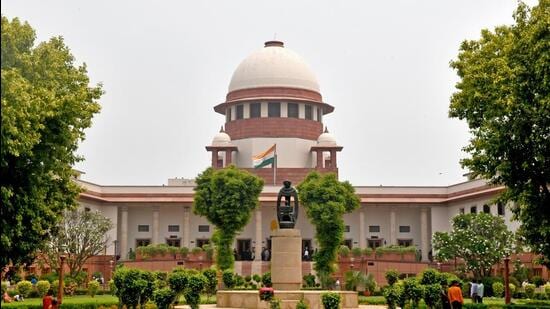
A bench of justices Surya Kant and Dipankar Datta emphasised that the Constitution, under Article 329, puts an embargo against interference by courts in allotment of seats or delimitation of constituencies. The provision adds that the results of a poll can be challenged only by way of election petitions.
“In a democracy, will you stall an election? What to say of democracy if an election is to be stayed?” the bench asked solicitor general Tushar Mehta, who was appearing in an election matter involving Dakshina Bharat Hindi Prachar Sabha.
While Mehta, representing the Sabha, argued that the election to the Karnataka division of the Sabha should not be allowed in view of several discrepancies and irregularities in the voters’ list and other affairs, the top court remained emphatic that it cannot stay an election.
“We cannot stay an election...We are absolutely powerless if it’s a case covered under Article 329. Starting from the Ponnuswami judgment in 1950s to Mohinder Singh Gill case in 1978, this court has always said the same thing,” the bench said.
It went on to add that the Supreme Court initially adopted an absolute hand off approach, leaving it to the Election Commission and other authorities to deal with each and every aspect of an electoral process. But the principles were later modulated to hold that courts can indeed issue certain directives in furtherance of an election.
“Our judges could not fathom in early years that there will be crooked persons taking advantage of our orders and approach. Later, justice Krisna Iyer in 1978 opened a window and justice Bhagwati expanded on that. So much reliance was paid on legislature and executive that they won’t be doing any wrong. But looking at what was happening, they (judges) had to say let’s open a window because nothing happens by saying it’s subject to election petitions. How many election petitions are decided within five years? Perhaps none,” the bench lamented.
It refused to interfere with a division bench order of the Karnataka high court on April 21, directing for compliance with a previous order of a single judge bench to conduct election to the managing committee and salaried employees of the Karnataka Provincial Sabha at Dharwad. The bench further pointed out that the April 21 order is an interim order subject to the final outcome of the proceedings before the division bench and therefore, no ground for interference is made out.
As it refused to entertain the Sabha’s appeal, the bench noted that it had declined to stay the election in January too when the Sabha came to the top court in an earlier round. “We cannot pass a contradictory order now,” it told the SG.
The Sabha was founded by Mahatma Gandhi in 1918 at Madras to propagate Hindi in the southern states of the country as the link language between the northern and southern states. The Union government declared the Sabha as an Institution of National Importance by 1964 Central Act, granting it the status of a deemed university that could award degrees, diplomas and other certificates.
The Sabha is divided into four divisions, one each for the states of Andhra Pradesh, Karnataka, Kerala and Tamil Nadu. The dispute before the Supreme Court pertains to an impending election to the managing committee and salaried employees of the Karnataka Provincial Sabha at Dharwad.
In the 1952 Ponnuswamy judgment, the Supreme Court held that the word “election” in Article 329 (b) connotes the entire electoral process commencing with the issue of the notification calling the election and culminating in the declaration of result, and that the electoral process once started could not be interfered with at any intermediary stage by courts.
Article 329 (b) states that no election to either House of Parliament or to the House or either House of the Legislature of a State shall be called in question, except by an election petition presented to such authority and in such manner as may be provided for by or under any law made by the appropriate Legislature.
The Constitution bench in the Gill case ruled that Article 329 (b) was a blanket ban on litigative challenges to electoral steps taken by the Election Commission and its officers to complete an election. This verdict, at the same time, distinguished between two types of decisions. The first, it said, relates to proceedings which interfere with the progress of the election while the second accelerates the completion of the election and acts in furtherance of an election.
“Article 329 (b) halts judicial intervention during this period, provided the act possesses the pre-requisites of ‘election’ in its semantic sweep. That is to say, immunity is conferred only if the act impeached is done for the apparent object of furthering a free and fair election and the protective armour drops down if the act challenged is either unrelated to or thwarts or taints the course of the election,” said justice Iyer, writing the judgment.


