
 E-Paper



Covid spread, restrictions hit NREGS work allotment
Three large states -- Gujarat, Rajasthan and Maharasthra -- that account for a large number of Covid-19 patients haven’t yet been able to distribute allot much work under the programme this summer.


As the Centre prepares to expand the Mahatma Gandhi National Rural Employment Guarantee Scheme (MGNREGS) to offer a financial cushion to rural India in the face of the Covid-19 pandemic, it turns out that the virus is reshaping the distribution of jobs under the flagship jobs programme..
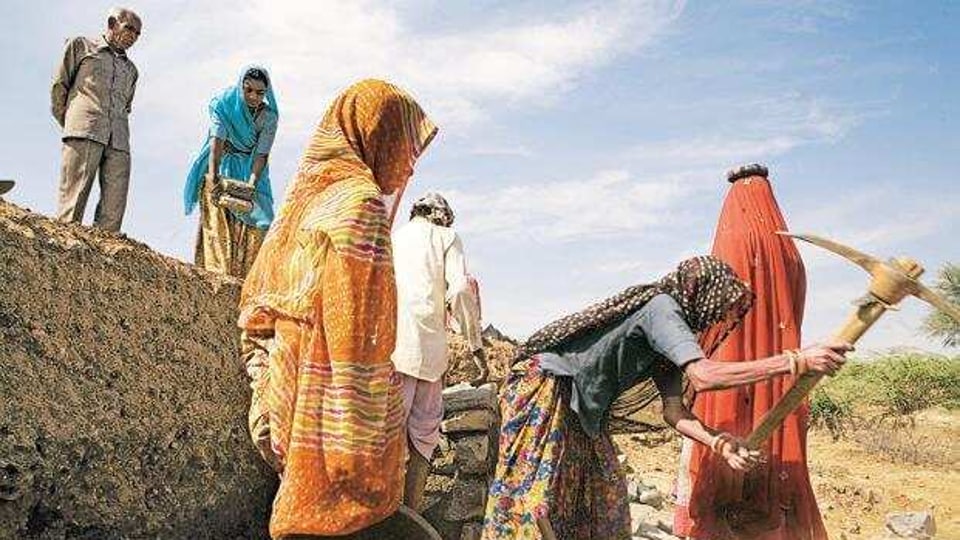
Three large states -- Gujarat, Rajasthan and Maharasthra -- that account for a large number of Covid-19 patients haven’t yet been able to distribute allot much work under the programme this summer. States such as Andhra Pradesh, Chhattisgarh, Bihar and Karnataka that have reported a relatively fewer number of coronavirus cases and have fewer red zones are, meanwhile, off to a roaring start
MGNREGS, which offers 100 days of work every year to at least one member of every rural household, is seen as an ideal tool to ease rural distress caused by the coronavirus disease that has forced an exodus of hundreds of thousands of migrant workers from the cities back home to the hinterland. Job creation under the programme has been skewed by the burden of disease each state is bearing.
Andhra Pradesh alone, according to data updated until Thursday, has accounted for 5.4 million out of 15.6 million persondays of work generated under the programme since April 1. Chhattisgarh has provided 3.3 million persondays of work and Bihar 1.7 million this month.
Karnataka, West Bengal and Odisha have generated 1.4 million, 1.1 million and 800,000 persondays of work, respectively.
According to the data, the pandemic has spread to 58.3% of the country’s 731 districts. There are 222 districts with up to 10 cases, 66 with 11-20 cases, 42 with 21-30 cases, and 96 districts with more than 30 cases each.
Tougher restrictions and a higher number of containment zones in the three big states -- Gujarat, Maharashtra and Rajasthan -- possibly didn’t allow their governments to maximize the MGNREGS opportunities in their states, a government official said on condition of anonymity
Rajasthan has generated 480,000 persondays of work while Maharashtra and Gujarat have allocated 260,000 And Gujarat Just 16,859 till date in April, the first month of the financial year.
The Centre is confident that once the Covid spread is arrested and the pandemic subsides, these states too will maximise their potential for job creation under the MGNREGS.
“We are keeping a daily tab on the work creation and spending of fund in all states. As soon as we see surge in jobs in these three states, we will allot more work,” said a senior official of the rural development ministry.
Government data reveals that the average expenditure on an MGNREGS worker has significantly increased in many states in April over last year’s average, indicating that workers are earning more than what they did in the previous year.Experts attributed this to two reasons: higher wages and fewer workers coming to work during the lockdown.
Andhra Pradesh has been allotted 10 million additional persondays of work this year than in FY 2019-20. Similarly, Bihar and Uttar Pradesh—home to a large number of migrant workers who have returned—have been given an additional 20 million and 10 million persondays of work, respectively.
Kerala, Jharkhand and Telangana have also been allotted an additional 10 million persondays of work each this year, which may be increased depending on demand..
Assam has been sanctioned 4.5 million more persondays of work, Odisha 30 million and Tamil Nadu 20 million jobs during FY 2020-21.
At the same time, the Centre has possibly factored in the Covid-19 spread in the districts to allot work because tthe three big states—Rajasthan, Maharashtra and Gujarat—have not been sanctioned any increase in work allocation under the MGNREGS.
Former rural development minister Jugal Kishore Mohapatra maintained that a surge in MGNREGS jobs in the bigger states is just a matter of time.
“Gujarat traditionally doesn’t see very high demand for MGNREGS. But in both Rajasthan and Maharashtra, things will pick up. Rajasthan also has very well-laid out work processes and labour standards. The demand will also pick when the harvest season gets over and labourers return to their states,” he said.
A rural development ministry official, who requested anonymity, said the situation was still very fluid.
“We will allot more money and work as soon as we see states picking up the allocated funds and are able to give more work,” this person said


