
 E-Paper



Covid-19 graph continues to soar: Capital adds 1,515 new infections
The seven-day average of new cases, known as case trajectory, crossed the 1,000-mark for the first time in 91 days, with the city adding an average of 1,016 cases per day over the past week.


The Covid-19 surge in the Capital continued unabated on Thursday as Delhi recorded its highest single-day case spike of the year, adding 1,515 new infections — the most since December 16, as experts urged authorities to consider stepping up curbs to prevent infections from spiralling beyond control.
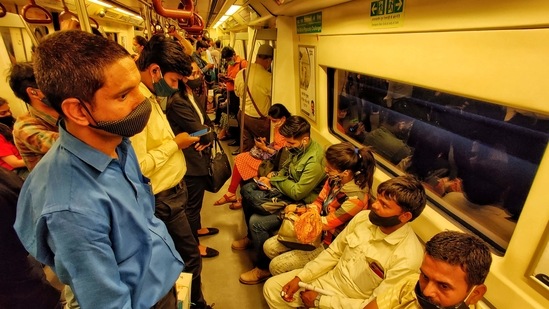
The seven-day average of new cases, known as case trajectory, crossed the 1,000-mark for the first time in 91 days, with the city adding an average of 1,016 cases per day over the past week.
The positivity rate also increased to 1.69%, even as the city ramped up testing. For six days now, the test positivity rate, which experts regard as a crucial metric to gauge the spread of an infection, has remained over 1% since it dipped below that number in December last year.
On Wednesday, numbers from which are reported a day later in Thursday’s bulletin, the city tested 89,836 samples for the infection. Of these, almost 65% samples were tested using the more accurate RT-PCR method. Just over 78,000 tests were conducted on average daily during the last seven days in comparison. Just over 71,000 tests were conducted the week before and over 65,000 tests the week before that.
Experts called for immediate measures such as curtailing all “non-essential” activities and large gatherings to prevent a surge in cases as seen in states such as Maharashtra. “There is a need for some restrictions such as curtailing the number of people at weddings, restricting travel between states, closing non-essential services such as bars, restaurants, and cinemas. And these need to be brought in now before we see a surge like in Maharashtra. The case fatality rate in Delhi as well as the country has come down since last year because of the better understanding about the disease, however it still kills. It is a myth that this time around the virus is causing milder infections,” said Dr GC Khilnani, former head of the department of pulmonology at the All India Institute of Medical Sciences.
Four deaths on average were reported each day over the past seven days, up from two deaths that were reported the week before. Five deaths due to the viral infection were reported in Thursday’s bulletin.
The case spike has bought with it a significant increase in hospitalisations as well. There were 1,094 people with the infection admitted to city hospitals as on Wednesday night, meaning one in five beds earmarked for Covid-19 are already occupied. A total of 5,740 beds in city hospitals are reserved for the treatment of the infection which has so far claimed 10,978 lives in the city.
Other than restrictions on transport, experts have also recommended that travel for events such as the Kumbh Mela be restricted.
“In cities where the cases are going up, restrictions have to be put in place. People have to be asked to avoid unnecessary travel and there have to be restrictions on the number of people allowed on modes of public transport,” said Dr Rajinder K Dhamija, professor of medicine and head of the department of neurology at Lady Hardinge Medical College.
In addition to the traditional methods of controlling the infection, the experts have also called for increasing the pace of vaccination.
“There is a need to enhance vaccination on a war footing. But, nobody seems to be worried about what is happening; I do not see a sense of urgency anywhere. In addition to the people over the age of 45 years and the healthcare and frontline workers, the government should also start vaccinating all the teachers and ancillary staff at schools and colleges so that they can be reopened,” said Dr T Jacob John, former head of the department of virology at Christian Medical College-Vellore.
However, the vaccination drive has failed to pick up pace in Delhi despite the government announcing that more vaccination centres will be opened up and they will remain open till 9 pm. Since the extended drive began on Monday, on average 34,027 jabs were administered each day. In comparison, 46,769 shots – both first and second dose – had been given on Saturday, according to government data.


