
 E-Paper



CUET registration from April 2; NTA releases exam pattern
The last date to submit online forms (at cuet.samarth.ac.in) will be April 20. The test is likely to be held in the first week of July over multiple days.


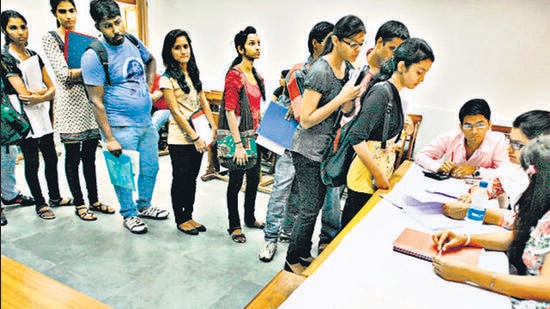
Students who want to take the Common University Entrance Test for undergraduate admissions (CUET-UG) in central universities can register from April 2, the National Testing Agency announced on Sunday.
The last date to submit online forms (at cuet.samarth.ac.in) will be April 20. The test is likely to be held in the first week of July over multiple days.
In a related development, public universities under state governments, colleges and private universities should also adopt the new entrance examination to admit students in undergraduate programmes from the 2022-23 academic year, the University Grants Commission appealed on Sunday.
The higher education regulator on March 21 made it mandatory for all central universities to conduct undergraduate admissions only on the basis of the common entrance test. The universities will be allowed set eligibility criteria based on marks secured in the class 12 board exams.
The test will be a computer-based, objective type examination, the testing agency said in a notification on Saturday. It will be conducted in 13 languages including English, Hindi, Gujarati, Assamese, Bengali, Kannada, Malayalam, Marathi, Odia, Punjabi, Tamil, Telugu and Urdu.
The exam will be based on the class 12 syllabus prescribed by the National Council of Educational Research and Training (NCERT). “All questions in various testing areas will be benchmarked at the level of Class 12 only. Students having studied Class 12 board syllabus would be able to do well in CUET-UG,” the testing agency said.
Aspirants will have to refer to the information bulletins of respective universities for eligibility criteria and courses on offer.
The CUET-UG test will be divided into four sections. Sections I-A and I-B will consist of language subjects. Section I-A will be compulsory for all students. Section I-B will be for those looking to pursue an undergraduate degree in languages. Section II will be domain specific and Section III will be a general test.
It will not be mandatory for the candidates to choose options from each section. They can choose the sections depending on the requirements of the university where they wish to study.
A candidate can choose a maximum of any three languages from Section I-A and Section I-B together, and up to six domain subjects. However, the third language can only be chosen as the sixth domain subject.
It means candidates can take a test in a maximum of nine subjects — two languages plus six domain specific subjects plus one general test or three languages plus five domain specific subjects plus one general test.
Section I-A will consist of 13 languages. Candidates can appear in any of these languages. Section I-B will consist of 19 languages, including French, Spanish, German, Nepali, Tibetan, Japanese, Russian, Chinese, among others. Candidates will have to attempt 40 questions out of 50 in each language. The duration for each language test will be 45 minutes.
Section II will test the domain specific knowledge of the candidates. There will be 27 core subjects, such as history, mathematics, accountancy, biology, economics and political science, offered under this section. Candidates may choose a maximum of six domains as desired by the concerned university.
Candidates will have to attempt 40 questions out of 50 in each domain specific test. The duration of each subject will be 45 minutes. The domain specific exams will be based on the NCERT class 12 syllabus.
Section III will consist of a general test. It will have questions based on general knowledge, current affairs, general mental ability, numerical ability, quantitative reasoning (simple application of basic mathematical concepts in arithmetic, algebra, geometry and mensuration taught till class 8), and logical and analytical reasoning. Candidates will have to attempt 60 questions out of 75 in an hour.
CUET-UG will be spread over multiple days, UGC chairperson M Jagadesh Kumar said. Two sessions will be conducted everyday.
In the first session, a student will have to attempt one language paper (Section I-A), two domain subjects and the general test. In the second session, candidates can write on four domain subjects and a language test from Section I-B.
The languages and subjects chosen by the candidates should be the ones that they opted for in class 12 board examinations. However, universities are allowed to provide flexibility on this count.
“Candidates must carefully refer to the eligibility requirements of various Central Universities in this regard. Moreover, if the subject to be studied in the Undergraduate course is not available in the list of 27 Domain Specific Subjects being offered, the Candidate may choose the Subject closest to his/her choice for e.g. for Biochemistry the candidate may choose Biology,” the notification said.
The universities will have a two-step process to prepare merit lists, Kumar had earlier told HT. First, they can fix qualifying marks in class 12 exams. Second, from among qualified candidates who have applied, they can make a merit list on the basis of their CUET-UG scores.
Meanwhile, the UGC on Sunday wrote to the vice-chancellors, directors and principals of all universities and colleges to adopt CUET.
“To save students from appearing in multiple entrance examinations, conducted in different dates, sometimes coinciding with each other, and to also provide equal opportunity to all students from different boards, UGC invites and encourages all state universities, deemed to be universities, private universities and other HEIs (higher education institutions) to adopt and use CUET score from 2022-23 onwards for admissions of students in their UG programs,” the regulator said in the letter.


