E-Paper



Why were Delhi earthquake tremors strong despite a low magnitude?
Delhi Earthquake today: According to NASA's science website, an earthquake's most intense shaking is often felt near the epicenter.

 Prefer HTon Google


Delhi earthquake: An earthquake jolted the people of Delhi and its surrounding areas up from their sleep on Monday morning. The earthquake was of a magnitude 4 on the Richter scale. Many people, however, claimed they had never felt such a strong jolt. Why did the earthquake feel strong despite a low magnitude?
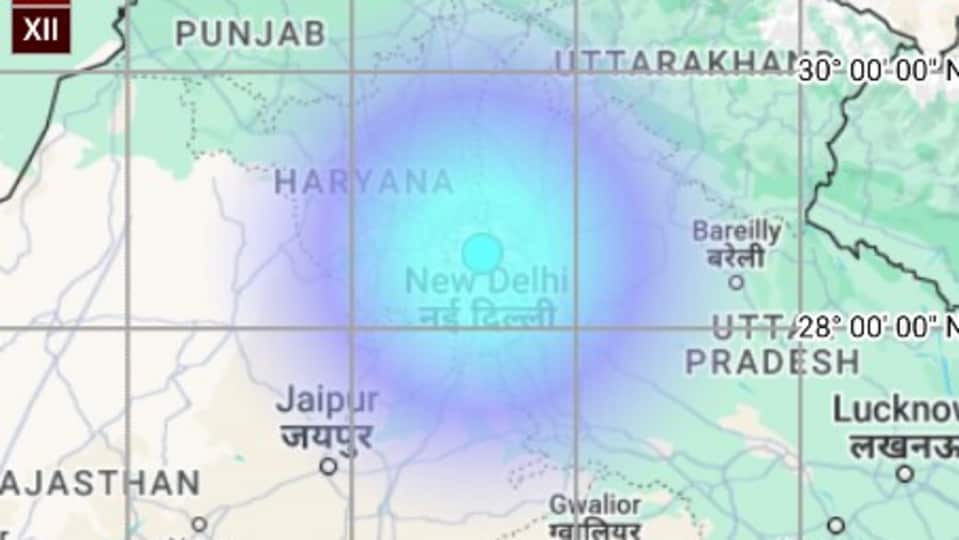
Delhi earthquake: What happened?
People ran out of their homes as the earthquake struck the capital at around 5:36 am on Monday morning, at a depth of five kilometres.
Why did the earthquake feel strong?
Srijan Pal Singh, the former advisor to the 11th President of India and founder of Kalam Centre and Homi lab, explained the phenomenon on X.
He said that the residents felt "bigger tremors than ever before" because the epicenter was in Delhi itself. “This is how quakes feel at the epicenter," he said.
"The Delhi earthquake you just witnessed was around 4.0 on the Richter scale. That is not very high (quakes can go up to 6.0 and more) but you felt bigger tremors than ever before. Why? Because the epicenter is within Delhi itself. This is how quakes feel at the epicenter," he wrote on X.
The US Geological Survey (USGS) describes ‘epicenter’ as the location directly above the earth's surface where the quake starts.
"The location below the earth’s surface where the earthquake starts is called the hypocenter, and the location directly above it on the surface of the earth is called the epicenter," USGS said.
ALSO READ | Delhi earthquake: Scary videos of tremors, panic emerge | Watch
According to the geological body, the main tremors, 'mainshock', are felt during the actual earthquake. What follows them are called the 'aftershocks'.
The crust and top of the mantle layer of the earth are made up of tectonic plates, the edges of which are called the plate boundaries. These boundaries are made up of many faults, and this is where the majority of the earthquakes take place across the world, USGS explaines.
According to NASA's science website, an earthquake's most intense shaking is often felt near the epicenter. "However, the vibrations from an earthquake can still be felt and detected hundreds, or even thousands of miles away from the epicenter," it added.
The energy from an earthquake travels through Earth in vibrations and are called 'seismic waves'.
Delhi earthquake: Where exactly was the epicentre?
Monday's earthquake in Delhi, as per official cited by news agency PTI, had its epicenter near Dhaula Kuan's Durgabai Deshmukh College of Special Education. He said that the region, which has a lake nearby, has been experiencing smaller and low-magnitude quakes once every two to three years.
Why is Delhi so vulnerable to earthquakes?
The national capital is an active seismic zone – both because of the faults around the Delhi-NCR region as well as its proximity to the Himalayas.
ALSO READ | 'Most insane earthquake': How people of Delhi reacted to tremors on X
Seismicity around Delhi appears to be associated with a major geological structure, which is known as the Delhi-Haridwar Ridge. It coincides with the extension of the Aravali Mountain belt beneath the alluvial plains of the Ganga basin to the northeast of Delhi towards the Himalayan mountain, the Delhi disaster management authority's website reads.
Prime Minister Narendra Modi, meanwhile, reacted to the earthquake and asked residents to remain calm and follow safety precautions. He also urged people to stay alert for possible aftershocks.
Google Trends
The search term 'earthquake in Delhi' saw a significant spike early on Monday, with peak interest around mid-morning. Most of the searches came from Delhi, Haryana, Uttar Pradesh, Uttarakhand, and Chandigarh. Related searches included terms like 'earthquake in Delhi 17 Feb', 'Delhi bhukamp', and 'epicenter'. This surge in queries followed an earthquake that shook Delhi and its surrounding areas early Monday, causing residents to wake up in alarm. The earthquake, which had a magnitude of 4 on the Richter scale, prompted widespread search activity seeking information on its epicenter and impact.