
 E-Paper



Delhi govt makes excise policy 2021-22 public
The policy, however, made no mention about reducing the legal drinking age from 25 years to 21 years, one of the key changes that deputy chief minister Manish Sisodia flagged when he announced the policy on March 22.

 Prefer HTon Google


The state government on Monday made the city’s new excise policy public after the Delhi high court heard a petition over the government floating tenders to appoint new liquor retail licensees in the city without informing stakeholders or the general public about the details of the rules.
The policy, however, made no mention about reducing the legal drinking age from 25 years to 21 years, one of the key changes that deputy chief minister Manish Sisodia flagged when he announced the policy on March 22. Senior government officials said the matter, including reducing slashing the number of dry days, will be taken up separately in a special session of the Delhi Assembly.
The Delhi Excise Policy 2021-22 was made public on the government’s website on Monday evening, even as the city’s liquor traders’ association, which filed the petition in the HC, questioned the delay in uploading the document.
“The tenders for new retail licenses were floated on June 28 without making the excise policy public. The pre-bid meeting for all tenders was scheduled at 4pm today (Monday) and the document was still not uploaded till then. As a result, many stakeholders who were interested in bidding remained unaware of the finer details of the new policy. It was uploaded only after 6pm. The policy was ready and approved in May this year and yet the tenders were floated without letting people know of it. It took a HC hearing for them to finally upload it,” said Naresh Goyal, a retailer licensee and president of Delhi liquor traders association.
Delhi government spokespersons did not respond to requests seeking comment.
The new excise policy aims to introduce sweeping changes in the city’s liquor business, clean up malpractices, and improve user experience.
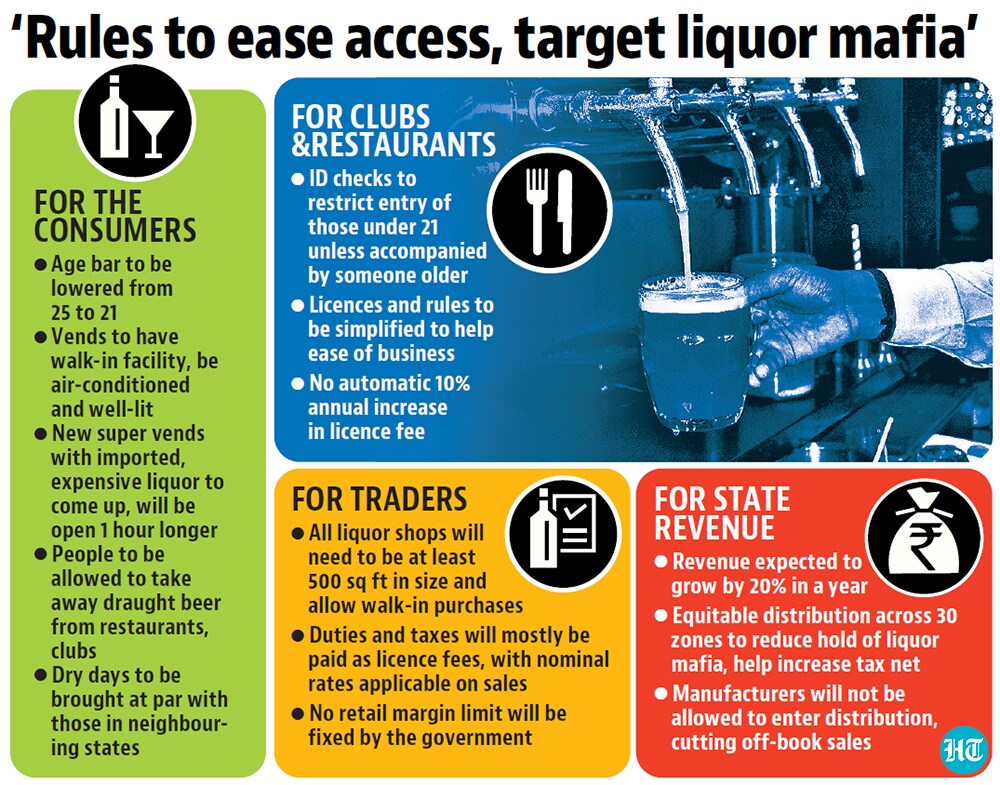
It, among other things, envisages five new super-premium liquor shops for high-value products. It includes a rule that will need any liquor shop in the city to be at least 500 square feet in size. It gets rid of the iron grilles at the front of most liquor vends in the Capital, and allows buyers to browse and purchase the brands of their choice. For this, the shops have to be spacious, well lit and air-conditioned to allow customers a walk-in experience and must be under camera surveillance. Shop owners will have to ensure that liquor sale and pick-up takes place properly inside the shop premises and there is a proper order outside. It also allows home delivery of liquor in the Capital through websites and apps.
As HT reported on July 1, the new rules will allow liquor shops in the Capital to offer discounts, enabling festive season offers of the kind that are usually seen around Diwali on vehicles, electronics, and gift items. HT reported this on July 1.
In another first, the policy also introduces a new annual licence system enabling banquet halls, farmhouses, motels and other such party venues to serve liquor at events, like it is done in hotels. Also, the one-time P10 licence has now been revised from ₹5,000 to ₹10,000 for hosting in-house parties — a permit which is extensively applied for by the general public to serve alcohol in private parties hosted at home or any other non-licenced premise. HT reported this on March 24.
On May 27, HT reported that the Lieutenant Governor Anil Baijal cleared the Delhi Excise Policy, 2021, and the draft Delhi Excise (Amendment) Rules, 2021, with some suggested tweaks. One of the amendments, suggested by the L-G and later approved by the Cabinet, included strengthening clauses aimed at preventing brand pushing and cartelisation by tightening checks not just on wholesalers, but also on retailers.
Delhi currently has 849 liquor shops. These, however, are not equitably distributed across the city. The government, through the changes in the excise system, plans to keep the total number of vends intact, reshuffling them into 32 zones to ensure a more equitable distribution across 272 municipal wards in the city, the New Delhi Municipal Council (NDMC) area and the airport.
By exiting the retail liquor business and opening up the market, the Delhi government is hoping to increase its annual revenue by ₹1,500-2,000 crore from the existing ₹6,500 crore earned annually as excise income, a government spokesperson said.


